
.jpg)

|
New Lacanian School Nous contacter : accueil@amp-nls.org Inscription : https://amp-nls.org/page/fr/42/sinscrire-nls-messager Le site de la NLS : https://amp-nls.org Lacan Quotidien : http://www.lacanquotidien.fr/blog/ |
New Lacanian School
NLS website
: |


An urgent appeal to the psychoanalytic community around the world:
Keep the Freud Museum London openPlease forward this newsletter and share this important message with your organization, members and colleagues.
A small, successful museum, Sigmund and Anna Freud’s final home and its powerful stories have been shared with thousands of visitors. The unique atmosphere of Freud’s study, preserved as he left it, offers a deeply emotional and inspirational experience.
We are writing to mental health colleagues to ask for financial help and support during this uniquely challenging period. Please consider a gift to the Freud Museum London, perhaps equivalent to your fee for one patient consultation.
Card donations can be made online, or in GBP from anywhere in the world via PayPal.
It is possible to make Tax Free Donations from the United States to the Freud Museum London. To find out more please email development@freud.org.uk
Virtual Tour of the Freud Museum
We hope to reopen the Museum in a safe, socially distanced way, in August. We will publish a date and booking details very shortly. Meanwhile you can explore the house on a Virtual Tour, going behind the barriers and seeing Freud’s famous couch up close. >>
Broadcasts from Freud's London Study
In 1938, shortly after arriving in London Sigmund Freud recorded an interview on his life's work with the BBC.
The Museum has responded to the pandemic by putting much of its public programme online, and you too can listen broadcasts from Freud's study.Some Thoughts on the Pandemic
If psychoanalysis can shed light on some aspects of individual and social responses to the current pandemic, what can it also learn from them? Psychoanalyst and author Darian Leader explores some of the unconscious processes at play, and problems and questions that psychoanalysis might wish to address.
LISTEN >>How Freud Would Have Handled the Coronavirus:
Lessons from a Beacon of Survival
Distinguished Freudian practitioner and historian of psychoanalysis, Professor Brett Kahr, talks about what we might learn from the genius of Sigmund Freud and how that might help us through this extremely challenging period of world history.
LISTEN >>
Freud At Home
In this strange new world of ‘self-isolation’ and working from home, many of us will be spending a long time in our houses. For Freud, home was always a live/work space, with his study and consulting room sitting alongside the family’s domestic space.In our series of blogs we’ve been looking at where Sigmund Freud and his family lived and worked. >>
The Freud Museum online shop is open! Click here to browse >>
Stay in touch
Sign up for regular e-news and we'll keep you posted on an amazing online programme including talks, courses, blogs. Subcribe to our e-news
Copyright © 2018 Freud Museum London All rights reserved.
Want to change how you receive these emails?
You can update your preferences or unsubscribe from this list.
New Lacanian School
Désinscription : nls-messager-unsubscribe@amp-nls.orgNous contacter : accueil@amp-nls.org
Inscription : https://amp-nls.org/page/fr/42/sinscrire-nls-messager
Le site de la NLS : https://amp-nls.org
BLOG du congrès de la NLS : https://www.nlscongress2020.com/accueil
New Lacanian School
Unsubscribe: nls-messager-unsubscribe@amp-nls.org
Enquiries: accueil@amp-nls.org
Sign up for the Newsletter:
https://amp-nls.org/page/gb/42/sinscrire-nls-messagerNLS
website:
NLS Congress BLOG: nlscongress2020


Initiative-Toronto
Toronto : 25 July
Special On-line Event
The Shoehorn Without Measure, Years Later
with Leonardo Gorostiza
Time: 12 pm local time
Book your place: elcuerpohablante@gmail.com
Via Zoom. Open to all
in Spanish

|
New Lacanian School Nous contacter : accueil@amp-nls.org Inscription : https://amp-nls.org/page/fr/42/sinscrire-nls-messager Le site de la NLS : https://amp-nls.org BLOG du congrès de la NLS : https://www.nlscongress2020.com/accueil  |
New Lacanian School
Sign up for the Newsletter:
https://amp-nls.org/page/gb/42/sinscrire-nls-messager NLS website
: NLS Congress BLOG: nlscongress2020
 |


|
New Lacanian School Nous contacter : accueil@amp-nls.org Inscription : https://amp-nls.org/page/fr/42/sinscrire-nls-messager Le site de la NLS : https://amp-nls.org BLOG du congrès de la NLS : https://www.nlscongress2020.com/accueil |
New Lacanian School
Sign up for the Newsletter:
https://amp-nls.org/page/gb/42/sinscrire-nls-messager NLS website
: NLS Congress BLOG: nlscongress2020
|


The Bodily Effects of Language
NLS Congress 22-23 May 2021
Argument
Alexandre STEVENS
Language, speech and discourse have effects on the body. It is at the very origin of the symptom that affects the body and that “expresses something structured like a language”. (1) Lacan takes up this expression in “The Function and Field of Speech and Language”: “symptoms can be entirely resolved in an analysis of language, because a symptom is itself structured like a language: a symptom is language from which speech must be delivered”. (2)
The effects of language on the body are articulated in the diachrony of Lacan's teaching according to a variation that goes from signifying mortification, in the classical period of his teaching, to the effect of jouissance arising from the impact of the signifier on the body, in the later Lacan.
Before the Rome Report
In Lacan's texts prior to the Rome report, it is not the signification extracted from language that is brought into play in the relationship to the body but, as Jacques-Alain Miller explains in “Lacanian Biology” (3), a satisfaction linked to the constitution of the unity of the body in its image: “The satisfaction proper to the mirror stage is the identification of the subject, conceived as original organic disarray, with what I will call a complete body image”. (4) We must thus consider that the subject is "affected by [affecté de] two discordant bodies" (5) which are the organism as real and the body grasped in its unity as an image. The body in its initial presence, as pure organism, as real, is fragmented and it is through the image that it is made One, but it is thus a wholly imaginary One. The only signification here is that of symbolic efficacy reduced to imaginary identification, but it is one that produces satisfaction in the form of the jubilation of the young child in front of the mirror. (6) The satisfaction produced by the image prevails over the signification of unity which remains entirely imaginary [toute imaginaire].
The body of the signifier
Jacques-Alain Miller underlines that “the first repercussion of Lacan's structuralism, that is to say of the privilege given to signification over satisfaction, is to refer the life drives to the imaginary, while the death drive is attributed to the symbolic.” (7) The life drives, in other words jouissance too, are now reduced to an imaginary that has somewhat lost its initial structuring character. On the other hand, the death drive marks the subject and his body through the signifier. This is the development that Lacan makes in the Function and Field: “the symbol first manifests itself as the killing of the thing”. (8) It is this death that constitutes “the endless perpetuation of […] desire” and that transcends the pure living animal: “Empedocles, by throwing himself into Mount Etna, leaves forever present in the memory of men the symbolic act of his being-towards-death”. (9)
The body is submitted to the deadly effects of the signifier. The Lacanian doctrine of the signifier “institutes presence against a background of absence, just as it constitutes absence in presence”. (10) The elephant on the cover of Seminar I testifies to this, the word has a consequence on the real of life: “With nothing more than the word elephant and the way in which men use it, propitious or unpropitious things, auspicious or inauspicious things, in any event catastrophic things have happened to elephants long before anyone raised a bow or a gun to them”. (11)
This is the effect of mortification that the signifier imposes on life, with the double effect on the body: symbolic death in life and symbolic life in death. This is how Jacques-Alain Miller formulates it in Lacanian Biology: “In this regard, symbolic death is conceived, on the one hand, as a negation of biological life, as evidenced by the act of suicide, but also as an affirmation of symbolic life beyond biological life”. (12) It is Empedocles forever present.
Burial is a clear example. The dead body is not simply carrion, the signifier has elevated it to a singular dimension that deserves to be captured in a funerary organization. Burial signifies a permanence of the body beyond life. It is even, for Lacan, “the first symbol in which we recognize humanity in its vestiges” (13), that is to say the sign that life and the body are henceforth marked by the signifier, unlike animal life. It is an S1 that marks the subject while also petrifying him. "This S1 is the stone of the living, it is what realizes the signifying petrification, which is moreover incarnated by what is nevertheless an almost universal rite, the tombstone." (14)
In his book, The Other Side of Biopolitics (15), Éric Laurent underlines that Lacan makes burial “the moment when the emergence of the speaking being occurred” (16) and that he thus anticipated the position of many prehistorians today. Language begins with this particular treatment of dead bodies. This burial is thus a writing, comments Éric Laurent: “In this funerary writing, the body becomes an inscribed absence, around which the objects of jouissance are arranged and deposited.” (17)
He also shows the shift that will take place in Lacan with Radiophonie: “In Radiophonie, Lacan articulates jouissance and body on the basis of set theory. Thus, burial is no longer mediation or eternalisation. It makes it possible to give a logical form to the excess that objects of jouissance carry with them in their relation to the orifices through which jouissance enters the body". (18)
Having a body
One has a body; one is not it. This formula is permanent for Lacan. Jacques-Alain Miller points out that it is already present in Seminar II, but it also appears in one of his last texts, "Joyce-le-symptôme". (19) That "one has it" also means that the subject can never quite be sure of it. The body may appear a little strange, if not alien to the subject. He does not really control it, and the body sometimes simply does its own thing.
This is already true in neurosis. The singular traits of jouissance appear stronger than the subject. Anorexia, for example, testifies to the drive’s investment in the oral object or the nothing.
This body, separated from the subject, is even more so in psychosis, where phenomena of disjunction or dissociation can be encountered. The body can also appear fragmented.
A very good example of this disjunction of the body and the subject's being is given to us in a text by Jacques-Alain Miller about one of Lacan’s patient presentations (20) that concludes with the notion of an “illness of mentality” [maladie de la mentalité]. A few words on this case which, according to Lacan, is to be counted, "as one of these normal madmen who make our environment" – which today would make us think of ordinary psychosis. This lady, who presented as being ill at ease in society, but also with her employer and who felt herself to be neither a true or a false patient, came out with the following striking expression: “I would like to live like an article of clothing”. Commenting upon this expression, Lacan remarks: “This person hasn’t the least idea of the body she is putting into this dress, there is no one to inhabit her clothing.” Illness of mentality is here opposed to an illness of the Other, which is linked to a certainty. Here is a subject’s relation to their body in which we are perfectly able to grasp this radical disjunction between the body and the subject, between the One of the body and the subject’s signifying being.
Having a body can indeed be understood in more than one way. In Being and the One, commenting on Lacan's text "Joyce-the-Symptom”, Jacques-Alain Miller says this: "Can we say of the Lacanian subject that it didn’t have a body? No, but it only had a visible body, reduced (…) to the pregnancy of its form (…). Did the subject recover a body with the drive, with castration, with the object little a? It only recovered a body sublimated (…) by the signifier. Before Lacan's later teaching, the subject's body was always a significantised body, borne by language. It is quite different when conceived on the basis of the jaculation Yadl’Un [there’s something of One], because in this case the body appears as the Other of the signifier, in so far as it is marked, in so far as the signifier constitutes an event there". (21) It is no longer the body conceived as mortified by the signifier, but the body as a place where the impact of the signifier produces an effect of jouissance.
The body and jouissance
After moving from satisfaction (“The Mirror Stage”) to signification (“The Function and Field”), Lacan will come to place the emphasis back on satisfaction in the last part of his teaching. This is what Jacques-Alain Miller underlines in Lacanian Biology: “This leads him, for example, to pass from the concept of language to that of lalangue, that is to say to propose that the signifier as such works not for signification, but for satisfaction”. (22) This goes in the direction of "posing an equivalence between signification and satisfaction”. (23)
And Miller draws out the fact that there are two movements present in the links between the body and the signifier. First, there is a significantisation of the body present from the first period of Lacan’s teaching, the principle example of which is the signifier of the phallus, which raises an organ to the dimension of the signifier. But in the last period of Lacan’s teaching, there is also a corporisation of the signifier to be considered, which is, on the contrary, “the signifier grasped as affecting the body of the speaking being, and the signifier becoming body, dividing up [morcelé] the body’s jouissance and making surplus-enjoyment spring forth, cutting up the body, but to the point of making surplus-enjoyment spurt from it”. (24) This allows us to grasp that the signifier affects the body other than through a set of meanings. It is “the bodily effect of the signifier, that is to say, neither its semantic effect, which is the signified, nor its effect as a supposed subject, in other words, all the signifier’s effects of truth, but its effects of jouissance”. (25)
This double movement of significantisation of the body and corporisation of the signifier is given by Lacan in “Radiophonie”: “I return first to the body of the symbolic which, it must be understood, is in no way a metaphor. This shows that it alone isolates the body, to be taken in the naive sense, namely the one according to which the being who supports himself with it doesn’t know that it is language that bestows it upon him, to the point that it would not be there if he were not able to speak about it. The first body makes the second by incorporating itself into it [de s’y incorporer]." (26) The being has his body only because of language, otherwise it wouldn't even be there, but it is the incorporation or corporisation of the signifier that gives him this body caught up in the effects of jouissance. This embodiment whereby the signifier becomes body makes the body a writing surface where the object is inscribed outside the body [s’inscrit hors-corps] but articulated to it [articulé au corps], as Eric Laurent notes. (27)
It is the body as a writing surface, it is the body decorated with piercings or tattoos, it is the body subject to the requirements of hygiene or to sports performances, it is the body augmented with objects of jouissance or incorporating products. This surface of inscription is thus both outside the body and articulated to the body. This body affected by the signifier outside of meaning is also affected by body events.
From the symptom that speaks to the symptom that is written
The Freudian symptom, drawn from hysterics, is a symptom that speaks in the body, which must be decoded in order to bring out its truth. It communicates and involves the “two”. As Jacques-Alain Miller says, “It is given a sense of truth and it is interpreted”. (28)
The reversal operated in the last Lacan invites us no longer to listen to the symptom, but to read it. There the symptom is no longer truth, it is reduced "to its initial formula, i.e. the material encounter between a signifier and the body, to the pure shock of language on the body". (29) It is no longer the truth of the symptom that is targeted by interpretation, it is its real, the symptom to be read. In the letter, it is not the being of the signifier that we find, it is a real.
This is how we can read the small sequence that Joyce describes in the portrait of the artist and that Lacan comments on in the last session of Seminar XXIII. (30) A boy named Heron, helped by classmates, gave him a beating, but immediately following “the escapade, Joyce wonders how it is that, once the thing was over, he bore no malice to him. (…) He observes that the whole business was divested of, like a fruit peel”. (31) And Lacan comments: “It’s not simply a matter of his relationship with his body, but, if I may say so, of the psychology of this relationship”, namely “the confused image that we have of our body.” (32) It is Joyce's failing ego that causes this image not to hold up, it is a “dropping of the relationship with the body”. (33) Without connection to the image Joyce builds a surrogate ego through writing.
"The parlêtre adores his body because he thinks that he has it”, says Lacan, adding that “adoration is the only relationship that the parlêtre has with his body”. (34) Adoration means worshiping it, it is love, more precisely what we call self-esteem [amour propre] when it comes to the love for one's own body [l’amour de son propre corps, (…) de corps propre]. It is the only “mental consistency” the parlêtre has because his physical body can “clear off at any moment.” What gives this mental consistency is in fact self-esteem for one’s body, the idea that we have of our own body and to which we hold dear. That is what becomes lax in Joyce, like the peel of an overripe fruit.
The body event
Jacques-Alain Miller underlines two definitions of the symptom. On the one hand, “the symptom is an advent [avènement] of signification. It is in this capacity that it is eminently interpretable. This definition says nothing else”. (35) This is the classic symptom with its effects of truth. On the other hand, “the definition of the symptom as a body event [évènement]] that I have promoted is necessary and inevitable in so far as the symptom constitutes a jouissance as such.” This definition “makes the status of the interpretation that could respond to it much more problematic.” (36)
From the moment the symptom is grasped by jouissance and affects the body "insofar as it enjoys itself" (37), it is an event of the body. And then it develops as meaning. But at its root it is "a pure reiteration of the One of jouissance that Lacan calls sinthome." (38) The One is repeated in the iteration and there is the body that appears as Other (39), the body event being the conjunction of the One and the body.
The event does not bear witness to a truth to be discovered. Rather, it refers to excess, surprise and the contingency of the encounter. It leaves no room for interpretation in terms of meanings. It is therefore about staying away from sense. “Indeed, these are meanings that first present themselves in listening; they are what capture and permeate you. It is already a great deal to succeed in detaching oneself from these enough to isolate in them the signifiers, and to interpret, on the basis not of signification, but of simple homophony, not of sense but of sound. On occasion, this interpretation can be reduced to making a sound resonate, nothing more." (40)
Translated by Philip Dravers
[1] Lacan J., “Le symbolique, l’imaginaire et le reel”, Lecture given on the 8th of July 1953 at Sainte-Anne’s Hospital as the opening address for the inaugural meeting of the Société française de Psychanalyse.
[2] Lacan J., “The Function and the Field of Speech and Language in Psychoanalysis, trans. Bruce Fink (Routledge: London, 2006), p.223.
[3] Miller J.-A., “Biologie lacanienne et événement de corps”, La Cause freudienne, n°44, pp. 5-45.
[4] Ibid. p. 19.
[5] Ibid. p. 20
[6] Lacan J., “Mirror Stage”, Écrits, op. cit. p. 76.
[7] Miller J.-A., “Biologie lacanienne”, op. cit. p.20
[8] Lacan J., “The Function and Field”, op. cit. p. 262. [
[9] Ibid. p.263.
[10] Lacan J., “The Direction of the Treatment”, Écrits op. cit., p.497.
[11] Lacan, J., The Seminar of Jacques Lacan: Book 1, Freud’s papers on Technique, trans. John Forrester, p. 178.
[12] Miller J.-A., “Biologie lacanienne”, op. cit. p.21.
[13] Lacan, J., “Function and Field”, op. cit. p. 262.
[14] Miller J.-A., “Biologie Lacanienne”, op. cit. p.17.
[15] Laurent É., “L’envers de la biopolitique, une écriture pour la jouissance, Navarin, Champ freudien, Paris, 2016.
[16] Ibid., p.35
[17] Ibid. p. 39.
[18] Ibid. p. 39.
[19] Miller J.-A., “Lacanian Biology”, op. cit. p. 9. Cf. J. Lacan, The Seminar of Jacques Lacan: Book II, The Ego in Freud’s Theory and in the Technique of Psychoanalysis, Transl. Sylvana Tomaselli, Cambridge: Cambridge University Press, 1988, p.72, and J. Lacan, “Joyce-the-Symptom”, Transl. A. R. Price, The Lacanian Review, Issue 5, July 2018, pp. 13-18.
[20] Miller J.-A., “Teachings of the Case Presentation”, in Returning to Freud: Clinical Psychoanalysis in the School of Lacan’, Stuart Schneiderman (Ed), Yale University Press, 1980, p. 51.
[21] Miller J.-A., “Being and the One”, lesson 12 (11 May 2011), unpublished.
[22] Miller J.-A., “Biologie Lacanienne”, op. cit. p. 23.
[23] Ibid., p. 23.
[24] Ibid., p. 44.
[25] Ibid., p. 44.
[26] Lacan, J., “Radiophonie”, Autres Écrits, p. 409.
[27] Laurent E., L’envers de la biopolitique, op. cit. pp. 34-35.
[28] Miller J.-A., “Reading a Symptom”, trans. Adrian Price, Hurly-Burly 6 (2011), p.148.
[29] Ibid. p.152
[30] Lacan, J. The Seminar of Jacques Lacan, Book XXIII: The Sinthome, trans. A.R. Price, Polity, 2016.
[31] Ibid. p.128.
[32] Ibid. p.129.
[33] Ibid.
[34] Ibid. p.52.
[35] Miller J.-A., “Biologie Lacanienne”, op. cit. p. 18.
[36] Ibid.
[37] Miller, J.-A., “L’être et l’Un”, unpublished, lesson 9.
[38] Ibid.
[39] Ibid., lesson 13.
[40] Ibid., lesson 8.

Reading Lacan’s Seminar XVII
Chapter 13: The power of the impossibles
with Éric Laurent
Date: 5th July
Time: 11am – 12:30 London Time
Previously registered participants will need to re-register for this final instalment of the programme. Participation is limited to 500 subscribers
http://londonsociety-nls.org.uk/index.php?file=Programme/2020/20-04-13_reading-lacans-seminar.html


|
New Lacanian School Nous contacter : accueil@amp-nls.org Inscription : https://amp-nls.org/page/fr/42/sinscrire-nls-messager Le site de la NLS : https://amp-nls.org BLOG du congrès de la NLS : https://www.nlscongress2020.com/accueil |
New Lacanian School
Sign up for the Newsletter:
https://amp-nls.org/page/gb/42/sinscrire-nls-messager NLS website
: NLS Congress BLOG: nlscongress2020
|


NEWSLETTER07-08/2020
SAVE THE DATES
DublinSaturday January 16Special Day on the Pass and the Formation of the Psychoanalyst ________
Ghent Saturday 22 & Sunday 23 May NLS Congress 2021
RÉSERVEZ LES DATES
Dublin Samedi 16 janvier Journée exceptionnelle sur la Passe et la Formation du Psychanalyste _____
Gand Samedi 22 et dimanche 23 mai Congrès de la NLS 2021

LES ACTIVITÉSDES SOCIÉTÉS ET GROUPES DE LA NLSTHE ACTIVITIESOF THE SOCIETIES AND GROUPS OF THE NLS
ÉVÉNEMENTS SPÉCIAUX DU MOIS :Juillet-Août / July-August 2020 SPECIAL EVENTS OF THE MONTH:
London Society5 July Online Reading of Seminar XVII, The Other Side of Psychoanalysis. Chapter 13:The Power of the Impossibles with Éric Laurent. Time: 11am – London Time Previously registered participants will need to re-register. Participation is limited to 500 subscribers. http://londonsociety-nls.org.uk/index.php?file=Programme/2020/20-04-13_reading-lacans-seminar.html

Initiative-Vienna, New Lacanian Field AustriaVienna: 10-11 July Clinical Seminar: Little about existence and dreams in the days of Corona with Shlomo 
Initiative-Toronto (Canada)Toronto : 25 July Special On-line Event : The Shoehorn Without Measure, Years Later – Conversation with Leonardo Gorostiza, in Spanish. Via Zoom. Open to all. Time: 12 pm local time. Book your place:

SÉMINAIRES ET AUTRES ACTIVITÉS :SEMINARS AND OTHER ACTIVITIES:Juillet-Août / July-August 2020
Kring voor Psychoanalyse (Belgium)

Gand : 28 Août Psychanalyse et film. ICLO-NLS (Ireland)
Dublin: 4, 18 July Online Summer Seminar: A Lacanian Reading of Freud's The Ego and the Id. Open to all. Time: 3 pm To register: register@iclo-nls.org GIEP-NLS (Israel) 
14 JulyMovie and Conversation. Via Zoom. Société Bulgare de la Psychanalyse Lacanienne (Bulgarie) 
Plovdid :8 juillet Atelier clinique.
Sofia: 14 juillet Atelier clinique. ACF-Portugal
Lisbon :2 juillet Séminaires ouverts.Lacan Circle of Australia
Melbourne:11,18, 26 July and 1 August On-line theoretical Seminar. Available by Zoom. Free and open to all. 22, 29 August Seminar I & II. Available by Zoom for enrolled 8 August Clinical Study Day: Case presentations. Available free to members, students and associates of LCA. Via Zoom. Lacanian Compass (USA) 
29 July: LC Member Monthly Meeting.
New York:1,8, 15, 22 July Reading Seminars.6, 20, 27 July Clinical Seminar. Via Zoom. Contact: jeffrey.erbe@gmail.com 
Miami:6, 7, 13, 20, 21, 27 July &3, 4, 10, 17, 24, 25, 31 AugustTheoretical Seminar.1, 8, 15, 22 July &5, 12, 19 August LC-Miami Group Meeting.
Houston:4, 11, 13, 18, 22 July &1, 8, 10, 22 August Reading Seminars.22 July & 19 August ZADIG Reading Seminar. 25 July & 29 August LC-Houston Group Meeting. 
Omaha:10, 17, 24, 31 July & 7, 14, 21, 28 August Reading Seminars.Initiative–Vienna, New Lacanian Field Austria
Vienna:17July Field-Evening: Case presentations.Initiative–Toronto 
Toronto:14 July On-line Clinical Seminar.
SECTIONS CLINIQUES ET CHAMP FREUDIEN :CLINICAL SECTIONS AND THE FREUDIAN FIELD:CRPA (Grèce) 
Athènes :1 juillet Soirée clinique.14 juillet Séminaire théorique. Société Bulgare de la Psychanalyse Lacanienne (Bulgarie) 
Sofia :11 juillet CIEN Bulgarie.PUBLICATIONS : 


THE LACANIAN REVIEWJOURNAL OF THE NEW LACANIAN SCHOOL AND THE WORLD ASSOCIATION OF PSYCHOANALYSISTHE LACANIAN REVIEW ONLINETo receive LRO weekly by email you may subscribe by writing to: thelacanianreviewonline@gmail.com
NLS –
New Lacanian School of Psychoanalysis Nouvelle École Lacanienne de Psychanalyse You receive this newsletter because you have subscribed to NLS-messager.
Vous recevez cette newsletter parce que vous êtes inscrit à NLS-messager. CONTACT : accueil@amp-nls.org JOIN NLS-Messager : https://amp-nls.org/page/gb/42/sinscrire-nls-messager NLS site : https://amp-nls.org/page/gb/43/home UNSUBSCRIBE : nls-messager-unsubscribe@amp-nls.org |


Intervention at the General
Assembly of the New Lacanian School: June 27th 2020
Alexandre Stevens
Dear Colleagues,
As I take up the presidency
of the NLS, let me first tell you what a pleasure it was for me to work with
the outgoing team. Bernard Seynhaeve made the NLS take a decisive step
towards what is the foundation of the school of Lacan, the formation of the
psychoanalyst. This was demonstrated by the wonderful day in Ghent in September
2019 on the Pass and Interpretation
But I also want to
emphasise the courage – I do not hesitate to use the word – that it took for
him to decide to cancel the Ghent Congress that was to have taken place this
weekend. It was a painful decision for the President, who put so much effort
into this debate on interpretation. This deserves our respect.
When Bernard asked me to be
vice-president two years ago, I immediately accepted, delighted to be back with
the NLS of which I had the opportunity to take up the presidency at its very
beginning and this has allowed me to measure the tremendous progress that has
been made, thanks to your hard work. From a school in formation, from the
intense clinical debates of the beginning, from the first extensions of certain
groups, to the situation of today which is that of a school that has fully
embraced its function, the commitment to the formation of the psychoanalyst,
without forgetting a wider extension. What a long way we have come.
The political orientation
that I and the incoming Executive Committee plan to bring to the school can be
summarised in a few words: continuity of our efforts to ensure the formation of
the psychoanalyst. Two Analyst of the School (AS) are currently in operation in
the NLS, Anne Béraud and Florencia Shanahan. A third AS, Dossia Avdelidi,
nominated several months ago has yet to present her first testimony. She will
be able to do so at the WAP Congress in Buenos Aires in December. But in order
for her teaching to happen quickly in our school, with that of the other AS, we
will organise an exceptional day on the Pass and the Formation of the Analyst.
I can already announce that
this day will take place on Saturday the 16th of January 2021, in Dublin,
Ireland, in the hope that the epidemic will no longer burden us at that time.
The AS will also continue their teaching as they travel to the Societies,
Groups and Initiatives. This teaching, in the form of seminars, is of course
left to the freedom of the AS. I would remind you that it was agreed at the
last meeting of the School Council that this teaching will be held under the
title “The Pass in our School, the Teaching of the AS”.
In speaking with many
of you I noted that the debates on the “Questions of the School” raised a great
deal of interest. So we will therefore continue and multiply such debates when
a member of the Executive Committee visits you. Many topics can be addressed.
The pass, the guarantee, cartels, and admissions of course, but also the topics
that specifically concern this or that group, for instance issues related to
distances in large countries or the pitfalls of insider-ism in smaller places.
We still have to discuss
the presence of bodies. The confinement of the epidemic confronted us with the
question of the use of internet communication in the absence of bodies. We will
have to learn from the experience without succumbing to the ease of it. I was
struck by your reaction to this situation, which allowed the school to remain
alive despite the confinement. The zoom seminars in London, Dublin or Tel Aviv
– and maybe in other places as well – have been an unexpected success. People
from all over the world, sometimes from countries where we have never had any
contact, have registered and followed our teaching. This opens up a new
responsibility and it will certainly be necessary to think about ways of
continuing this action without diluting psychoanalysis.
Formation in the school
also rests on cartels. Lilia Mahjoub strongly insisted on this point during her
presidency and this must continue to be a focus of work in the school. The
cartel is the privileged place of elaboration for a few. It is also an
enlightening place on the structure of the group if one reads the Founding Act[1] of the École Freudienne de Paris by
Lacan, where he said that in the cartel “direction will not constitute
chiefdom”. It is a useful to remember that it is a treatment of group
phenomenon.
The question of admissions
is also important for the seriousness of the school and the guarantee that the
public finds when it addresses a psychoanalyst whose name is listed in our
directory. We will therefore remain very demanding in the admission of new
members. But it must be said that admissions to Groups and Societies are no
less important since it should always be in a perspective towards the school.
I can assure you that the
Executive Committee will look after each Society or Group and will ensure the
development of the Initiatives, which do not have members because they are
places where our involvement is at its beginning. We will travel there as much
as it is useful.
We will also support all of
the instruments which are used for the transmission of work by the various
paper and online publications in the groups.
* * *
Before announcing the venue
and theme of our next Congress, I would now like to present the new Executive
Committee.
Vice President, Daniel Roy
is well known to many of you. He is from Bordeaux but he has been very active
in the Eastern Europe Secretariat since the beginnings of the NLS. He has been
closely involved with our Russian colleagues and it is thanks to his serious
and assiduous work with our Bulgarian colleagues that the NLS was able to
establish a Group in Bulgaria.
Secretary Els Van
Compernolle, who until recently served as the President of the Kring and who
was co-director of the Congress to be held in Ghent this year. I know her
capacity for work and the tactfulness with which she deals with any
difficulties that may arise.
As with the outgoing
Executive Committee the secretariat will be shared with Ruzanna Hakobyan from
Quebec, who has agreed to continue with the new team, about which I am very
happy. She will mainly take care of the electronic mailing lists – she will
continue to distribute NLS Press which shows the liveliness of all of our local
teams. She will also be in charge of the new website as soon as it is in place,
which should be imminent. I would also like to take this opportunity to thank
Pamela King, who has worked very hard to bring it to fruition and who will
continue to oversee the completion of the new website. This new website will
be, I think, a remarkable tool. Maria Cristina Aguirre from New York is the
president of the Lacanian Compass. She will also share the secretariat, as she
did in the outgoing team, where she was mainly focused on internal reporting
and contacts with other bodies.
Bruno de Halleux who is
from Brussels, has agreed to take on the heavy and delicate task of the treasurer.
He will look after our income and expenditure. He will be both the spur of our
actions and the principle of limiting our excesses.
Finally, we will have two
cartel delegates: René Raggenbass, who is the current president of the ASREEP
in Switzerland and Joanne Conway who is still, until tonight, the president of
ICLO, our Irish Society. They will both put their energy, which I know is
great, to develop work transference toward the school.
A Russia-Ukraine commission
has been set-up with Bernard Seynhaeve and Ruzanna Hakobyan to help with the
development of psychoanalysis in those countries. This is a region where the
Foundation of the Freudian Field provides significant support for the
organisation of seminars and financial support for the organisation of training
courses and travel related to formation. I myself will co-ordinate our activity
with Ève Miller-Rose for the Freudian Field. I want to thank her for her
support for the work of our colleagues in the East.
I also intend to personally
support the development of our Group in the United States, as best as I can.
The NLS was originally founded to bring together the scattered groups in Europe
and, more broadly, in the Anglo-Saxon world – that is the reason why our school
is bilingual. It is therefore very logical that the Lacanian Compass is part of
it, as is the Australian group. The United States is a very large country with
its own style. We certainly remember the Freudian trap where the plague was
reduced to an adaptive psychology. But today the introduction of rigorous
Lacanian clinic and work of the school which seeks to orient itself on the real
continues and develops there, about which we can be very happy and which we
must support. Our American group is very active in the NLS. The new website is
actually being designed with their assistance.
The review of the NLS, The
Lacanian Review owes much to the work of our North American colleagues. It will
continue under the formidable leadership of Marie-Hélène Brousse, together with
the Lacanian Revue Online to which Florencia Shanahan devotes a lot of energy.
* * *
Our friends from Ghent were
deprived of the Congress this year. We have therefore decided that the next NLS
Congress will take place in Ghent. It will be held on the 22nd and
23rd of May 2021, with the General Assembly taking place on the
evening of Friday the 21st of May. I wanted the theme to articulate
both the body and language. Jacques-Alain Miller proposed the title “Bodily
Effects of Language” [Effets Corporels de la Langue]. This title, precise and
broad, has a certain originality, since it is the first time that we will speak
of bodily effects, that is to be addressed in its various references. From the
mortification of the signifier in the first stage of Lacan’s teaching, to the
striking of the signifier on the body and jouissance effects in the later
Lacan. In the clinic this covers the diseases of mentality [maladies de la
mentalité] and body phenomena. It is also the body event, by which the title is
inscribed in the continuation of the theme of interpretation, from truth to
event.
Voilà.
We have therefore two
important meetings this year: on the 16th of January in Dublin for a
special day on the pass and on the 22nd and 23rd of May
in Ghent for our Congress “Bodily Effects of Language”
Until Soon.
Alexandre Stevens
Trans Joanne Conway
[1] Available here:
https://amp-nls.org/page/gb/59/fouding-act
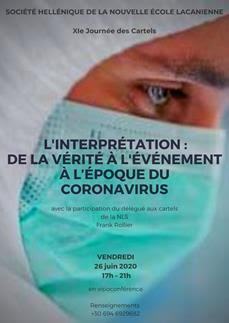
Société Hellénique de la NLS
Athènes : 26 juin
|
New Lacanian School Nous contacter : accueil@amp-nls.org Inscription : https://amp-nls.org/page/fr/42/sinscrire-nls-messager Le site de la NLS : https://amp-nls.org BLOG du congrès de la NLS : https://www.nlscongress2020.com/accueil  |
New Lacanian School
Sign up for the Newsletter:
https://amp-nls.org/page/gb/42/sinscrire-nls-messager NLS website
: NLS Congress BLOG: nlscongress2020
 |
Société Hellénique de la NLS
Athènes : 26 juin
|
New Lacanian School Nous contacter : accueil@amp-nls.org Inscription : https://amp-nls.org/page/fr/42/sinscrire-nls-messager Le site de la NLS : https://amp-nls.org BLOG du congrès de la NLS : https://www.nlscongress2020.com/accueil |
New Lacanian School
Sign up for the Newsletter:
https://amp-nls.org/page/gb/42/sinscrire-nls-messager NLS website
: NLS Congress BLOG: nlscongress2020
|