
Il sera au Forum !
Il vit à Bruxelles
He will be at the Forum !
He lives in Brussels

Martin Deleixhe est professeur intérimaire à l’Université Saint-Louis – Bruxelles. Il enseigne également à Sciences Po Lille. Ses recherches portent sur des problématiques situées au carrefour des théories de la démocratie de la sociologie des migrations. Outre de nombreux articles scientifiques consacrés à ce sujet, il a par ailleurs publié deux livres. L’un est consacré à la trajectoire intellectuelle singulière du philosophe politique Étienne Balibar, L’illimitation démocratique(1) et l’autre explore les difficultés normatives soulevées par le contrôle des frontières dans les démocraties contemporaines, et en particulier aux frontières extérieures de l’Union européenne, Aux bords de la démocratie(2).
(1) Paris, Michalon, 2014.
(2) Paris, Classiques Garnier, 2016.
__________
Martin Deleixhe is Acting Professor at Saint Louis University – Brussels. He also teaches at Sciences Po Lille [Lille Institute of Political Studies]. His research focuses on issues at the crossroads of theories of democracy with respect to the sociology of migration. In addition to numerous scientific articles on this subject, he has also published two books. One is devoted to the unique intellectual journey of the political philosopher Étienne Balibar, L’illimitation démocratique [Democratic Illimitation] (1), and the other explores the normative difficulties raised by border controls in contemporary democracies, and in particular at the external borders of Europe. l’Union européenne, Aux bords de la démocratie [European Union, On the Edges of Democracy] (2).
(1) Paris, Michalon, 2014.
(2) Paris, Classiques Garnier, 2016.
________________
Venue: University St. Louis, Auditorium OM 10,
6, rue de l'Ommegang, 1000 Brussels
Simultaneous Translations in French, Dutch and English
Schedule: 9.00 AM – 7.00 PM
________________________
Adresse: Université de St. Louis, Salle OM 10
6, rue de l'Ommegang, 1000 Bruxelles
Traductions simultanées en français, anglais et néerlandais
|
New Lacanian School Nous contacter : accueil@amp-nls.org Inscription : https://amp-nls.org/page/fr/42/sinscrire-nls-messager Le site de la NLS : https://amp-nls.org Lacan Quotidien : http://www.lacanquotidien.fr/blog/ |
New Lacanian School
website
: |


Il sera au Forum !
Il vit à Bruxelles
He will be at the Forum !
He lives in Brussels
Martin Deleixhe est professeur intérimaire à l’Université Saint-Louis – Bruxelles. Il enseigne également à Sciences Po Lille. Ses recherches portent sur des problématiques situées au carrefour des théories de la démocratie de la sociologie des migrations. Outre de nombreux articles scientifiques consacrés à ce sujet, il a par ailleurs publié deux livres. L’un est consacré à la trajectoire intellectuelle singulière du philosophe politique Étienne Balibar, L’illimitation démocratique(1) et l’autre explore les difficultés normatives soulevées par le contrôle des frontières dans les démocraties contemporaines, et en particulier aux frontières extérieures de l’Union européenne, Aux bords de la démocratie(2).
(1) Paris, Michalon, 2014.
(2) Paris, Classiques Garnier, 2016.
__________
Martin Deleixhe is Acting Professor at Saint Louis University – Brussels. He also teaches at Sciences Po Lille [Lille Institute of Political Studies]. His research focuses on issues at the crossroads of theories of democracy with respect to the sociology of migration. In addition to numerous scientific articles on this subject, he has also published two books. One is devoted to the unique intellectual journey of the political philosopher Étienne Balibar, L’illimitation démocratique [Democratic Illimitation] (1), and the other explores the normative difficulties raised by border controls in contemporary democracies, and in particular at the external borders of Europe. l’Union européenne, Aux bords de la démocratie [European Union, On the Edges of Democracy] (2).
(1) Paris, Michalon, 2014.
(2) Paris, Classiques Garnier, 2016.
________________
Venue: University St. Louis, Auditorium OM 10,
6, rue de l'Ommegang, 1000 Brussels
Simultaneous Translations in French, Dutch and English
Schedule: 9.00 AM – 7.00 PM
________________________
Adresse: Université de St. Louis, Salle OM 10
6, rue de l'Ommegang, 1000 Bruxelles
Traductions simultanées en français, anglais et néerlandais
|
New Lacanian School Nous contacter : accueil@amp-nls.org Inscription : https://amp-nls.org/page/fr/42/sinscrire-nls-messager Le site de la NLS : https://amp-nls.org Lacan Quotidien : http://www.lacanquotidien.fr/blog/ |
New Lacanian School
website
: |


|
New Lacanian School Nous contacter : accueil@amp-nls.org Inscription : https://amp-nls.org/page/fr/42/sinscrire-nls-messager Le site de la NLS : https://amp-nls.org Lacan Quotidien : http://www.lacanquotidien.fr/blog/ |
New Lacanian School
website
: |


|
New Lacanian School Nous contacter : accueil@amp-nls.org Inscription : https://amp-nls.org/page/fr/42/sinscrire-nls-messager Le site de la NLS : https://amp-nls.org Lacan Quotidien : http://www.lacanquotidien.fr/blog/ |
New Lacanian School
website
: |


From 9 a.m until 7 p.m.
“One Is an Accomplice or One Is Rebellious” (1)
Pascale Simonet
A war is happening today in the world, and it is an information war.
Politics, are reduced more and more to its immediate communication, making the media space a black theater where simplistic and false solutions evolve, where new enemies are invented to hide their trampling, where hateful slogans are fomented, -a knock of contradictory figures that does not make sense. It is urgent to mobilize to reveal the monstrosity of this show. To proclaim loudly and clear that to bet on hatred to justify the unjustifiable is a criminal circle that must be unmasked.
Faced with extremists on all sides, governments are positioning themselves by seeking to beat them on their own ground. This strategy, we know, does not offer a way out. It only adds chaos to chaos, merely overbidding multiform frustrations. It follows the devilish movement that tends to divide, undo, destroy, disfigure, devitalize.
The calls for the most regressive social conformity against increasing fears are no longer counted. They have, in the background, the scientist ideal of the “pure” man, mechanized, having abolished any singular peculiarity. Thus the segregations multiply endlessly, and a new horizon emerges: that of the dead man, stripped of his sensitive body, anemic of his own words, melted into all.
“When one imposes the all alike, the step ahead that exceeds abhorring the surprise, as soon as it arises, it is crushed under the heel – with the heel of the boot, but the stiletto heel as well. By means of which, we make more necessary, intense and inevitable the emergence of the One, to the applause of all “(2), recalled JA Miller, as early as 1992.
“The obscure allegations, repeated on all sides, now shine like steel” (3), leaving behind it the police fascination, the lynching of the “elites” who dare to revolt. Between the populist jaws, the breathing space continues to shrink. Is running a fratricidal war of all against all. It is “a rush against people,” announced Bernard-Henri Levy on October 18 (4).
We know it, but we forget it too often: the essence of the massacre is a desire for totality: “Kill them all”. The crime of mass is not only unreasonable, animalistic drive, but a planning of a reason that became crazy, socialization of crime transformed into ordinary work.
Thus, it is necessary, without delay, a resistance of every moment: that of singular bodies and the living speech. “We need a new spirit of beginning and a verb strong enough to avoid this immediate passage from the flesh to the corpse. »(5)
It is urgent to remember that projects that reject differences, that advocate the elimination of certain groups of people are not opinions, but calls for crime. That democracy is only true when all the differences can coexist. That “pretending not to see the pain of others also kills” (6). That politics is as much the fact of the convinced as that of the “docile ignorant” (7).
That besides the sequestration of debates, the first victory of hate is to violently impact the bodies, to push them to silence, to plunge them into a paralyzing terror, destroying them from within. “Many people experienced the violence of the Bolsonaro campaign and its supporters as violence against their own bodies, against their thinking and against their spirit,” says journalist Éliane Brum in a very beautiful article (8).
This fight, which we make ours, is then conducted with the language. It is an argumentative struggle for complexity, the only one capable of preserving a keen awareness of jouissance and of giving to sensitivity all its acuteness. A fight in favor of the ethics of consequences against the ethics of intentions, the only one that preserves the safeguarding of the singularity against conformism as forgetfulness of self (9). The problem is not so much to know if we win or lose, but to know how we lose. With what principles, with what honor (10).
(1) Saviano R., https://www.lepoint.fr/culture/literature-roberto-saviano-or-on-is-complice-or-on-is-rebell-13-10-2018-2262665_3.php ? utm_medium = Social & utm_source = Twitter & Echobox = 1539586234 = # xtor CS1-32- [Echobox]
(2) Miller J.-A. , “État de droit et exception”; Mental, 37, p. 145.
(3) Cherix F., political scientist https://www.letemps.ch/opinions/temps-une-furieuse-odeur-dannees-trente
(4) Lévy B.-H., “Bloc-notes”; Le Point, October 18, 2018.
(5) Deliverance, Ph. Sollers and M. Clavel, interviews, Points-Seuil.
(7) Muller H., quoted by Eliane Brum, op cit
(8) Ibidem.
(9) Laurent É., The reverse of biopolitics, Navarin, p. 21.
(10) Saviano R. op cit.
Translated by Lorena Hojman Davis
Venue: University St. Louis, Auditorium OM 10,
6, rue de l’Ommegang, 1000 Brussels
Simultaneous Translations in French, Dutch and English
Schedule: 9.00 AM – 7.00 PM
|
New Lacanian School Nous contacter : accueil@amp-nls.org Inscription : https://amp-nls.org/page/fr/42/sinscrire-nls-messager Le site de la NLS : https://amp-nls.org Lacan Quotidien : http://www.lacanquotidien.fr/blog/ |
New Lacanian School
Registration:
https://amp-nls.org/page/gb/42/sinscrire-nls-messager NLS
website
: |


|
|

|

|


|
New Lacanian School Nous contacter : accueil@amp-nls.org Inscription : https://amp-nls.org/page/fr/42/sinscrire-nls-messager Le site de la NLS : https://amp-nls.org Lacan Quotidien : http://www.lacanquotidien.fr/blog/ |
New Lacanian School
website
: |


From 9 a.m until 7 p.m.
The Truth of Man Is in the Language
Katty Langelez-Stevens
In his essay on the language of the Third Reich (LTI), Viktor Klemperer advances the thesis that supports his research. It resonates very strangely with that of Freud who was his contemporary but he seems to have not read. This thesis will also be the one that Lacan will extract from Freud's work to make it the red thread, and even the peak of his teaching.
Klemperer refers to Talleyrand's famous saying that the language is there to hide the diplomat's thoughts and he rejects it: "The exact opposite is true. What someone deliberately wants to conceal, to others and to oneself, is what he carries unconsciously and the language reveals it. This, no doubt, is the meaning of the sentence: the style is the man; the statements of a man may be untrue, the style of his language exposes his being."(1)
For Freud, the unconscious is revealed in the words, the sentences that the subject says, or forgets: slips of the tongue, denials, omissions of words. Lacan interprets Freud's work from this point and declares in the Écrits that the unconscious is structured as a language. Lacan parodies the formula of the count of Buffon that Klemperer resumes, “the style is the man” (2) since 1966 when he said in the overture of his Écrits: "the style is the man himself”. While stating that if the style is ordered by the Other to whom the subject who writes is addressing, this is not enough to make a style. From 1966, Lacan proposes a definition of style that focus on the object, neglecting the subject. The condition of possibility of a style is when the subject agrees to submit to the object by fading (3). At the end of his teaching, the style becomes even the signature of the jouissance of the subject through his symptom, his indelible mark.
From 1933 until 1945, Viktor Klemperer kept a diary in which he first noted all the daily troubles of his life as a Jew, the husband of an Aryan, in Dresden. Very quickly, he notices that the language is profoundly transformed by the arrival of Hitler to the power; that these modifications are voluntary and testify of a will to indoctrinate the people. He, himself, finds it very difficult to resist. Goebbels, master of propaganda in the Third Reich, orchestrated this OPA on the German language. The reference work that served as a base for him, or even as a Bible is Hitler's "Mein Kampf", himself put in the position of god.
From this view of Klemperer and that of Freud, we can now draw lessons to find between the lines and behind the words the wolves who hide under the appearances of devoted servants of the people.
Translation by Lorena Hojman Davis
(1) Viktor Klemperer, LTI, La langue du IIIè Reich, Albin Michel, 1976.
(2) "The well-written works will be the only ones that will pass to posterity: the quantity of knowledge, the singularity of facts, the novelty of discoveries, guarantors of immortality are not sure: if the works that contain them only roll on small objects, if they are written without taste, without nobility and without genius, they will perish, because the knowledge, the facts and the discoveries are easily removed, transported, and even gain to be put into works by more skilled hands. These things are out of the man, the style is the man himself the style cannot thus be removed, nor to be transported, nor to be altered: if it is high, noble, sublime, the author will be admired in all times; because there is only the truth that is lasting and even eternal”. Georges-Louis Leclerc, Count of BUFFON, Discourse on Style, Paris, J. Lecoffre 1872 [BnF], Speech delivered at the French Academy on August 25, 1753, p. 23.
(3) Bruno Miani, "L’actualité du style dans la psychose", article published on http://www.causefreudienne.net/lactualite-du-style-in-the-psychose/
Venue: University St. Louis, Auditorium OM 10,
6, rue de l'Ommegang, 1000 Brussels
Simultaneous Translations in French, Dutch and English
Schedule: 9.00 AM – 7.00 PM
|
New Lacanian School Nous contacter : accueil@amp-nls.org Inscription : https://amp-nls.org/page/fr/42/sinscrire-nls-messager Le site de la NLS : https://amp-nls.org Lacan Quotidien : http://www.lacanquotidien.fr/blog/ |
New Lacanian School
website
: |


From 9 a.m until 7 p.m.
Interview with Leonard Simon:
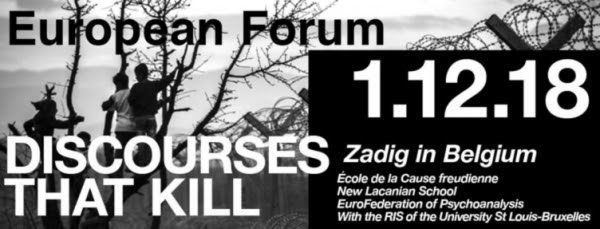
Photographer of the Forum Poster

Marie Brémond : In the series Idomeni, the picture with the sign “open the borders we are not terrorists”, why did you choose to capture this sign?
Léonard Simon : First I have to say that I spent seven days at the camp in Idomeni in March 2016. Most of the time, I had my tent next to other refugee tents. So, I had plenty of time to connect with people camping there. The camp was a loose formation of tents directly at the Greek-Macedonian border; there were no fences or walls surrounding the “camp”. Because people literally did not know where to go next, some started to protest from time to time. During my time, there were no violent clashes between refugees and the police or the military. There were also many other journalists present, some of them for many weeks.
The protest you can see in the picture consisted of a smaller group of people, holding some signs with different messages. Shortly before that event, the terror attacks at the airport in Brussels had taken place. Even in the camp, refugees could feel the hostile environment towards refugees generally and wanted to communicate with the European public.
Marie Brémond : The picture with the Big Mac and the phones chargers: can you tell me a bit more about this symbolic contrast you chose to highlight?

Léonard Simon : During the exhibition, people were a bit confused and mentioned that was quite weird, because the refugees do have expensive smartphones. However, the picture says much more if one thinks about it.
Firstly, yes these people do have smartphones, mostly not the newest, as so many other people in the world also have. Secondly, we also see many smartphones but only one, dirty plug-board. If one considers, that more than 7000 people (which is probably a very conservative estimate), lived at the campsite that time, then this is very few sockets.
On the other hand, I chose this picture, as the Hamburgers in the background are kind of representative of the unreachable of desire of the people living in the camp, and are in sharp contrast to the living conditions of the many who lived in the camp. For example, for many the only way to make tea was to carefully heat up water in a plastic bottle over the open fire; they mostly burned plastic as timber was very scarce.
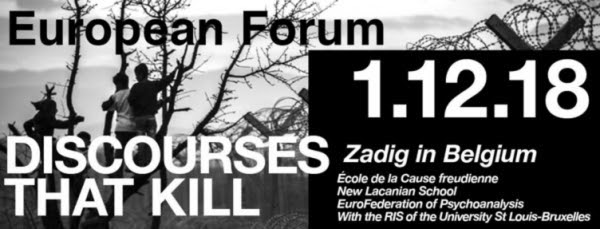
Marie Brémond : The picture for the European Forum: the barbed wire. What does it illustrate?

Léonard Simon : The barbed fence is the border with Macedonia and there are children playing in a tree directly alongside the fence. Even the tree looks hostile and at the same time appears try to tower above the fence. The children, in all their innocence of the situation, will never have the possibility to get over the fence: a very sad moment without any joy or hope.
Marie Brémond : What kind of impression did you get from your time spent with migrants in Idomeni ?
Léonard Simon : Des souvenirs très positifs. Les gens qui vivaient dans ces camps étaient heureux que l’on s’intéresse à leur destin.
Mais j’ai été marqué aussi par le fait que beaucoup de personnes tentaient de tirer profit des réfugiés. Dès que des réfugiés franchissaient la frontière, ils devaient payer un chauffeur de taxi, un ticket de bus, de train. Mais, du moment qu’ils partaient et pouvaient payer leur déplacement, tout le monde était « content ». Je n’oublie pas non plus les petits restaurants installés sur la route avec des panneaux en arabe pour vendre des boissons et de la nourriture.
J’ai été frappé également par le fait qu’il n’y avait jamais de silence dans le camp, il n’y avait pas non plus un seul endroit au chaud ou au sec. Les installations changeaient tout le temps, sans aucune protection contre la pluie ou d’autres intempéries.
Very positive, people living in the camp were happy that people were interested in their destiny.
What was very interesting for me to see was that everyone tried to gain as much profit as possible from the refugees; most of the time in an economic sense. As soon as refugees have crossed one border, in order to travel to the next border they must pay a taxi driver, or bus driver, or for the train. As long as everyone did not stay but paid for their transit, people were happy; not to forget the small restaurants along the route. Many even had Arabic signs offering food and beverages for sale.
Another aspect of the journey was also to see the living situation of the people, particularly to see that there has never been a silent moment or a moment where one had access to a warm and dry place to stay. Everything was on the move and there was no protection from rain and from other bad weather conditions.
More on the Idomeni Series: http://lsphotography.eu/photo_press/idomeni/#7
Venue: University St. Louis, Auditorium OM 10,
6, rue de l’Ommegang, 1000 Brussels
Simultaneous Translations in French, Dutch and English
Schedule: 9.00 AM – 7.00 PM
|
New Lacanian School Nous contacter : accueil@amp-nls.org Inscription : https://amp-nls.org/page/fr/42/sinscrire-nls-messager Le site de la NLS : https://amp-nls.org Lacan Quotidien : http://www.lacanquotidien.fr/blog/ |
New Lacanian School
Registration:
https://amp-nls.org/page/gb/42/sinscrire-nls-messager NLS
website
: |


The Formation of the Analyst: Analysis, Supervision, Pass
With special guest Bruno de Halleux
Saturday 24 November

|
New Lacanian School Nous contacter : accueil@amp-nls.org Inscription : https://amp-nls.org/page/fr/42/sinscrire-nls-messager Le site de la NLS : https://amp-nls.org Lacan Quotidien : http://www.lacanquotidien.fr/blog/ |
New Lacanian School
Registration:
https://amp-nls.org/page/gb/42/sinscrire-nls-messager NLS
website
: |


From 9 a.m until 7 p.m.
Trivialization of discourses that kill
Geert Hoornaert
An International Transatlantic of Xenophobia settles. The language that speaks is a pedagogy of hate. There is us, and there is them; there is here, and there is elsewhere; there is inside and there is outside; there are friends, then there are enemies; those we know, and the foreign. By these words, it claims to describe only the immediate information of experience; it pretends not to speak: it merely reflects the imminent order of things, which, at the same time, prescribe an inexorable policy.
Political speech today has direct consequences on the bodies of thousands of people. It is because certain discourses serve not to restrain, but to provoke violence, while masking it. Euphemism is back, paired with other perversions of the language that our totalitarianisms handles. No one is exposed to death, no, no; we manage migratory flows.
We manage, and under the limitation of the need. The order of things constrains, and politics, it is the only interpreter of this order. But if it is things that speak, and if fate dictates politics, the free circulation of speech, the soul of democracy, has no more reason to exist. Politics then has only one task to accomplish: promoting consensus; solidify common sense; to translate the necessities of the moment to the people; submitted to "force majeure", which will be the One who will solve the desperate complexity of the world.
Political speech strives to erase the point from which it speaks. This point is related to what Freud identified as a real, each individual is, he noted, inhabited by a desire to dominate the other, to submit, kill, rape [1]. It is from this point that each one will have to position themselves, and to build their way of diverting these drives to the paths of realization. This is where an intrapsychic task meets the stakes of a civilization. But the gap between drive and civilization is slim, and there are only words that keep it open. So they matter, and not a little: history shows that they are perfectly capable of releasing the worst, justifying it with Good.
Today, the enemies of civilization are deafen their invariably stifling “solutions". They want to make believe that in what they say, they have nothing to do with it. They only translate the necessities of the moment that the constraining order of things imposes [2]. This erasure of the place from which it speaks gives us the Newspeak of today. In his words, commonplace evil takes shelter and spreads.
Because evil is never trivialized alone. It takes a whole language for that, which prepares the ground by sweeping the obstacles [3]. He will say, tirelessly, that instead of our choices, it is Necessity that speaks. And what Necessity speaks, it is things, not humans. This style has become ubiquitous. We erase the function of speech and destroy the field of language, to sow only messages – neutral, banal, ferocious. As in the Belgian psychiatric hospitals, where, in the name of the rights of the patient, it is informed, in neutrality of course, that a euthanasia procedure for "unbearable psychic suffering" exists; information with what the patient will be free to do what he wants, under condition that he abstains to see there a suggestion…
This Newspeak is covering all human issues; objectification of intimacy, from the assessments in the work to the intrusion of the State into psychotherapies; reification of the public sphere reduced to an arena to manage; segregation of the foreigner in order to lock itself in a barricaded between- oneself, which will turn to be objectified. The discourses on the waves of immigration are thus paired with the injunction to purify the 'self': times require that the human thing consent to the sacrifice of its own. Therefore, by dehumanizing the other, we manage to objectify ourselves.
[1] S. Freud, Malaise dans la Civilization (1930).
[2] See J.-Cl. Milner, La politique des choses, Verdier, 2011.
[3] See, eg, V. Klemperer, LTI
Translation by Lorena Hojman Davis
Venue: University St. Louis, Auditorium OM 10,
6, rue de l'Ommegang, 1000 Brussels
Simultaneous Translations in French, Dutch and English
Schedule: 9.00 AM – 7.00 PM
|
New Lacanian School Nous contacter : accueil@amp-nls.org Inscription : https://amp-nls.org/page/fr/42/sinscrire-nls-messager Le site de la NLS : https://amp-nls.org Lacan Quotidien : http://www.lacanquotidien.fr/blog/ |
New Lacanian School
website
: |

