|
Aucune image? Version web 
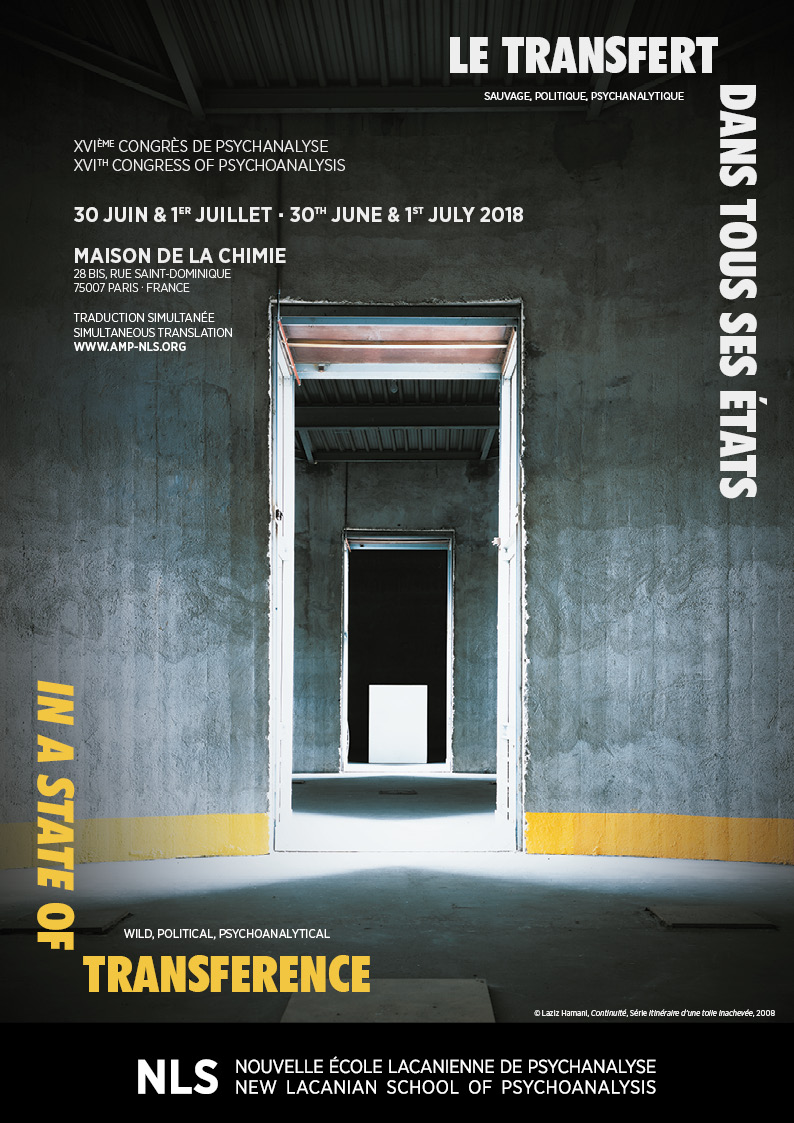
Activités des sociétés et groupes de la NLSActivities of the Societies and Groups of the NLS______________________________ THE 2018 CONGRESS OF THE NLS In a State of Transference Paris 30 June – 1 July 


LE CONGRÈS DE LA NLS 2018 Le transfert dans tous ses états Paris 30 juin – 1 juillet
March / mars 2018ASREEP-NLS (Suisse)
Genève

Aigle

Genève

Martigny

Genève

Fribourg
Genève

Neuchâtel
London Society-NLS (United Kingdom)
London

London

London

London

Société hellénique-NLS (Grèce)Athènes

La Crète
Thessalonique

GIEP-NLS (Israel)
Tel Aviv

Tel Aviv

Tel-Aviv

Tel Aviv

Kring voor psychoanalyse (Belgium)
Gand


Bruges

Gand
ICLO-NLS (Ireland)
Dublin

Bulgarian Society of Lacanian Psychoanalysis of the NLS (Bulgaria)
Sofia
Sofia
Sofia

Cercle de Cracovie (Pologne)


Cercle de Varsovie (Pologne)

NLS-Copenhagen (Denmark)Copenhagen
ACF – PortugalLisbonne

NLS-Québec (Canada)
Montréal
Montréal

Lacan Circle of Melbourne (Australia)
Melbourne

Melbourne

Lacanian Compass (USA)Member Conversations
New York City
Columbia, Missouri
Houston, Texas
Miami, FL
Secrétariat de l'Est
Tirana

Tirana

Tirana

Prague
Amsterdam (the Netherlands)
Amsterdam
Berlin (Germany)
Berlin
Vienna (Austria)
Vienna
Publications
Les Cahiers de l’ASREEP-NLS nº 2, mars, 2018Conversation du TyA« Les addictions sans substances »Réserver un Numéro des Cahiers auprès de nelson.feldman@bluewin.ch ou de alexandra.clerc555@gmail.

The 2nd issue of the Journal from the Lacanschen Orientierung BerlinThe 3rd issue of the ICLO-NLS online Newsletter

Revue internationale de la psychanalyse N 7 en langue russe. Pour commander: RELEASED LAST MONTH: THE LACANIAN REVIEW 4JOURNAL OF THE NEW LACANIAN SCHOOL AND THE WORLD ASSOCIATION OF PSYCHOANALYSIS

LROTHE LACANIAN REVIEW ONLINE
via LacanWEG VAN HET ONBEWUSTE ?Second edition of the journal of the Kring voor psychoanalyse van de NLS 
Revue International de Psychanalyse de l'EFPMental 36L'INCONSCIENT, INTIME ET POLITIQUEIntroduction à la clinique psychanalytique. Neuf conférences espagnoles

New Lacanian SchoolContact: New Lacanian SchoolEnquiries: Nouvelle inscription: New registration: Vous désinscrire en cliquant ici: Unsubscribe by clicking here: Crédit image pour le logo NLS et ses déclinaisons ©Anish Kapoor, 2014
NLS Nouvelle École Lacanienne de Psychanalyse – New Lacanian School of Psychoanalysis
Vous recevez cette lettre parce que vous êtes inscrit à NLS-messager / You receive this because you subscribed to NLS-messager
|


|
New Lacanian School Nous contacter : nls-messager-help@amp-nls.or Inscription : https://amp-nls.org/page/ Le site de la NLS : https://amp-nls.org Le Blog du Congrès NLS 2017 : http://nlscongress2017.org/fr/ Lacan Quotidien : http://www.lacanqu |
New Lacanian School Registration: http://www.amp-n The website of the NLS: https://amp-nls.org Blog of the 2017 NLS Congress: http://nlscongress20 Lacan Quotidien : http://www.lacanqu |


Living
Time-Bombs
The Real Threat of the Foreigner
Roger
Litten
In the unfolding series of Forums it is quite apt that
the theme of the stranger follows on from that of democracy. We could try to
situate these two themes as different sides of the same question.
Taking our reference from Freud, we could consider the
notion of the strange, ‘fremd’, as the
converse of the familiar, ‘heimlich’.
Freud considers the phenomenon of the eruption of the strange into the space in
which we feel at home in terms of the logic of repression and the return of the
repressed. Lacan allows us to approach it on the basis of the mechanism of
foreclosure, according to which that which is rejected within returns from
without. The current politics of post-Brexit Britain suggests that it is even
more alarming when what is rejected from without begins to return from within.
The figure of the refugee can serve us a point of reference
in our attempts to trace the logic and the political consequences of this
process. What kind of crisis is involved in this contemporary phenomenon with
inextricable political, social, economic and humanitarian aspects? Amongst the
different registers we could suggest that this is precisely a crisis of the
principles of European democracy. This assertion might be situated in the form
of a question: Is there going to be a democratic solution to the refugee crisis
and what kind of solution might that be?
I.
If we try to situate the so-called refugee crisis as
the inverse, the underside, of the system of European democracy, we can ask
whether the reason the refugee poses such a crisis to the discourse of liberal
democracy is not because in this figure we witness the incarnation of the very
element on whose exclusion that system is predicated.
It is thus the return of the refugee, the
unassimilable element that our political discourse is at a loss to resolve but
unable to ignore, that exposes some of the hidden conditions of the discursive
configuration of Western democracy, made up of the hybrid alliance between the
discourses of capitalism and democracy, held together in tenuous articulation
with the principles of human rights at the foundation of the European nation
state.
Under the logic of capitalism a dynamic of expansion
and growth is required in order to maintain the precarious balance between the
margins of production and consumption, labour and goods. There is however a
point at which this dynamic reaches a limit, a tipping point where the logic of
expansion and growth is exhausted and the system begins to turn back on itself.
For a long time capitalism has relied on outsourcing
cheap labour in the developing world where the cost of reproduction of labour
is lower. At the same time it is constantly seeking to open up new markets for
the goods that already saturate our domestic market. But at a certain point
this system stumbles over the contradiction between the need for cheap labour
and the need for new consumers of the goods produced by that labour, most
obviously when both consumers and producers come to be situated in the same
location.
One response to this contradiction is the attempt to
delimit new frontiers between zones of consumption and production. At the point
where global capitalism has profited from the reduction of tariff thresholds to
a minimum when it is a question of the export of goods, we witness the attempt
to erect new barriers against the free movement of labour travelling in the
opposite direction. The very notion of the frontier then begins to take on
paradoxical and contradictory aspects, operating as a permeable threshold in
one direction but an impenetrable barrier in the other. At the same time the
border begins to operate a prismatic effect of refraction, separating out the
rights of subjects as consumers from their value as the raw material of labour.
It is here that the frontier zone betrays the fiction
of the attempt to superimpose these two registers as if they were equivalent,
or as if one would necessarily entail the other. At the same time parallel
questions begin to arise for the associated superimposition of the principles
of democratic rights with those of human rights within the system of global
capitalism, precisely at the point where these converge in the logic of the
European nation state.
The refugee crisis, in all its forms, thus poses a
critical difficulty for the assumptions of Western democracy. ‘They’ too want
what we have, not simply at the level of material possessions, but also at the
level of all the goods and benefits supposedly assured us by the system of
Western democracy itself – security, health, freedom from oppression, freedom
of speech and association, basic values of free choice and universal values of
human rights.
Are we going to be prepared to grant refugees the
right to a share in these goods, everything we take for granted as assured us
by the system of capitalist democracy? Do they have a right to the share in
these goods, or only in principle, or only at a distance, safely out of sight
in their country of origin, but not necessarily as our neighbours? Or will we
try to resolve the issue by ignoring it, by turning our backs on it and not
wanting to know anything about it, leaving it to others to resolve these
questions on our behalf?
II.
We can consider the outcome of the Brexit referendum
as one mode of response to this question. In Britain the attraction of not just
turning one’s back on the problem, but of actively and materially cutting
oneself off from it, is of course facilitated by the island geography that
ironically served to underpin the rise of the British Empire off the back of
naval power. Our topographical location thus facilitates the illusion of being
able to resolve the question by simply closing our borders, separating
ourselves from the source of the difficulty, and creating a hermetically sealed
land mass that was never truly part of the European continent in the first
place.
The Brexit campaign was played out around the logic of
a fundamental alternative between the economic risks of leaving the European
market and a more visceral reaction to the immigration crisis reaching its
height during the summers of 2015 and 2016. The campaign to remain part of the
European Union was able to produce no shortage of local and international
experts to testify to the serious dangers to the nation’s economic interests
posed by separation from the common market. The leave campaign was able to play
on various ingrained and unarticulated fears about the consequences of
unrestricted immigration.
Vocabulary of ‘swarms’, ‘hordes’, and ‘waves’ of
refugees perpetuated the image of an undifferentiated mass of immigrants
heading towards Calais, looking for ways to gain entry via the tunnel that
links us to the body of mainland Europe. This vocabulary was integral to the
governing party’s long-standing strategy of bundling together foreign
nationals, economic migrants, asylum seekers, refugees and most importantly
terrorists, into one single undifferentiated category of dangers to our
economic, national and physical security.
The result of the referendum demonstrated, against all
neo-liberal expectations, that the multiple concerns crystallised around the
figure of the immigrant were able to override any considerations of economic
self-interest. The threat that Islamic terrorists might be mingled in with this
undifferentiated horde threatening to do harm to our safety and security, or
simply to undermine the stability of our way of life, allowed every migrant to
be considered as a threat to security.
The irony, of course, is that since the outcome of the
referendum the question of immigration has to a remarkable extent disappeared
from the centre of the political discourse. Instead we have witnessed attempts
to reconfigure the logic of Brexit in terms of national and economic interest,
attempts that keep running up against obstacles that testify to the impossibility
of trying to square the circle in these particular terms.
In the meantime hatred of the foreign continues to
bubble away at the fringes of the mainstream political discourse, as testified
to by a largely unreported increase in hate crimes, attacks on foreigners or
religious minorities, which have hit record levels since the referendum. The
security issue, however, is never far from the top of the agenda, with constant
pleas for more powers and more funding from the security services in the name
of the multiple and unspecified threats to our national security constantly
being thwarted in the shadows.
III.
But it turns out that it is not only foreign nationals
who pose a threat to our national sovereignty. Recent reports have highlighted
the threat posed by British nationals returning from fighting in Syria.
Proposals have already been passed without significant comment or opposition to
strip of their right to citizenship any British national suspected of
participation in terrorist activities abroad.
Unlike the resident European citizens being held
hostage to the government’s negotiating strategy with Brussels over subjection
to jurisdiction of the European Court of Justice, stripping British nationals
of their citizenship does not render these individuals foreigners, nor does it
allow us to repatriate them as citizens of a foreign state. Stripped of their
British citizenship but belonging to no other nationality, would these be the
subjects referred to by Theresa May as “citizens of nowhere”?
The British government has for some time now been
launching targeted airstrikes against their own citizens involved in fighting
on foreign soil. But what then would be the legal status of these individuals
once they find themselves repatriated to their land of birth? Will they end up
in the same legal limbo as those still languishing in Guantanamo Bay after all
these years, despite being convicted of no crime?
Under the front-page headline “Terror Alert on Jihadi
Children”, the London Evening Standard recently published an exclusive
interview with Commander Dean Haden, the head of the London Metropolitan
counter-terrorism command. He highlighted the dangers not just of known
fighters returning from Syria but also of the children born of British
nationals in Syria.
He revealed that police are now carrying out DNA tests
on any children being brought into Britain having been born abroad. This, he
says, is in order to “establish their identity and to determine whether they
have the right to live here. If a mother turns up with a stateless child born
in Syria we need to be satisfied that that child actually belongs to that
mother.”
Here he refers to recent comments apparently made by
his German counterpart, Hans-Georg Maassen, head of Germany’s domestic
intelligence agency, who has apparently asserted: “We have to consider that
these children could be living time-bombs. There is a danger that these
children come back brainwashed with a mission to carry out attacks.”
Are we to simply dismiss these concerns as the florid fantasies
of the operatives of the security state? Or is it here that we are close to
grasping something of the real at stake, the point at which the stranger inside
us becomes truly alien, posing an explosive threat to the integrity of the
social body?
ISCRIZIONE ON LINE
INFO
INGRESSO LIBERO
SOTTOSCRIZIONE VOLONTARIA
|
New Lacanian School Nous contacter : nls-messager-help@amp-nls.or Inscription : https://amp-nls.org/page/ Le site de la NLS : https://amp-nls.org Le Blog du Congrès NLS 2017 : http://nlscongress2017.org/fr/ Lacan Quotidien : http://www.lacanqu |
New Lacanian School Registration: http://www.amp-n The website of the NLS: https://amp-nls.org Blog of the 2017 NLS Congress: http://nlscongress20 Lacan Quotidien : http://www.lacanqu |


|
New Lacanian School Nous contacter : nls-messager-help@amp-nls.or Inscription : https://amp-nls.org/page/ Le site de la NLS : https://amp-nls.org Le Blog du Congrès NLS 2017 : http://nlscongress2017.org/fr/ Lacan Quotidien : http://www.lacanqu |
New Lacanian School Registration: http://www.amp-n The website of the NLS: https://amp-nls.org Blog of the 2017 NLS Congress: http://nlscongress20 Lacan Quotidien : http://www.lacanqu |

A Foreigner In Her Own Land
Maria
Cristina Aguirre
While thinking about writing this lines,
following the invitation from Marie-Helene Brousse, the words of the
Argentinian singer and composer Facundo Cabral resonated in me: Ni soy de aqui, ni soy de alla (I’m not
from here, I’m not from there).
Where does this feeling of stranger,
foreign, alien come from? I can trace it of course to my history but also to
language and to being a woman.
Born in the USA, and more specifically in
New York City, at an early age I moved with my family to Ecuador where I grew
up. When I was 4 years old we came for an extended period of time to the US and
when I returned to Ecuador I had forgotten completely how to speak Spanish. I
recognized my cousins who were my playmates and immediately began speaking to
them, but unbeknownst to me, I was speaking in English. So they didn’t
understand me, and I didn’t know why. I was terrified. Since then, they
nicknamed me “la gringa”, term used by Latinos and Hispanics to denominate
those who come from the States and/or Europe – the foreigners. So language made
me a foreigner among my peers.
Later on when I was studying in France, I
spoke French with was gently called “a charming accent”, marking again the fact
that I was not from “there”.
The other common point these two places had
was that I was not able to vote, as I was not a citizen.
When I decided to move to New York City, my
native city, I had the illusion that finally I would be home, where I was born
and where I could vote. But again, the real of language installed that
invisible barrier that marked my difference: I had an accent in English too,
which leads constantly to the same question, “Where are you from?” I don’t have
a quick answer to this as the “truthful” one, “I’m from here”, leaves the other
unsatisfied and suspicious. So I’m constantly forced to find creative, witty
answers without having to go through my life story, with strangers in an
elevator or other chance encounters.
I even thought to take accent-reducing
classes, until someone told me that everybody has an accent, especially in
English and that it was charming. So I have accepted the trait of “gringa”,
foreigner, represented by the accent, but I think it goes beyond that. I think
it is the particular form that being a woman, the mark of the difference, being
other to oneself, takes for me. And yes, I do enjoy the equivocal that the
three languages provide.
ISCRIZIONE ON LINE
INFO
INGRESSO LIBERO
SOTTOSCRIZIONE VOLONTARIA
|
New Lacanian School Nous contacter : nls-messager-help@amp-nls.or Inscription : https://amp-nls.org/page/ Le site de la NLS : https://amp-nls.org Le Blog du Congrès NLS 2017 : http://nlscongress2017.org/fr/ Lacan Quotidien : http://www.lacanqu |
New Lacanian School Registration: http://www.amp-n The website of the NLS: https://amp-nls.org Blog of the 2017 NLS Congress: http://nlscongress20 Lacan Quotidien : http://www.lacanqu |

The Logic of the
Stranger
Miquel Bassols
Am I a stranger
only to those who are foreign to me? The question
about the structure of the reciprocities that would be required by a society of
mutual recognition is worth asking. The answer depends – without doubt – more
on the question of where one is (donde uno está) rather than on the question of where one is from (es). I’m a stranger for the other when I am (estoy) outside my country – but what is my country? The other is a
stranger to me when he leaves his country to live in (estar) mine – but what, in fact, is his country? These
reciprocities immediately reveal some dissonances: if the other is (está) in a country other than his own
that is also not mine, then I would not consider him a stranger, especially if
I am (estoy) not in the country where
he is (está). If I stay (estoy) in a country that is not the
country that the other is from, then I will not be considered so foreign by
him. The level of extraneousness depends more on the place where I stay (donde estoy) than
on the place where I come from (de
donde soy) and am. It is not certain,
therefore, that I am always a stranger in the same way for those who are
foreign to me. It depends on the place where we
(the other and I) stay. Necessarily, being (ser)
evaporates into staying (estar),
showing itself as an empty identity, as a lack of being (falta de ser), to use a typical Lacanian term. Could one of the names of this empty identity be
“the stranger”?
On the other
hand, it is interesting to observe that when two people recognise themselves as
being (estando) foreign in a country
that is not theirs, they are no longer so foreign to each other. If it’s the case that they are (sean)
from the same country, this trait of extraneousness will make them more
familiar in a strange way, in a kind of secret solidarity. It is in this
strange familiarity that we meet the dimension Freud called the Unheimlich – the sinister, the foreign, even if
it is familiar. This happens to me – for example – when I encounter traces of
the story of my country in a different country. Above all, it was there, in the
place of the other, that I recognised that country as mine. On the other hand,
what is my country when I recognise it above all in the location of the other –
that is, in another country? In this place that is always foreign, I can meet
what is more familiar to me. This is where I get to feel a stranger to
myself.
At this point, I can be also a stranger to someone who is not a stranger
to me. And someone can be a stranger to me without my being a stranger to him.
This is the untold, the not mutually recognised extraneousness. It is only when
this extraneousness appears as evident that something becomes radically
extraneous to me, and I ask myself: when I stay (estoy) in the place of the other, in his country, what am I to him?
Firstly, the relation of extraneousness seemed to be, for us, one to
one: I’m the stranger only for someone who is a stranger to me. But this
appearance conceals in its foundations a deeper reflexive relation, the
relation of each element to itself: Am I a stranger to myself? Yes, in the
place where I meet, in myself, this other that lives me – in his words and in
the way in which he enjoys himself – this other that twitches in me and which,
at the same time, we call “unconscious”.
This
is the best term that Freud found to designate what of myself is most foreign
to me. It’s about a very singular relation in the building of
a set of membership because, when applied as a reflexive relation of each
element to itself, it excludes this element at the same time that it includes
it in the set, suspending the principle of identity: if I am a stranger to myself
just as I am a stranger to the other, then I’m not a part of the set of
membership because this set defines itself through the trait of “being a
stranger to myself”. It is in the extent to which the other makes present in me
this alterity, the alterity of extraneousness, that the more radical feeling of
the stranger appears: a feeling that is both the opposite of, and the
correlative to, the identity between being (ser)
from a place and staying (estar) in a
place.
On the contrary, if we separate the being (ser) from the staying (estar),
each person is a stranger to himself without necessarily being (estar) a stranger to the other – or each
one is (está) just that to the
stranger without necessarily being a stranger for others. It would be the
principle of a mutual and generalised recognition, based on the recognition of
the stranger that lives in everyone. Without doubt, it is an ideal. But it’s a
better ideal, no doubt, than any relation of segregation inherent in the social
bond based on the identification – more ideal, however – between being (ser) and being (estar).
At the end of this strange logic of the stranger, it is possible to
deduce a trait of our own analytic experience. It’s about a way of knowing how
to stay (estar) there where I am (soy) not, but also a way of knowing how
to be (ser) there where I don’t stay
(estoy). And this is possible without producing disasters and knowing how to
recognise ourselves in every place as strangers to ourselves.
Note on
Strangeness between Languages
The precise difference in Castilian between being (ser) and staying (estar) is not the same in other languages. This is why it is hard
to translate this short text into French: ser and estar are both translated as être.
The same thing happens in English with the verb to be, although the verb to stay seems
to be – according to an etymological point of view – closer to estar. In Italian, as in Castilian, there is
the difference between being and
staying, but it doesn’t concern the same semantic fields. For
this reason, as is often shown, the use of the verbs ser and estar is always confusing
for foreign students, although it depends, in a different way and at different
levels, on the place where they come from and are (sean). A good way to feel the stranger in ourselves is to question
where someone comes from (es)
considering where he is (esté).
Ultimately, it is through the difference of languages that we can craft
a deeper experience of the stranger. Originally, the term “barbarian” was a way
to nominate the other who spoke in a way that couldn’t be understood: bar,
bar, bar…
Translated by
Sabrina Di Cioccio
Revised by J.
Haney
ISCRIZIONE ON LINE
INFO
INGRESSO LIBERO
SOTTOSCRIZIONE VOLONTARIA
|
New Lacanian School Nous contacter : nls-messager-help@amp-nls.or Inscription : https://amp-nls.org/page/ Le site de la NLS : https://amp-nls.org Le Blog du Congrès NLS 2017 : http://nlscongress2017.org/fr/ Lacan Quotidien : http://www.lacanqu |
New Lacanian School Registration: http://www.amp-n The website of the NLS: https://amp-nls.org Blog of the 2017 NLS Congress: http://nlscongress20 Lacan Quotidien : http://www.lacanqu |

Immigration
in a Time of “Democratic Deficit”
Alan
Rowan
The idea that
Europe actually needs inward immigration – and rather urgently – is not new.
Thus, for example, Zygmunt Bauman (2012)[i]
citing the then President of the European Foundation for Progressive Studies,
Massimo D’Alema, several years ago pointed out that the European population
could shrink over the coming 40 years by approximately 100 million due
primarily to falling birth rates. In
this context, D’Alema argued, approximately 30 million newcomers would be
needed if the European economy is to avoid significant collapse and it’s
cherished standard of living is to be preserved. That the European population
is also aging, further complicates this picture. According to the US Census
Bureau’s International Data Base one in five Western Europeans were over 65 in
2014 – a figure that is predicted to rise to one in four by 2030 – thus placing
increasingly acute demands on the economy as a whole, as well as in particular,
on services like health and social care.
Though
differences exist between countries (e.g. Ireland’s birth rate remains
relatively high), and within Europe migration is a further factor, there is
general agreement that Europe is currently facing challenging demographic
changes. In a context of global population growth, Europe’s population, and
particularly its working age population, is declining. Thus, one may wonder,
why is it that immigration today is generally seen as a great danger rather
than a welcome asset?
One answer
concerns the changing nature of the symbolic in a world of hyper-consumption.
Thus, on one side, we notice how the contemporary subject is increasingly
captured by a jouissance that isolates and fixes him to a solitary and
anonymous drive satisfaction, while on the other, symbolic structures and
values are weakened and loose traction. Here for example, political
institutions and governments, in a globalised, financialized and quantified
world, simply do not have the sort of importance or decision making power they
once had, and “global reach” on issues such as the rule of law, fair taxation
and the redistribution of wealth (including geographically) seem far away.
This has
created what one can call a “democratic deficit”. Namely, the alienation and
erosion of citizens interest in the political, low turnout at elections, a
weakening of bonds between people who share the same material environment, and
with this, the creation of psycho-social spaces vulnerable to colonisation by
extremist ideologies. Here traditional “party politics” increasingly evokes
apathy, even animosity, among a voting population who experience inter-party
politics more as a charade, a “self-interested game” on which one cannot rely, based
on minor policy differences that have little real impact on the structure of
most people’s lives. While the call for a new type of politics has been made,
and new political parties have emerged (e.g. in France and Spain) it remains
unclear if such developments, respecting a diverse citizenship, can lead to an
increased societal sense of shared cohesion and purpose – one that must
simultaneously be both local and non-local (i.e. have a global
perspective). A crucial challenge here
of course, in any politics that seeks to reinvest the notion of “the common” or
common good, is that such a possibility also depends on finding new and
creative ways to operate, without and beyond appeal to the grand narratives and
master signifiers/semblances of previous times.
It is thus in
this context that one must situate the “othering” of the immigrant and with it
the contemporary forms of anxiety aroused by “the stranger”. Subjects today are
more isolated in a world where, as Lacan predicted, we see the rise of the
object to its social zenith accompanied by lives that are increasingly less
stable, less continuous, more “liquid” to use Bauman’s term. A key paradox here
is that the subject is both soothed and also made anxious by this ever-growing
abundance of industrial objects, and one can suggest, it is the overflowing of
this un-worded anxiety into the social bond that has the power to hook the
subject into a process that “others” the immigrant. At its most simple, the
unspoken for immigrant (e.g. socially and politically) becomes a reason, a
pseudo-explanation, for the subject’s unease, a target for the irreducible of
the death drive.
Antonio
Gramsci, commenting on his experience of Europe in the 1930’s, wrote: “The
crisis consists precisely in the fact that the old is dying and the new cannot
be born; in this interregnum a great variety of morbid symptoms appear”.[ii]
There can be little doubt that something of this crisis is with us again –
albeit in a contemporary form.
[i]
Bauman, Z. (2012). Times
of interregnum. Ethics & Global
Politics. Vol. 5, No. 1, pp 49-56.
[ii]
Gramsci, A. (1971). Selections from Prison Notebooks. [Ed. &
Trans. Q. Hoare & G. Nowell-Smith]. P276, Lawrence & Wishart,
London.
ISCRIZIONE ON LINE
INFO
INGRESSO LIBERO
SOTTOSCRIZIONE VOLONTARIA
|
New Lacanian School Nous contacter : nls-messager-help@amp-nls.or Inscription : https://amp-nls.org/page/ Le site de la NLS : https://amp-nls.org Le Blog du Congrès NLS 2017 : http://nlscongress2017.org/fr/ Lacan Quotidien : http://www.lacanqu |
New Lacanian School Registration: http://www.amp-n The website of the NLS: https://amp-nls.org Blog of the 2017 NLS Congress: http://nlscongress20 Lacan Quotidien : http://www.lacanqu |

There’s only one month left to register at a reduced fee…
|
New Lacanian School
Nous contacter : nls-messager-help@amp-nls.or
Inscription : https://amp-nls.org/page/ Le site de la NLS : https://amp-nls.org Le Blog du Congrès NLS 2017 :
http://nlscongress2017.org/fr/
Lacan Quotidien : http://www.lacanqu
|
New Lacanian School
Registration: http://www.amp-n The website of the NLS: https://amp-nls.org
Blog of the 2017 NLS Congress: http://nlscongress20
Lacan Quotidien : http://www.lacanqu |


|
New Lacanian School Nous contacter : nls-messager-help@amp-nls.or Inscription : https://amp-nls.org/page/ Le site de la NLS : https://amp-nls.org Le Blog du Congrès NLS 2017 : http://nlscongress2017.org/fr/ Lacan Quotidien : http://www.lacanqu |
New Lacanian School Registration: http://www.amp-n The website of the NLS: https://amp-nls.org Blog of the 2017 NLS Congress: http://nlscongress20 Lacan Quotidien : http://www.lacanqu |


Communiqué of the NLS
The NLS is pleased to announce the admission of nine new members, whose
names are:
Isolda Arango Alvarez (Miami, USA)
Juan Felipe Arango (Miami, USA)
Ludovic Bornand (Sâles, Switzerland)
Bruno De Halleux (Brussels, Belgium)
Sebastian Godlewski (Poznan, Poland)
Nina Krajnik (Ljubljana, Slovenia)
Liliana Macotinsky Kruszel (Miami, USA)
Carmen D. Navarro De Niño (Houston, USA)
Karina Tenenbaum (Miami, USA)
I welcome them in the name of the NLS.
With regard to the aggiornamento
of the Schools of the World Association of Psychoanalysis initiated recently by
Jacques-Alain Miller, the School is counting on their decided commitment to
what it proposes, both on the level of its activities (the Congress, the
cartels) and its objectives.
Lilia Mahjoub
President de la NLS
|
New Lacanian School Nous contacter : nls-messager-help@amp-nls.or Inscription : https://amp-nls.org/page/ Le site de la NLS : https://amp-nls.org Le Blog du Congrès NLS 2017 : http://nlscongress2017.org/fr/ Lacan Quotidien : http://www.lacanqu |
New Lacanian School Registration: http://www.amp-n The website of the NLS: https://amp-nls.org Blog of the 2017 NLS Congress: http://nlscongress20 Lacan Quotidien : http://www.lacanqu |