XVth Study Days of the Escuela Lacaniana de Psicoanálisis (ELP)
Colegio de Médicos, Madrid
19th and 20th November 2016
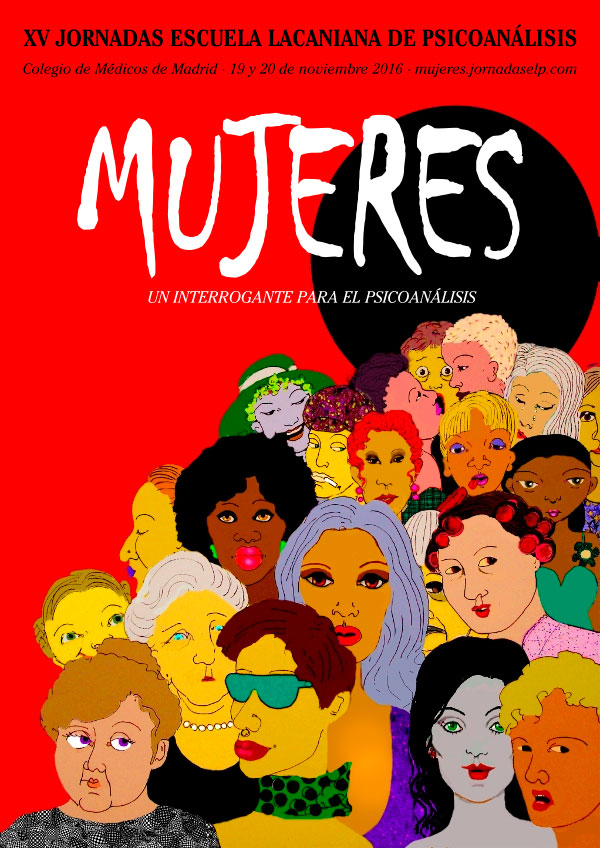
WOMEN
A question
for Psychoanalysis
A
special link ties psychoanalysis to women. For Sigmund Freud, women opened the
door to the unconscious and led him to the creation of psychoanalysis. Since
then, the Freudian question, “What does woman want?” is central to
psychoanalytical practice.Men
have always meditated on the question of femininity. However, they are not the
only ones to have sweated over this “mystery”. Women are affected by it too.Psychoanalysis
demonstrates that femininity, “by the nature of things, which is the nature of
words” (1), constitutes the prototype of otherness for every speaking being.“Women”
exist. They frequently turn to psychoanalysis. Women are as varied as they are
numerous. The more “The Woman” does not exist, the more diverse.The
enigma of the feminine stills questions the so-called universality of ideals
and values. Psychoanalysis of the Lacanian orientation reveals that any attempt
to reduce the multiplicity of the feminine to a universal may cause irreparable
damage to subjectivities and cultures.Jacques-Alain
Miller –interpreting contemporary time—has pointed out that the “virile”
aspirations Freud described have been substituted by an aspiration to
femininity. This change is not only the result of feminism and women's greater
inclusion in culture, economics and politics. It is fundamentally due to the
advance of a society that is getting used to the dissolution of ideals,
particularly those that want to regulate the relationship between the sexes.At the
same time, hatred and rejection of women are still in force. The effort to stop
gender violence through educational and prevention campaigns produces more case
statistics rather than actual results. Let’s not forget those places in the
world where women are the object of culturally -licensed rejection and
degradation at all levels of public and private life.Changes
in contemporary Western societies have modified women's traditional roles.
Today’s woman can play the game of life within a male logic both in the fields
of love and work. However, this strategy has its drawbacks: the more she play
like men, the more she loses herself. Clinical experience shows us that
separating love and sex leads women to suffering. Certainly, love –in multiple
ways—is still essential to women.The
necessary sequence in a woman’s love life is often Speak-Love-Enjoy. A woman
can repeatedly address her demand for words to a walled-off partner or be blown
away by the one whose words take her to a state of extra-ordinary happiness.At the
limit, we find a certain feminine “madness” derived for the search of an
absolute love for which some women will sacrifice everything-her dignity, her
goods, even her life. The ravage, understood as unlimited devastation, is the
price that those women pay for their insatiable demand of love.In
short, the relationship between the sexes is an eternal discourse. Desire is a
never-ending quest and love a way “to get round” difficulties. In this sense,
the present is not different from the past or from the future. Femaleness is,
and will continue to be, an object of constant interrogation.What is
new is that the master discourse is not interested in posing these big
questions. We live in a time of answers -for-everything: answers about genetic
and neurological causes from science, answers about behavioural adaptation from
psychology, and those from technology with its move to act limitlessly over the
most intimate spheres of human life.It is a
mirage to believe that the truth of the speaking being can be revealed
through the study of the genomics or the brain. In fact, no knowledge can
account for the existence of an insurmountable limit. The Woman is one of the
names of that limit. On the other hand, we find new semblants and unknown forms
of “matching up”. We find women who become men, women who become mothers
through sperm or egg donors, women who marry other women and those who remain
alone, or who manage big corporations or command an entire army.
Psychoanalytical practice shows us that it is possible for a woman to find her
own solution in one of those labyrinths. It is a matter of finding one’s own
orientation according to one’s singular way of jouissance- and of granting this
solution the dignity it deserves.Jacques
Lacan invites us to let ourselves be questioned by the feminine, knowing that
the all of the feminine can never be completely said. This does not prevent the
psychoanalytical discourse from providing some references on women, one by one.
Translated by Neus Carbonell and Sheila Power
Quotes: Lacan, Jacques: Encore, 20th February 1973.
|
New Lacanian School Nous contacter: nls-messager-help@a Nouvelle inscription: http://www.amp-nl | Le site de la NLS https://amp-nls.org | |
New Lacanian School New registration: http://www.amp-n | The website of the NLS https://amp-nls.org | |


|
New Lacanian School
Nous contacter: nls-messager-help@a
Nouvelle inscription: http://www.amp-nl | Le site de la NLS www.amp-nls.org | |
New Lacanian School
New registration: http://www.amp-n | The website of the NLS www.amp-nls.org | |
Dear colleagues,
The beginning of the academic year is a good moment
to set up a cartel, whether it is dedicated to study, to the preparation of an
event or a Knotting Seminar, to connecting
psychoanalysis with another field… or even to working towards the 2017
NLS Congress, which will take place in Paris next 29-30 April under the
title About the Unconscious – Place and
Interpretation of Formations of the Unconscious in Psychoanalytic Treatments.
There are two ways of forming a cartel:
– Three to five people decide to share a common theme
of work, and then they choose a plus-one.– Someone who wishes to be in a cartel may contact
the cartel’s delegate in his/her area, who will help that person to join an
emerging cartel.
The NLS also offers to organize e-cartels, which give
the possibility of forming cartels beyond the borders of one’s society or
group. Think also of using Skype, which may foster exchanges. The NLS’s Cartel
Representative may also put you in touch with other people looking for a
cartel. Don’t forget to mention your working language (English, French, or
both) and if you’re looking for a cartel working “Towards the Congress”.
The new cartels, as well as those continuing for a
second year, are to be registered by the plus-ones
before December 2016 on the NLS website.Thank you for informing me at the same time so that
I will be able to validate the registration.
New:
The NLS Cartels’ Newsletter / La Newsletter des
cartels de la NLS, called « 4 + one », is a non-periodical e-Newsletter
which will host short papers (up to 3,500 characters maximum)
written by cartel participants either in English or in French; they will be
proposed to “ 4 plus one” by the cartels‘ plus-ones, by sending them to <frollier@wanadoo.fr> . The papers will then
be selected by a reading committee.
Please do not
hesitate to contact me for any questions you may have.Best regards,
Frank Rollier
NLS cartels’
delegate
|
New Lacanian School Nous contacter: nls-messager-help@a Nouvelle inscription: http://www.amp-nl | Le site de la NLS www.amp-nls.org | |
New Lacanian School New registration: http://www.amp-n | The website of the NLS www.amp-nls.org | |

 111
111
|
New Lacanian School Nous contacter: nls-messager-help@a Nouvelle inscription: http://www.amp-nl | Le site de la NLS www.amp-nls.org | |
New Lacanian School New registration: http://www.amp-n | The website of the NLS www.amp-nls.org | |

NLS-Press n° 22 – octobre / October 2016
Activités des sociétés et groupes de la NLS
Activities of the Societies and Groups of the NLS
Octobre / October 2016
ASREEP-NLS (Suisse)
- 7 octobre
Genève
Conversation avec Laurent Dupont (AE de l’ECF).

- 8 octobre
Genève
Journée Max und Moritz. Invité : Laurent Dupont (AE de l’ECF). Cette journée du 8 octobre est ouverte (sur inscription).

- 19 octobre
Martigny
Atelier de Criminologie lacanienne, «C-o-r-p-s mis en acte ». Organisé par René Raggenbass.

London Society-NLS (United Kingdom)
-
1st October
London
Seminar XXIII Reading Group: “From Symptom to Sinthome”. Organizer: Roger Litten.
-
18th October
London
“Between Anxiety and Love”; Lacanian Lessons Seminar 2016 – 2017
Lesson 1: Introduction to the Seminar X, Anxiety of Jacques Lacan.
The work and legacy of Freud’s Inhibitions, symptoms, anxiety. Between difficulty and movement: the missing term. Organizer: Bogdan Wolf.

Société hellénique-NLS (Grèce)
- 15 octobre
La Crète
Introduction au prochain thème du congrès de la NLS par Georgia Fountoulaki.
Thessalonique
Cercle psychanalytique de Thessalonique, sous l’égide de la Société hellénique:
Cinéma et psychanalyse – Projection du film Shame de Steve McQueen.
Animé par Réginald Blanchet.
Commentaires de Elisabeth Neofitidou, Vaguélis Douros et de l’écrivain Filis Tellos.

- 20 octobre
La Crète
Séminaire clinique et théorique : « Face à une tentative de suicide », par Georgia Fountoulaki.
- 22 octobre
Athènes
Séminaire Nouages sur le thème du prochain congrès de la NLS : « Autour de l’inconscient. Place et interprétation des formations de l’inconscient » avec Bernard Seynhaeve, Joanne Conway, Alan Rowan et Argyris Tsakos.

Kring voor psychoanalyse-NLS (Belgium)
-
8 octobre
Gand
Atelier de recherche « Choses de finesse en psychanalyse ».
Tous les participants sont invités à lire deux leçons de « Choses de finesse en psychanalyse » de Jacques-Alain Miller. 4 + 1 personnes ouvrent la conversation avec une ou quelques questions.Séminaire de travail : « Politique lacanienne » : psychanalyse et santé mentale.
Les effets et les conséquences de la nouvelle loi sur les professions de santé mentale seront étudiés. Deux participants ouvrent la discussion avec une brève intervention sur cette question.
ICLO-NLS (Ireland)
- 21th October
Dublin
Special Interest Group (SIG) Child & Adolescent Lacanian Psychoanalysis.
This working group aims to develop and share the Lacanian psychoanalytic clinic with children and young people. Its participants wish to investigate questions pertaining to their clinical work, from a variety of disciplines. Responsible: Joanne Conway
- 22nd October
Dublin
Inter-cartel Day: The Question of Cartels.
Responsible: Tom Ryan and Linda Clarke

Bulgarian Society of Lacanian Psychoanalysis of the NLS (Bulgaria)
-
11th October
Sofia
Clinical Workshop 2016 – 2017
The “Clinical Workshop” is an activity of the Bulgarian Society of Lacanian Psychoanalysis. Organized for the past four years, it aims to open a space for the clinical discussion – theoretically oriented by Lacanian psychoanalysis – of clinical cases that have been prepared in advance and taken from the psychotherapeutic practice of a wide circle of professionals. Keeping the new elements from its 13th edition, the Clinical Workshop of the school year 2016 – 2017 will start in October and will have one meeting each month until July 2017.
Interventions: Vessela Banova, Dr. Evgueni Genchev, Desislava Ivanova, Theodora Pavlova
Cercle de Cracovie (Pologne)
- 8 octobre
Continuation du séminaire mensuel de formation clinique autour de deux stages dans l’hôpital psychiatrique avec lequel le Cercle collabore depuis janvier 2015. Nous allons travailler sur le diagnostic d’un cas clinique dans l’approche lacanienne.
Présentation de cas : Serge Dziomba, présidente de séance : Alina Henzel-Korzeniowska
- 9 octobre
Séminaire de formation de 2 ans et demi, dans le cadre de l’étude des écrits de Lacan. Il portera sur le Séminaire IV, La relation d’objet, traduction d’Anna Turczyn (tous les chapitres seront traduits). Chapitre XIX.
Chaque rencontre comprend le commentaire d’un chapitre et une partie clinique. Certaines rencontres comporteront un élément supplémentaire : un bref commentaire d’un texte choisi de Freud par l’un des participants.
Commentaire sur le dix-neuviéme chapitre : Serge Dziomba
Présentation de cas clinique : Arkadiusz Garczyński

- 17 octobre
Dans le cadre du point de consultation : En cherchant le contexte de compréhension d’un cas clinique d’un petit garçon – l’analyse des Trois essais sur la théorie sexuelle de Freud.
Présentation de cas, présidente de séance : Małgorzata Gorzula

Cercle de Varsovie (Pologne)
- 22 octobre
Projection du film de Mariana Otero, À ciel ouvert. Après le film il y aura une discussion avec la participation de Guy Poblome.

- 22 – 23 octobre
Séminaire « Un sujet autiste, au bord du lien social », par Guy Poblome.
Les cas cliniques seront présentés par Guy Poblome et Janusz Kkotara.

ACF-Portugal
- 6 – 13 – 20 – 27 octobre
Groupe de lecture : lecture du Séminaire XX de Lacan, Encore.
Participants : Filipe Pereirinha, Igor Lobão, Joana Gonçalves, João Guedes, Jorge Gonçalves, José Martinho, Júlia Brito, Rosa Busse, Michael Knock, Geórgia Castro, Gisele Fernandes, Pia Hylén, Tanja Lopes, Fernando Cavaco.Le Séminaire ACF sur le « Ravage », animé par José Martinho.
NLS-Québec (Canada)
- 3 octobre

Québec
Café Lacan : «Pourquoi une éthique de la psychanalyse à l’heure de la déontologie?», discussion proposée par Anne Marché Paillé, discutant Tahar Amghar, tous deux membres de NLS-Québec.
Activité organisée à Québec en association avec NLS-Québec.
- 12 octobre

Montréal
Séminaire mensuel du Pont Freudien : Le Séminaire VII, L’éthique de la psychanalyse, chapitre 14. Présentation par Pierre Lafrenière, membre fondateur de Pont Freudien ; discutant Benjamin Mortagne, membre de NLS-Québec.
- 18 octobre
Québec
Conférence de Silvia Elena Tendlarz : « Pourquoi souffre-t-on de l’amour ? »
Activité organisée à Québec en association avec NLS-Québec.

- 21, 22, 23 octobre
Montréal
43e rencontre de Pont Freudien avec l’invitée Silvia Elena Tendlarz,
Conférence publique: « Pourquoi souffre-t-on de l’amour ? »
Séminaire: Masochisme et jouissance féminine.
Lacanian Compass (USA)
- Call for papers
Clinical Study Days 10, “Beyond Oedipus, Family Dramas, Family Traumas”; with the participation of Marie-Hélène Brousse and Pierre-Gilles Guéguen, Miami Beach, Florida, 3-5 February 2017. The Scientific Committee invites you to propose a case study for the CSD10, 15,000 signs, before October 31st. Please send to: ThomasSvolos@creighton.edu
.
New York Freud & Lacan Analytic Group (USA)
New York
- 5th October
Clinical Seminar on Obsessional Neurosis: Lacan, Seminar X, Anxiety, Ch. 7 (January 9, 1963).
- 12th October
Miller, J.-A. (2013). Spare parts (A. Price, Trans.). Psychoanalytical Notebooks, 27.
- 19th October
Special guest lecture by psychoanalyst Gustavo Dessal titled “On Some Almost Unnoticed Ways of Being Crazy.” Details to follow.
- 22nd October
Miller, J.-A. (2013) “Spare Parts”; Psychoanalytical Notebooks 27. Culture and Psychoanalysis Seminar: Guest lecture by psychoanalyst Adrian Price titled “Flat Surface Painting and the Plan of Alterity.” Details to follow.
- 26th October
Clinical Seminar on Obsessional Neurosis: Lacan, Seminar XII, Crucial Problems for Psychoanalysis, Ch. 17 (May 5, 1965).
*Meetings are free and open to all
Circle Lacanian Orientation of Omaha (USA)
- 14th October
Omaha
Clinical Seminar on Hysteria – Case presentation by Pam Jespersen.
Preparatory Activities for CSD10 – Discussion of Eric Laurent’s, “Protecting the Child from the Family Delusion”.Creighton Psychiatry Dodge Clinic, Directed by Thomas Svolos, MD ThomasSvolos@creighton.edu
Secrétariat NLS-Est
- 8 octobre
Ljubljana
5e Séminaire du Champ freudien en Slovénie
Ce que l’hystérie nous apprend.
« Le transfert et l’interprétation dans la clinique psychanalytique de l’hystérie »
Enseignant : Domenico Cosenza, psychanalyste à Milan, membre de la Scuola Lacaniana di Psicoanalisi, enseignant à l’Istituto freudiano.Matin: Séminaire clinique, ouvert aux praticiens.
Après-midi: Conférence de D. Cosenza, suivi d’une conversation.
Références :
Freud : « Le cas Dora »
Lacan : « Intervention sur le transfert »

Publications
THE LACANIAN REVIEW.HURLY-BURLY (NEW)
JOURNAL OF THE NEW LACANIAN SCHOOL AND THE WORLD ASSOCIATION OF PSYCHOANALYSIS
Issue 1
To subscribe/ buy TLR-HB

LRO
THE LACANIAN REVIEW ONLINE
To receive LRO weekly by e-mail you may subscribe by writing to: thelacanianreviewonline@gmail.
com


New Lacanian School
Contact:
New Lacanian School
Enquiries:
Nouvelle inscription:
New registration:
Vous désinscrire en cliquant ici:
Unsubscribe by clicking here:


Crédit image pour le logo NLS et ses déclinaisons ©Anish Kapoor, 2014
(ANISH KAPOOR, Untitled, 1990, Fibreglass and pigment, 250×250×167cm)
 |
 |


|
New Lacanian School Nous contacter: nls-messager-help@a Nouvelle inscription: http://www.amp-nl | Le site de la NLS www.amp-nls.org | |
New Lacanian School New registration: http://www.amp-n | The website of the NLS www.amp-nls.org | |


|
New Lacanian School Nous contacter: nls-messager-help@a Nouvelle inscription: http://www.amp-nl | Le site de la NLS www.amp-nls.org | |
New Lacanian School New registration: http://www.amp-n | The website of the NLS www.amp-nls.org | |

Congress of the NLS
29 and 30 April 2017 – Paris
About the Unconscious
Place and Interpretation of the Formations of the Unconscious
in Psychoanalytic Treatments
“What I have tried to give body to with the creation of the symbolic
has very precisely this fate, that it does not reach its recipient.
How is it, then, that it expresses itself? This is
the central question of psychoanalysis.”
(Jacques Lacan, 10 May 1977)
“We’ve always known about the unconscious”[1], said Lacan, “But”, he adds, “in psychoanalysis, the unconscious is an unconscious that thinks hard”[2]. And then – surprise! – Lacan says, “If they are thoughts, it can’t be unconscious”[3]. It is what Jacques-Alain Miller refers to as “Lacan’s Paradoxes”[4], and if Lacan said it with this apparent simplicity, it could also not be more serious for his part.
In fact, Lacan claimed to be the only one to have given full weight to what Freud aspired towards with this notion of the unconscious. In this way he did not stop questioning the status of the unconscious throughout his teaching, to the point of making it a fundamental concept. For Lacan, the matter was not closed, even if many considered it to be so at the time.
In order to demonstrate the hypothesis of the unconscious, one must go by way of words, for “the unconscious does not have a body except through words”[5]. And if psychoanalysis operates with words, the practice of psychoanalysis consists of knowing how.
All words? Of course not, since it is a matter of reducing what is presented as a continuous torrent of words – one that psychoanalysts invite from those to whom they listen. The unconscious is not this mass of words, of signifiers, even if, at the start, Lacan proposes the aphorism that it is structured like a language.
While Freud himself approached the question of the unconscious only with reference to the play of the signifier, he made room for its specific formations: dreams, parapraxes, jokes, forgetting, even symptoms. What is striking is that these formations appear in the form of a failure, rupture, stumbling, fault, or “discovery” [trouvaille][6] – in short, a discontinuity. And it is there that Freud went in search of the unconscious.
Does this mean that this discontinuity linked to the formations of the unconscious occurs against a background of continuity? No, for Lacan points out that this would be to postulate a sort of one that is anterior to discontinuity. In 1964, when he questioned this concept of the unconscious anew, he insisted that his teaching is to put an end to the “mirage to which is attached the reference to the enveloping psyche, a sort of double of the organism in which this false unit is thought to reside”[7].
However, this mirage constantly returns. One only has to listen to what gets put about in the media to realise that this is what is generally believed. One thus hears psychoanalysts – so-called psychoanalysts – expressing themselves here, there and everywhere, who conceive of the unconscious as a closed space, indeed as an organ that must be penetrated by suggestion, giving it sense, or even, if they are so-inclined, as mapped out by cerebral imaging. In this way preference is given to matter, to the imaginary consistency, to what claims to be scientific – in other words, to what is supposedly proven.
This is far from “the one of the split, of the stroke, of rupture” [8], namely from “the one that is (…) the Un of the Unbewusste”[9], a term that designates the Freudian unconscious and that Lacan translates as “une-bévue”[10], as one-slip, a translation that makes the ambiguity between unconscious [inconscient] and unconsciousness [inconscience] disappear.
The dream constitutes a slip [une bévue], just like the other formations of the unconscious. Yet, “A dream is not ‘the unconscious’”[11], wrote Freud with regard to the dream material that the young homosexual woman brought to him in order to trick him and continue to defy her father. The desire to trick is what is realised here, not the desire to love men.
Thus, with the une-bévue that forms part of the title of his 1976-77 Seminar, L’insu-que-sait de l’une-bévue, Lacan is introducing something that goes beyond the unconscious. He had already, the year before, distinguished the Freudian unconscious from the one he elaborated with the sinthome, declaring it was “a matter of situating what the sinthome has to do with the real, the real of the unconscious, should the unconscious indeed prove to be real”. And he adds that the unconscious partakes of an equivocation between the real and the imaginary[12]. In other words, to grasp what the unconscious is, we may be obliged to pass via the symbolic but we cannot reduce it to this. And Lacan then underlines that “the use of the cut in relation to the symbolic, risks provoking, at the end of a psychoanalysis, a preference given wholly to the unconscious”[13].
Hence the notion of the hole [trou], already present in the trou-vaille, which he creates with his Borromean Knot – in other words, by knotting the symbolic, imaginary and real, without any one of the three dimensions taking on more importance than the two others. It is this hole that he maintains until the end, as in 1980 when he writes: “To elaborate the unconscious, as one does in analysis, is nothing but to produce a hole there.”[14]
But this can be forgotten. Hasn’t the unconscious already closed itself up against Freud’s message, thanks to the practice of generations of analysts who came after him, a practice that stitches up the opening of the unconscious, which, Lacan says, he never re-opens without great care?[15]
A short time ago, Jacques-Alain Miller also remarked that, “Psychoanalysts pay for their status by forgetting what creates them”[16]. And he continued, “Once they have established themselves, and at best, once they have grasped their singularity, they take the unconscious to be a matter of semblance, elaborating the unconscious not seeming for them sufficient criteria for being an analyst”[17].
So, our chosen title, “About the Unconscious”, indicates this hole around which the formations of the unconscious are produced, formations which must vary with the elaboration, the elucidation of the unconscious. A dream at the start of analysis will not be of the same order as one at its end. It will therefore be a matter of questioning the formations of the unconscious in psychoanalytic treatments, their place as well as their interpretation, and in this way putting the emphasis on the reading that psychoanalysts make of them based on the conception that they have constructed of the unconscious today.
Lilia Mahjoub
President of the NLS
Translated by Philip Dravers
The pdf version of this text can be downloaded here.
[1] Lacan, J., My Teaching, trans. D. Macey, London, Verso, 2008, p.7.
[2] Ibid.
[3] Ibid.
[4] [TN: “Paradoxes de Lacan” is the name of the short series of French texts that the original version of Mon Enseignement (Paris, Seuil, October 2005) appears within. Jacques-Alain Miller refers to it in his preface to the French edition on p. 8.]
[5] Lacan, J., « Propos sur l’hystérie », Quarto n°2, supplement to the Lettre Mensuelle of the École de la Cause freudienne in Brussells, 1981, p. 6.,
[6] Lacan, J., The Seminar, Book XI, The Four Fundamental Concepts of Psychoanalysis, London/New York, W.W. Norton, 1998, p. 25.
[7] Ibid., p. 26.
[8] Ibid. [TN: It is worth noting that the original French here is: “le un de la feinte, du trait, de rupture”.]
[9] Ibid.
[10] Lacan, J., L’insu que sait de l’une-bévue s’aile à mourre, Séminaire 1976-1977, Ornicar ? n° 12/13, Paris, décembre 1977, p. 5.
[11] Freud, S., “A Case of Homosexuality in a Woman”, SE 18, p.165.
[12] Cf. Lacan, J. The Seminar, Book XXIII, The Sinthome, trans. A. R. Price, Cambridge, Polity, 2016, 84.
[13] Lacan, J., L’insu que sait de l’une-bévue s’aile à mourre, op. cit., p. 15.
[14] Lacan, J., Lettre pour la Cause freudienne du 23 octobre 1980, published by the École de la Cause freudienne with the Directory, 1982, p. 92.
[15] Cf. Lacan, J. “The Seminar, Book XI, The Four Fundamental Concepts of Psychoanalysis”, op. cit. p. 23.
[16] Miller, J.-A., Choses de finesse en psychanalyse, Cours « L’orientation lacanienne » du 19 novembre 2008, on le site de l’École de la Cause freudienne : http://www.causefreudienne.net/wp-content/uploads/2014/08/Choses-de-finesse-II.pdf
[17] Ibid.
|
New Lacanian School
Nous contacter: nls-messager-help@
Nouvelle inscription: http://www.amp- | Le site de la NLS https://amp-nls.org | |
New Lacanian School
New registration: http://www.amp- | The website of the NLS https://amp-nls.org | |


|
New Lacanian School Nous contacter: nls-messager-help@a Nouvelle inscription: http://www.amp-nl | Le site de la NLS www.amp-nls.org | |
New Lacanian School New registration: http://www.amp-n | The website of the NLS www.amp-nls.org | |


|
New Lacanian School Nous contacter: nls-messager-help@a Nouvelle inscription: http://www.amp-nl | Le site de la NLS https://amp-nls.org | |
New Lacanian School New registration: http://www.amp-n | The website of the NLS https://amp-nls.org | |