


|
New Lacanian School envoyez un message à : nls-messager-unsubscribe@amp-nls.org Nous contacter: nls-messager-help@amp-nls.org Nouvelle inscription: https://amp-nls.org/page/fr/42/sinscrire-nls-messager | |
New Lacanian School by sending a message to:nls-messager-unsubscribe@amp-nls.org New registration: https://amp-nls.org/page/gb/42/sinscrire-nls-messager | |


– 17 –
To Diagnose: An Effort of Poetry
Gil Caroz
Belgium
Text
published in The Hebdo Blog, No 64 (21 Feb 2016), dedicated to the FIPA Study
Days, 12 March 2016
Clinical Phenomenon or Diagnostic Dispute?
During
an afternoon of discussion and debate with the CPCTs[1]
and related institutions in March 2015 (reported by Patricia Bosquin-Caroz and
published by FIPA), Jacques-Alain Miller underlined that diagnosis is no longer
applicable in a clinic that has taken note of the Lacanian notion that ‘all the
world is mad’. In this context, he added, diagnosis is no longer spoken, but is
understood. Elsewhere, what is brought to the fore is clinical questioning in
so far as it allows us to see the phenomenon, to specify it, and to describe it
succinctly. This concise description is of the order of a nomination.
For
those clinicians unable to give up their knowledge of the catalogue of true
psychiatry, as opposed to the DSM, their competence to describe the clinical
tableau will depend upon their talent to speak well; clinicians who are able to
name the phenomenon without effacing either the subject (the patient) or the
clinical relation between them. The genius of Clérambault is here a source of
inspiration. Speaking of the reports which Clérambault compiled each day by the
dozen, Paul Guiraud, (in his preface to Clerambault’s Œuvre Psychiatrique),
qualifies these as “certificates, works of art as much as science”. In one or
two pages, Clérambault knew “how to flawlessly, seamlessly trace the
personality of the patient, without recoiling from the neologism that was
always the genuine foundation. We can say that he almost created a literary
school, one that should be the school of all administrations.”[2]
In
using the DSM5, you can content yourself with noting the code 297.1 (F22) in
order to indicate that the patient suffers from Delusional Disorder. All that then remains is to specify whether it
is erotomaniac, grandiose, jealous, persecuted, somatic, or ‘mixed’. In opposition
to that, Clérambault’s literary descriptions in his short ‘certificates’ give a
living consistency to the person described. It is not only a clinical picture
but also has a presence, a materiality, which is seasoned by the patient’s
words. Thus, you can believe that you can hear the voice of Amélie, seamstress
in a religious house, describing the strangeness of the parasitic mental
automatism that affects her. To quote her: “When one says ‘one’, one has the
air of speaking of two people… There is something that speaks when it wants to,
and that stops when it no longer speaks.” Much later Clérambault notes that
“her eroticism is manifested in smiles and prolonged blushing” or again that
she “starts and stops from impulsive gestures. She says out loud what she
supposes we think.” The reader feels as if they participate in the interview
when they read Clérambault: “A part of her is getting tired at the end of the
examination and this inclines her not to reply, and another part of her, which
is favourable to us, is irritated by this, and she rebuffs the former part out
loud: “we want to answer; you leave; we can wait a little” (ibid, p. 457-8). We
think of L’amante anglaise by
Marguerite Duras[3], which
allows us to put our finger on the psychotic reticence that forms the basis of
the staging of the link established between the author of the crime and the person
investigating it, who tries to identify the inexpressible hole of her motivation.
And then, when Clérambault writes, in his laconic fashion: “In conclusion: Automatism.
Erotism. Mysticism. Megalomania”, these words, which belong to a universal
classification, are transformed, in the case of Amélie, into nominations of phenomena
wholly particular to her.
The présentations de malades given by
Jacques Lacan testify to the teaching of Clérambault, who he regarded as his sole
master in psychiatry. Jacques-Alain Miller portrays how these presentations remind
us of Greek tragedy, except that the participants at the presentation, simultaneously
the chorus and the public, are waiting not for a catharsis, but for a diagnosis
that will be the last word on the patient.
Lacan
dodges this expectation, he makes a sidestep. He ends up affirming the diagnosis,
but at the same time suspends it and problematises it in order to lengthen the
study. His reference to classification is there in order to speak of the
normality of the psychotic subject who does not fail to recognise the Other in
the mental automatism that traverses him. For the rest, Lacan follows the
Freudian thread of naming the singular jouissance that is carried along by the
psychiatric nomenclature. So, Ernst Lanzer has entered into the history of
psychoanalysis under the name of the Rat Man rather than as a case of obsessional neurosis. And again, we think
of Sergei Konstantinovich Pankejeff as being the Wolf Man, before considering
him as a case of infantile neurosis
(a diagnosis that has since been contested).
Thus,
psychoanalysis agrees with the psychiatric nosography but tries to follow more
closely not only the personality but also the jouissance of the subject. The
nomination of phenomena requires a literary competence more than a scientific
one, and there is nothing better to shape and form this effort of nomination
than the analytic experience itself. To know how to name your own jouissance is
a precondition to being able to speak about that of another. To diagnose is to
make an effort of poetry.
Translated by Janet Haney
[1] The Centres for
Psychoanalytical Consultation and Treatment (CPCTs) are one of the many forms
of the Federation of Institutions of Applied Psychoanalysis (FIPA), see http://www.causefreudienne.net/connexions/fipa/
[2] Clérambault, G., Œuvre
psychiatrique, PUF, Paris, 1942.
[3] Duras, M, L’amante
anglaise, Transl. Barbara
Bray, Pantheon Books, New York, 1968.



Students (- 26 years old): 90 euro
Party/Dinner on Saturday evening: 50 euro

Congress Time: Saturday 9am – 6pm / Sunday 9am – 3pm.
|
New Lacanian School Nous contacter: nls-messager-help@amp-nls.org Nouvelle inscription: https://amp-nls.org/page/fr/42/sinscrire-nls-messager | Le site de la NLS www.amp-nls.org | |
New Lacanian School New registration: https://amp-nls.org/page/gb/42/sinscrire-nls-messager | The website of the NLS www.amp-nls.org | |

“an Seisiún” Irish Social Event of the NLS / Soirée Irlandaise de la NLS


|
New Lacanian School Nous contacter: nls-messager-help@amp-nls.org Nouvelle inscription: https://amp-nls.org/page/fr/42/sinscrire-nls-messager | Le site de la NLS www.amp-nls.org | |
New Lacanian School New registration: https://amp-nls.org/page/gb/42/sinscrire-nls-messager | The website of the NLS www.amp-nls.org | |
Earlier this month Anna Aromí was interviewed for Radio Lacan following her participation at the 16th Clinical Conversation of the Institute of the Freudian Field, which took place on March 5th and 6th 2016 in Barcelona.
Anna Aromí referred to some points that the conversation, where she presented a clinical case, sparked for her. Firstly, how each clinical presentation is an opportunity to be open to surprise, in the sense that ‘one does not know in advance what it is going to produce’. On this occasion the unexpected arose in the form of a differential diagnostic question between obsessional neurosis and non-triggered psychosis, which she had not envisaged and which allowed for a ‘discussion about the subtle clinic’.
Also, she mentioned J.-A. Miller’s indication that ‘the analytic clinic is not one of thick, rough strokes’ but rather one ‘of small traits’, of subtleties, thus highlighting the necessity, in each case, of a ‘close-up of the symptom’.
Finally, she emphasised the interest and teaching at play when clinical presentations allow to situate something of the ‘presence of the analyst, of his or her action’ in the treatment. In other words, what was it that the analyst incarnated in that singular experience.
|
New Lacanian School Nous contacter: nls-messager-help@amp-nls.org Nouvelle inscription: https://amp-nls.org/page/fr/42/sinscrire-nls-messager | Le site de la NLS www.amp-nls.org | |
New Lacanian School New registration: https://amp-nls.org/page/gb/42/sinscrire-nls-messager | The website of the NLS www.amp-nls.org | |
Writing with the Body
Luc Vander Vennet*
The Skin project: writing with bodies
In 2003 the Californian artist Shelley Jackson created her Skin Project. She wrote a novel on the skin of 2095 volunteers by means of tattoos. Volunteers who wanted to participate to the project had to write a solicitation. If they were accepted they got one word that they had to tattoo somewhere on their body. She possesses a video fragment from each volunteer exposing his/her tattoo and pronouncing the word. When she had collected 2095 volunteers – ‘words’ as she calls them- she wrote a novel with them. Assembling all these videos in a movie in a certain way makes appear a novel text. So she literally writes with bodies.
She herself called this Skin Project a ‘mortal work of art’: “From this time on, participants will be known as ‘words’. They are not understood as carriers or agents of the words they bear, but as their embodiments. As a result, injuries to the printed text, such as dermabrasion, laser surgery, tattoo cover work or the loss of body parts, will not be considered to alter the work. Only the death of words effaces them from the text. As words die the story will change; when the last word dies the story will also have died. The author will make every effort to attend the funerals of her words”
Shelley Jackson was born in 1962 in a little bookstore in California. She teaches actually in New York (The New School) and Switzerland (European Graduate School). Reading around her autobiographical works we discover a subject with particular problems concerning her body and her relationship with language, and more specifically with the articulation of both. Her whole artistic oeuvre tries to deal with it from the beginning to the end.
When a subject doesn’t dispose of an established discourse about the function of the body
Let us start with the body. In her digital project, A patchwork girl, she makes a digital rag doll, an assembly of different parts of female bodies. When you click on the different parts, a text opens. Within the text appear several hyperlinks that conduct you again to other texts. So you can navigate in several different ways through several parts of the body and several texts. The goal is very clear: to ‘patchwork’ a woman. “To become a whole, a unity, you will have to puzzle me together like a collage, an assembly wherein boundaries, limits and borders will always stay obscure and vague.” We notice also that while she is writing her texts she chains herself to the table with her piercing in her belly button so that her body doesn’t ‘run away’.
Another digital project, My body. A Wunderkammer ( http://www.altx.com/thebody/ ) , reveals us still more clearly her problem with her body. She made a drawing of her naked body and once again you can click on the different parts of it. A text opens in which she writes her experiences with that body part. Several hyperlinks conduct you again to several texts. Let’s quote some fragments of these texts. Clicking on the breasts we read: “The arrival of breasts was traumatic. I hated having breasts, dangling, ridiculous extras. Gravity had a taunting grip on me.” We click on the hips and read: “I never understood hips, what or even exactly where they were, though I knew the womanly hip was supposed to be a desirable entity from occasional soft-core pornographic passages in novels (I remember the phrase, “churning hips”). My hip was an indeterminate straight stretch connecting my stomach to my legs. There was nothing there to linger over.” We continue with the vagina and read: “The landscape between my legs was hard to map, any more than these other organs, mooted about, whose functions I hardly understood.”
So she testifies in several ways of the impossibility to experience her body as a whole and that she doesn’t dispose of an established discourse that prescribes the function of the body and its organs and the way to behave with it.
Language as a parasite infiltrating the body
The second problem is the invasion of the language into all the holes of her body without any barrier. She herself describes it as her ‘libidinal attachment’ to books as a result of the ‘love for books’ that was developed during her childhood in the bookstore. But we will see that this love and libidinal investment has to be understood as a jouissance, as the invasion of language into her body. She describes that she started putting pages of the books she read in all the holes of her body, her mouth, her vagina and her anus. Pulling out the moistened pages she discovered that the ink and the words had flown out so that the text was changed. “So I had rewritten Joyce with my vagina. I decided to become a writer.” And she became indeed a writer….with bodies.
In a first step she started to scratch a labyrinth in her bottom that her lovers had to ‘read’. Then she cut out her initials in a piece of textile that she draped on her shoulders when she took a sunbath. The sun burned the red marks of her initials in her body. Then she put two tattoos on her body but she hated the questions people asked her about it and she decided to let the whole of her body be tattooed with an ink that was of the same color of her skin. Her whole body was virtually covered with a tattoo that was only visible as white lines when her body was burned red by the sun. She teaches her lovers to read her as a book. So she became a book herself.
It was only in a next step that she started writing on the bodies of others by means of tattoos. Bodies that became in this way the embodiment of words with which she started writing novels. She literally writes books with bodies. We let you discover yourself one of the examples that circulate on the internet: https://www.youtube.com/watch?v=viF-xuLrGvA
* Member of Kring Psychoanalyse-NLS, NLS, AMP
|
New Lacanian School Nous contacter: nls-messager-help@amp-nls.org Nouvelle inscription: https://amp-nls.org/page/fr/42/sinscrire-nls-messager | Le site de la NLS www.amp-nls.org | |
New Lacanian School New registration: https://amp-nls.org/page/gb/42/sinscrire-nls-messager | The website of the NLS www.amp-nls.org | |


Texte en français plus bas
|
||
|
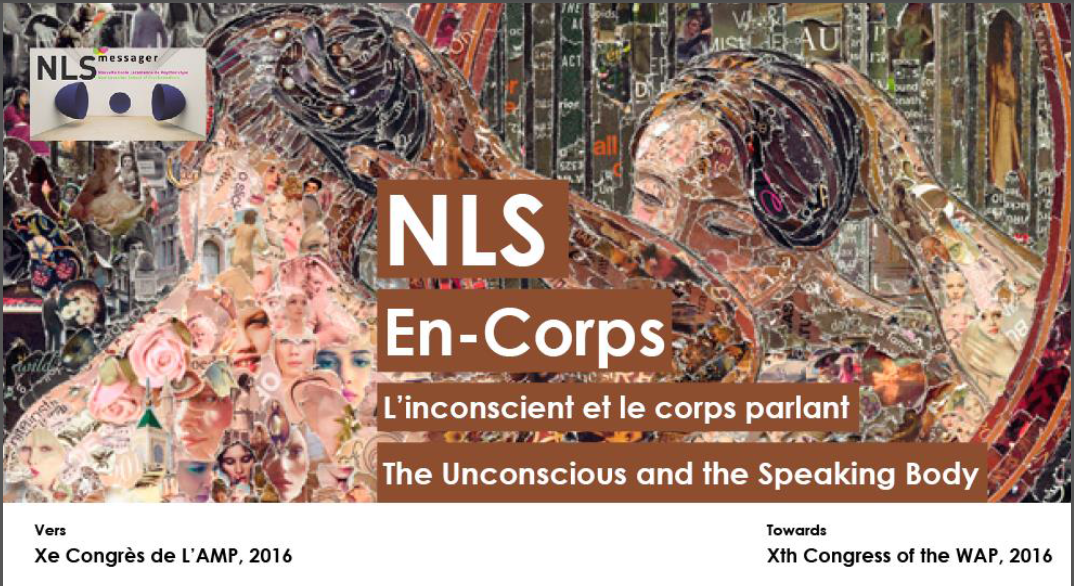
PROGRAMME ET COLLAGE SURRÉALISTE
Communiqué du Xème Congrès de l’AMP
Nous avons le plaisir de vous communiquer que le programme du
Xème Congrès de l’AMP est établi et peut être consulté dans le
site du Congrès. Pour le consulter et/ou l’enregistrer il suffit
de cliquer ici :
www.congressoamp2016.com
Le programme est actuellement en portugais, français et
espagnol, il va bientôt être mis en anglais et en italien. Il
peut également être téléchargé au format PDF.
En le lisant vous allez constater que le programme traduit une
convergence de travail de notre communauté et s’annonce riche et
prometteur.
Nous avons reçu 246 contributions pour la Journée Clinique. Nous
remercions chaleureusement les collègues qui ont décidé de faire
part de leur clinique pour bien-dire comment s’analyse le parlêtre
aujourd’hui. Le Comité Scientifique a été obligé de choisir les
contributions en fonction de leur adaptation au thème du Congrès
et à leur précision. Nous regrettons ne pas avoir pas pu
accepter qu’une partie des propositions.
Enfin, nous vous rappelons d’amener vos “pièces détachés”; des
petits objets de votre choix. Nous en ferons, dans le lobby de
l’hôtel, un grand collage surréaliste, selon les lignes de
l’affiche du Congrès, donnant corps à notre Rencontre.
Bien cordialement,
Marcus André Vieira – Directeur du Xème Congrès
Miquel Bassols – président du Xème Congrès


|
|
|
Fáilte go dtí “an Seisiún”, Imeacht Sóisialta na hÉireann ar NLS 2016

|
New Lacanian School Nous contacter: nls-messager-help@amp-nls.org Nouvelle inscription: https://amp-nls.org/page/fr/42/sinscrire-nls-messager | Le site de la NLS www.amp-nls.org | |
New Lacanian School New registration: https://amp-nls.org/page/gb/42/sinscrire-nls-messager | The website of the NLS www.amp-nls.org | |

|
New Lacanian School Nous contacter: nls-messager-help@amp-nls.org Nouvelle inscription: https://amp-nls.org/page/fr/42/sinscrire-nls-messager | Le site de la NLS www.amp-nls.org | |
New Lacanian School New registration: https://amp-nls.org/page/gb/42/sinscrire-nls-messager | The website of the NLS www.amp-nls.org | |
|
New Lacanian School Nous contacter: nls-messager-help@amp-nls.org Nouvelle inscription: https://amp-nls.org/page/fr/42/sinscrire-nls-messager | Le site de la NLS www.amp-nls.org | |
New Lacanian School New registration: https://amp-nls.org/page/gb/42/sinscrire-nls-messager | The website of the NLS www.amp-nls.org | |