“From the moment that norms are diversified, we are in the era of
ordinary psychosis.
Ordinary psychosis is coherent with the time of the Other which does not
exist.” J.-A.Miller, The Antibes Convention
AUDIO OF THE
PRESENTATION HERE
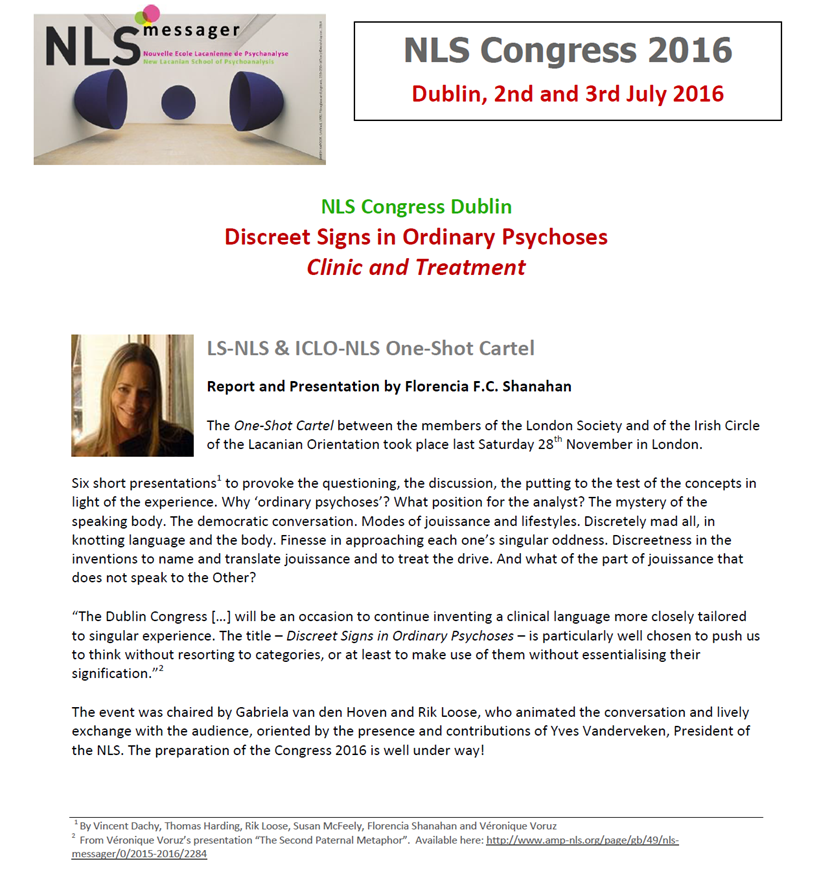
3rd July
2016
Discreet Signs in Ordinary
Psychoses
Clinic and Treatment

2016
180 euro, after
Students (- 26 years old): 70 euro
90 euro, after 1st March 2016
Congress Time:
Saturday 9am – 6pm, Sunday 9am – 3pm.
Party/Dinner on Saturday evening: 50
euro
Payment can be
made in three ways:
1 – Secure
on-line payment by credit card via ogone – https://amp-nls.org/page/gb/211/registration
2 – Payment by
bank transfer (from EU countries only)
IBAN: BE38 0014
5620 0372, BIC: GEBABEBB
BNP Paribas
Fortis, Agence Albertlaan, Ghent.
3 – Payment by
cheque (French cheques only).
Payable to the
NLS and sent to Lynn Gaillard, 333 rue de la Vie
Dessus, 01170
Echenevex, France.
|
New Nous contacter: nls-messager-help@amp-nls.org Nouvelle inscription: https://amp-nls.org/page/fr/42/sinscrire-nls-messager | Le site de la NLS www.amp-nls.org | | Agenda en ligne – Cliquez ici |
New New registration: https://amp-nls.org/page/gb/42/sinscrire-nls-messager | The website of the NLS www.amp-nls.org | | On-line calendar – Click |

Psychoanalytic Notebooks
Special Iss
 ue 30
ue 30


|
New Lacanian School envoyez un Nous contacter: nls-messager-help@amp-nls.org Nouvelle inscription: https://amp-nls.org/page/fr/42/sinscrire-nls-messager | Le site de la NLS www.amp-nls.org | | Agenda en ligne – Cliquez ici |
New Lacanian School by sending a New registration: https://amp-nls.org/page/gb/42/sinscrire-nls-messager | The website of | On-line calendar – Click here |

Knottings
Seminar of the NLS – Tel Aviv:
“Discreet Signs in Ordinary Psychoses. Clinic
and Treatment"
By Malka
Shein member of the GIEP-NLS
The seminar
was held at Beit Zionei America at the center of lively Tel Aviv, on 19th May 2015.
The opening
remarks were given by Jacques Borie, a member of the ECF and the NLS; three clinical
presentations by: Lynn Gaillard, NLS and Asreep member, Anne Edan, Asreep
member and Yair Zivoni, GIEP member. Susana Huler and Marco
Mauas, members of NLS-GIEP concluded the seminar with some remarks about ordinary psychosis.
Jacques
Borie in his lecture entitled "To take interest
in small things" argued that ordinary psychosis is not about delusion or
hallucination; it has to do with small and discreet signs and signals. Ordinary
psychosis marks the end of differential diagnosis by classification. The
passage from the logic of articulation to the other logic of a sign turns
directly to a certain subject. No more meaning leaning upon articulation but
elementary phenomenon, which touches the body as well as language. As
opposed to the psychoanalytic tradition that approaches from the meaning of
things, emphasis is now on how to get along with it, and on the multiple
variations of language, and it has a linkage to quantity. With classic Lacan we
thought about the name of the father as universal. Ordinary psychosis teaches
that the function of the name of the father is actually what most escapes from
the universal, the function of the name of the father did not disappear but has
to be thought of as the most intimate, almost impossible to be interpreted. Maybe
the most real. The psychoanalyst, said Jacques Borie , must become the
subjects' partner, an active partner who searches and emphasizes details and
incarnates in presence the function itself. The problem in our era is the
unstable status of jouissance. What means that in our practice we should focus
not on meaning but on the use.
Three
clinical presentations:
Lynn Gaillard presented an adolescent analysand for whom some life events sealed
the foreclosure of the name of the father.
Through a particular sport she creates a body for herself whereby the partner functions as
the stopper of castration. When her solution fails, a set of circumstances brings on
panic attacks. During analysis, interpretations of meaning fall into the hole
and Lynn accompanies and follows her in her search to build herself around the
hole.
Anne Edan presented a teenager at risk. She was
hospitalized at a crisis center for adolescents in Geneva by her mother who was worried
by her anorexia. Anne reported
about various questions which arose during hospitalization: curing the anorexia
caused a diminishing in the taste for life, questions of diagnosis based on
discreet signs, remarks about direction of the treatment and the articulation of what
can be offered to her by the psychoanalyst, which included also a stopping
point, the only one possible for the subject.
Yair Zivoni presented a case of a psychotic
subject. Yair attributes therapeutic effects to his position as related to
love. Yair said: "I didn’t feel I have a lot to give him, except for
telling him: yes". A father as such
is a father of love he says. (In Hebrew the word father includes the letters of
the word love א(ה)ב(ה) )
2 remarks
about ordinary psychosis.
Susana Huler pointed out changes in methods of working with
psychosis in the Freudian field and demonstrated it with clinical vignettes.
She argued that with Lacan's introduction of the two tools of the Borromean knots
and the sinthome and J-A Miller's explanation of how these tools are linked to lalangue,
the Freudian field had begun working with psychosis in a significantly new way.
As to the question raised in the 1990s with members of the clinical section in
Angers, France, whereas clinical practice with 'neo-psychosis' generated a
'neo-stance' for analysts or had the analysts' 'neo-stance' generated a
'neo-transference' with psychosis? She argues it’s very hard to answer but no
doubt everything had changed. The search for the non-existent
coming-up-against-the-one-father event was then set aside in favor of listening
for disconnections, for the dropping of identifications and for particular
physical phenomena. The psychoanalytic function is to provide shelter to the
homeless, a guest with respect to discourse, moreover, who has brought a
gift, the invention he has brought with him. She also said that one of the
great virtues of the Lacanian field's deep study into common psychosis is that
it not only it enables us to offer a psychoanalytic response to those others who
ask for analysis who are not neurotics, but it also enables us to update our
mode of work to the needs of our new era.
Marco Mauas outlined the history of psychoanalysis in terms
of a shift from phenomenology to structure and back to phenomenology. With
respect to the first staff meeting of the Arabic-Hebrew center for children and
their others in Haifa, Marco quoted Miller's suggestion to the c.p.c.t. :
"to emphasize phenomenology, in the direction of Clérambault, and to
restrain pressure and expectations towards diagnosis". Marco found this very useful together with
another remark by Miller when he mentioned a seminar he gave at the ECF
about the ordinary psychosis of the Wolf-man: "for a year some argued that he
was neurotic, and others argued he was psychotic, my pleasure was to keep that on
hold, because the question aroused great interest and interesting remarks from my
colleagues". Marco found in that the same analytic formation effect as
caused by the question-hole: "what is a psychoanalyst"?
|
New Lacanian School envoyez un Nous contacter: nls-messager-help@amp-nls.org Nouvelle inscription: https://amp-nls.org/page/fr/42/sinscrire-nls-messager | Le site de la NLS www.amp-nls.org | | Agenda en ligne – Cliquez ici |
New Lacanian School by sending a New registration: https://amp-nls.org/page/gb/42/sinscrire-nls-messager | The website of | On-line calendar – Click here |

The second paternal metaphor
Veronique
Voruz
In
his closing address at the NLS Congress in Tel Aviv, Psychosis, or Radical Belief in the
Symptom[i],
Éric Laurent poses the necessity for psychoanalysis to invent other ways to
speak of psychosis in light of the generalization of the psychotic effort to
all. As an effect of this generalization, he says that: “the day will likely
come when the word ‘psychosis’ will be so out of sync with the spirit of the
times that instead we will be speaking in terms of ordinary delusions”.[ii]
In other words, psychoanalytic theory will increasingly be moving towards a continuist clinical approach – as Yves
Vanderveken outlined in his intervention towards the next NLS Congress last
month here in London.[iii]
In
this brief intervention, I wanted to speak about the second paternal metaphor
because I think that if, in his 2012 paper, Laurent re-introduced this concept,
formalised by Jacques-Alain Miller in his 1985-6 course Extimité, it is so that we may use it to
support our effort to move towards the continuist clinical approach on our
horizon. But before, I would like to make a few clarifications.
A
few preliminary points
- What
is this psychotic effort said to be generalized?
It
is the effort that we each have to make to treat the drive and phenomena of
jouissance beyond what is ready-made for this purpose in civilisation. Such
treatment can take place either by making use of the Name-of-the-Father or
through the symptom: repression or formal envelope.
-
Why
this generalization?
The
curbing of jouissance is what is at stake in civilization – to the extent that
humanity can be defined as a conflict
between jouissance and the law[iv]
– but our civilization is prey to the paradoxical logic of the superego. A
central working hypothesis in our orientation is that the incitement to
jouissance characteristic of the capitalist discourse, a discourse in which the
only universal identification available is that of consumer[v],
has for correlate addiction as a mode of relation between a subject and any
object (x): addiction is a mode of relation between subject and object specific
to our times, to the extent that it refers to the generalized inability for a
subject to not consume a given object (x).[vi]
The rise of addiction as the main contemporary form of the symptom has to be
correlated to the dissolution of the bond between S and s, which has been commented by Miller
and Laurent in many places.[vii]
The effect of this dissolution is the weakening efficacy of truth in treating
the real.
These
two elements constitute the background for our clinical work: addiction as a
mode of relation between $ and a, and
the averred status of all discourses as semblant, with the disorientation that
ensues.
Adjusting
the theory of our praxis
So
we need to adjust our theoretical apparatus for two reasons.
-
First,
we need to account for what we have called in our field the emergence of
‘ordinary psychosis’.[viii]
The coining of this signifier is an epistemic[ix]
move by Jacques-Alain Miller designed to gather up unclassifiable cases under
a single term and to define our “research project”, as Éric Laurent put it in
Tel-Aviv. For my part, I think this term is essentially a stepping stone on
our journey to try and speak more precisely about the changing effects of
subject produced by the matrix of our civilization[x],
and in a way that circumscribes the real more closely. The Dublin Congress
will be particularly important in this respect; it will be an occasion to
continue inventing a clinical language more closely tailored to singular
experience. The title – Discreet Signs
in Ordinary Psychoses – is particularly well chosen to push us to think
without resorting to categories, or at least to make use of them without
essentialising their signification.
-
Second,
because the question of the necessarily singular treatment of one’s jouissance
has become key for all. To the extent that the Name-of-the-Father could be
considered a ready-made solution, even when it operates, it appears to no
longer be sufficient for most individuals to lead a pacified existence.
The
treatment of jouissance by language
Central
to the question of the subject’s treatment of jouissance is Lacan’s invention of
the paternal metaphor, which refers to the metaphorisation of jouissance by the
Other of the signifier, and so to its transformation into desire. We could think
that the paternal metaphor is a concept that belongs to the binary clinic
Neurosis/Psychosis because it is Lacan’s formalization of the Freudian invention
of the Oedipus complex, and that it should therefore be of the past. Or we could
take Jacques-Alain Miller’s lead in his text on the speaking body[xi],
and work with the idea that concepts need to be constantly woven anew in
psychoanalytic theory (this is Miller’s own choice: to metaphorise the term unconscious by that of speaking body). And so with the paternal
metaphor: the concept can be actualized and be used in the continuist perspective. Thus in Psychosis, or Radical Belief in the Symptom,
Éric Laurent proposes a simplified formulation of the second paternal
metaphor, developed by Jacques-Alain Miller in Extimité. Miller’s argument in Extimité in complex and I haven’t had
the time to work through it sufficiently for today but I hope we can place it on
our agenda for the Congress. I will just say a few words to open up the
question.
The
first paternal metaphor: the historical step of monotheism
In
Extimité Jacques-Alain Miller is
trying to articulate jouissance with the Other of the signifier. For this
purpose, the paternal metaphor is obviously a crucial concept. Addressing the
question of what of Judaism is present in Freud, Miller specifies that it is not
the father, but the function of the
father, which is present in both Freud and Judaism. Miller historicizes the
emergence of this function with regards to religion: “the emergence of paternal
monotheism consumed the great maternal religion”.[xii]
Here he is referring to the prohibition by the Jewish religion of the orgies and
sexual rites that were practiced in order to access the divine by polytheistic
religions, as a way of establishing the existence of the Other as Other of
jouissance. By extension, “what Lacan called the paternal metaphor is exactly
that: the Name-of-the-Father coming to metaphorise the desire of the Mother.”
Implicit in Jacques-Alain Miller’s elaboration of the “historical step of
monotheism” is the double status of the Other. The Other of the signifier
metaphorises the Other of jouissance, and orders it by means of the phallus.
This is the formula of the first paternal metaphor as we know it:
NP
A
Phallus
To
put it more structurally, the paternal metaphor allows language “to house the
phenomena of jouissance”[xiii]
– this is written by Laurent A over J – by localising jouissance in the body,
delineating phallic zones. In this perspective, what we call psychosis is the
failure of language to do so: there is, then, a delocalization of jouissance to
non-phallic zones.
But
from the perspective of the second paternal metaphor, we can learn that this is
also the case for neurosis, because the Other in the second paternal metaphor is
inconsistent: this is what Lacan develops in Seminar X, arguing that A is divided by
J.[xiv]
The
second paternal metaphor
The
second paternal metaphor[xv]
is simplified by Laurent as follows: “it is language itself [which] takes charge
of the phenomena of jouissance”, bearing in mind however that, whereas the first
paternal metaphor implies a consistent Other metaphorising the Other of
Jouissance and transforming all of jouissance into phallic jouissance, the
second paternal metaphor implies an inconsistent Other, (barred A over J),
implying that not all of jouissance can
be metaphorised. All subjects have to deal with an irreducible remainder,
although to a lesser or greater extent of course:
The
second paternal metaphor is a generalisation from the singular psychotic effort
to the clinical field as a whole. From the psychotic subject we also have to
learn how the neurotic subject forms a language from his symptom, and that this
symptom stems from both the first and second paternal metaphors.[xvi]
[i]
Hurly-Burly 8, p.
243-251.
[ii]
Ibid. at
249.
[iii]
“Towards a Generalisation of
the Clinic of Discreet Signs”, published in NLS-Messager 1779.
[iv]
Miller, J.-A., « Rien n’est plus humain que le crime », Mental 21 : « L’humain est peut-être précisément le
conflit entre les deux versants de la Loi et la jouissance. », p.
10.
[v]
See the third lesson of L’Autre
qui n’existe pas et ses comités d’éthique,
1995-6, unpublished.
[vi]
As argued by Marie-Hélène Brousse in her introduction to issue 88 of La Cause du désir, http://addicta.org/2015/02/27/marie-helene-brousse-parle-de-lexperience-des-addicts/
[vii]
For example in L’Autre qui n’existe pas, op. cit.
[viii]
Miller J.-A. ed. (2005), La convention d’Antibes – La psychose ordinaire
(Paris: Agalma/Le
Seuil).
[ix]
Miller J.-A. (2008), “Ordinary Psychosis Revisited”, Psychoanalytical Notebooks 19.
[x]
Miller J.-A. (2003), “Intuitions Milanaises [2]”,
Mental 12.
[xi]
Miller J.-A. (2014), “The Unconscious and the Speaking Body”, Hurly-Burly 10.
[xii]
Lessons of 29 January and 5 February 1986,
unpublished.
[xiii]
Laurent É., “Psychosis, or Radical Belief in the
Symptom”, op.
cit.
[xiv]
See also Miller J.-A., « Introduction à la lecture du Séminaire L’angoisse de Jacques Lacan », in La Cause freudienne 58 and 59.
[xv]
Miller takes the second paternal metaphor from Lacan’s “Subversion of the
Subject”.
[xvi]
Laurent É., ibid. p.
247.
3rd July
2016
Discreet Signs in Ordinary
Psychoses
Clinic and Treatment
Congress: 140 euro, until 1st March
2016
180 euro, after
Students (- 26 years old): 70 euro
90 euro, after 1st March 2016
Congress Time:
Saturday 9am – 6pm, Sunday 9am – 3pm.
Party/Dinner on Saturday evening: 50
euro
Payment can be
made in three ways:
1 – Secure
on-line payment by credit card via ogone – https://amp-nls.org/page/gb/211/registration
2 – Payment by
bank transfer (from EU countries only)
IBAN: BE38 0014
5620 0372, BIC: GEBABEBB
BNP Paribas
Fortis, Agence Albertlaan, Ghent.
3 – Payment by
cheque (French cheques only).
Payable to the
NLS and sent to Lynn Gaillard, 333 rue de la Vie
Dessus, 01170
Echenevex, France.
|
New Nous contacter: nls-messager-help@amp-nls.org Nouvelle inscription: https://amp-nls.org/page/fr/42/sinscrire-nls-messager | Le site de la NLS www.amp-nls.org | | Agenda en ligne – Cliquez ici |
New New registration: https://amp-nls.org/page/gb/42/sinscrire-nls-messager | The website of the NLS www.amp-nls.org | | On-line calendar – Click |

la NLS
Activities of the Societies and
Groups of the NLS

|
New envoyez un message à Nous Nouvelle inscription: https://amp-nls.org/page/fr/42/sinscrire-nls-messager | Le | ici |
New Lacanian School by sending a message New | | here |

la NLS
Groups of the NLS

|
New envoyez un message à Nous Nouvelle inscription: https://amp-nls.org/page/fr/42/sinscrire-nls-messager | Le | ici |
New Lacanian School by sending a message New | | here |

la NLS
Activities of the Societies and
Groups of the NLS

|
New envoyez un message à Nous Nouvelle inscription: https://amp-nls.org/page/fr/42/sinscrire-nls-messager | Le | ici |
New Lacanian School by sending a message New | | here |

Newsletter


|
New Lacanian School envoyez un Nous contacter: nls-messager-help@amp-nls.org Nouvelle inscription: https://amp-nls.org/page/fr/42/sinscrire-nls-messager | Le site de la NLS www.amp-nls.org | | Agenda en ligne – Cliquez ici |
New Lacanian School by sending a New registration: https://amp-nls.org/page/gb/42/sinscrire-nls-messager | The website of | On-line calendar – Click here |
|
New envoyez un message à Nous Nouvelle inscription: https://amp-nls.org/page/fr/42/sinscrire-nls-messager | Le | ici |
New Lacanian School by sending a message New | | here |

Newsletter


|
New envoyez un message à Nous Nouvelle inscription: https://amp-nls.org/page/fr/42/sinscrire-nls-messager | Le | ici |
New Lacanian School by sending a message New | | here |