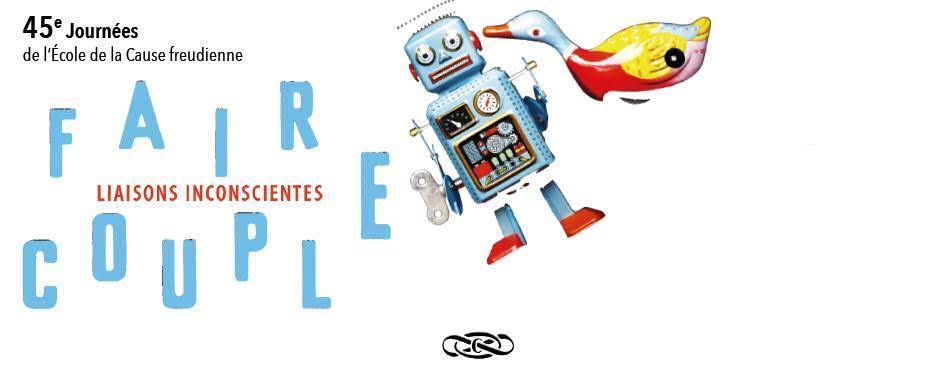
Quick-fire Questions and Answers for the
Simultaneous Sessions
For
the opening of each of the simultaneous sessions on Saturday, the 14th
of November, two psychoanalysts will participate in a round of quick-fire
questions and answers [Tac au Tac].
The
pair will engage with an idea extracted from psychoanalytic literature or from
modernity.

Why
do you want to marry?
Carole Dewambrechies-La Sagna, Gil Caroz
Isn’t
marriage sometimes just a love that passes unawares?
What
remains of the bourgeoisie?
Agnès Aflalo, Jean-Daniel Matet
The
bourgeoisie in all its states in the 21st century.
Bachellor
ethics
Clotilde Leguil, Hervé Castanet
From
primitive Christianity to contemporary figures.
Chatting
up
Deborah Gutermann-Jacquet, Bruno De Halleux
Is it an
art? What is it that hooks a woman? A man? And the love therein?
Girls
in twos, boys in gangs
Marie-Hélène Brousse, Laurent
Dupont
«For
boys, hard-on required», not so simple… For girls, ardent narcissistic-love
followed by a split.
"My
child, my sister"
Sonia Chiriaco, Jean-Louis
Gault
"Sweet
to live with me/All alone, my child, my love? —" Tamara de Lempicka and her
daughter, Kizette.
"’I
two myself’ – and how to conjugate it…"
Nathalie Jaudel, Philippe La Sagna
The
inaccessible twosome: so don’t screw-up being three!
Libertines @ swingers . com [échangistes
. com]
Serge
Cottet, Bénédicte Jullien
The
libertines of today: Swapping one for another. Swinging: a shared perversion?
Donjuanism
will be feminine or it won’t
Catherine Lazarus-Matet, Philippe Hellebois
Dona
Elvire and Don Juan speak of Lacan, of Freud, and of some others…
Are
you fusional?
Laure Naveau, Pierre-Gilles Guéguen
The
exigency of fusion, the search for liberty. The one is fusional, the other not:
Francis Bacon, Georges Dyer
Everyone
is looking for their other half
Virginie
Leblanc, Philippe Lacadée
Two
bodies become one, but which one of the two ? (Oscar Wilde)
"Two pigeons were deeply in love"
Dominique
Miller, Damien Guyonnet
How to
take it up? Boredom, the quest for elsewhere? Two threats, two solutions ?
Autoeroticism,
is it erotic?
Lilia Mahjoub, Armand Zaloszyc
The case
Florrie (Havelock Ellis). The function of the Other in the drive.
A
common place:"Doing
everything as long as nothing is said"
Laura Sokolowsky, Daniel
Roy
Doing
everything, saying everything, two impossibles: two edges of a real which make
and unmake a couple?
Being
bored, arguing
Francesca Biagi-Chai, Pierre Naveau
I am Emma
Bovary and I speak to you of boredom. Molly Bloom detests long disputes in bed.
The
unfaithful woman
Esthela Solano-Suárez, Éric Zuliani
Does she
exist? The function of deception and the embrace.
The
two of us against all the rest
Philippe De Georges, Hélène Bonnaud
The
affair of Russier, the parents Lambert, Beate and Serge Klarsfeld…
The
analysts of my life
Dominique
Laurent, Pierre Stréliski
Truth/Real:
The only worthwhile couple.
Care
providing institutions that create links
Jacqueline Dhéret, Jean-François Cottes
When
transference happens at these places, creating a supporting link…
"We
won’t grow old together"
Rose-PauleVinciguerra, Camilo
Ramirez
The
rupture as revealer, for women, for men. New
Modalities of separation…
United
by crime
Dalila Arpin, François Leguil
Couples
who commit crimes, crimes which creates couples..
Instruments,
machinesand
other partners.
Sophie Marret-Maleval, Rodolphe
Adam
Partners
of the subject? Let’s see with Dickens, Vian, Lacan, Lucrèce, Joaquin
Phoenix…

|
New envoyez un message à Nous Nouvelle inscription: https://amp-nls.org/page/fr/42/sinscrire-nls-messager | Le | ici |
New Lacanian School by sending a message New | | here |


|
New envoyez un message à Nous Nouvelle inscription: https://amp-nls.org/page/fr/42/sinscrire-nls-messager | Le | ici |
New Lacanian School by sending a message New | | here |
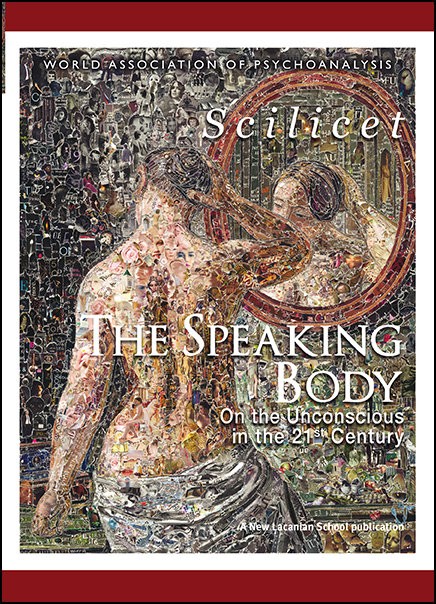
"The Speaking Body. On the Unconscious in the 21st Century"
“What exactly is a speaking body? What makes a body human is indeed that it isa speaking body. The term “speaking” here is not an adjective that would complete a predefined noun, the body, by adding to it the act of speaking. The common error made by psychology is to think that speech is a cognitive function of the body, an acquired behavior, although it is supported in an innate way within a profound structure of the organism. This is not the case. Neither speech nor language is reducible to cognitive functions, since these functions, considered as organic functions, depend on the already a priori relation of the subject to the signifier, to the structure of language, which precedes him as body and as being that speaks. Hence, a language is not learned, it is transmitted by the experience of jouissance which touches the body of the image. “Speaking” functions also in the expression “the speaking body” as an active participle or present participle, equivalent in some cases to the gerund. This doesn’t mean that a being exists there a priori, to which the property of speaking is added. It means that this being, as Lacan points out several times, is a being only to the extent that he speaks. In the same way, we must also point out that this being is only able to have a body insofar as he speaks, insofar as he is speaking or spoken.”
Miquel Bassols
The psychoanalysts of the World Association of Psychoanalysis welcome one by one living bodies, hurt by the bewilderment or the debility forced by the discourses in which they are immersed. In this volume, which borrows its form from the dictionary, they decant their experience in order to make the speaking body resonate: Anatomy, Androgyny, Cosmetics, Exhibition, Lacanian Unconscious, Jouissance, Obesity, Ill-treatments, Pornography, Segregation, Selfies….
Psychoanalysis tends to make possible for each, according to one’s singularity, the invention of an alliance between one’s body and the resources of speech against the worst.
Ève Miller-Rose
Contents
FOREWORD – Scilicet, The Speaking Body of the WAP– Miquel Bassols 15
PRESENTATION – Scilicet of the Speaking Body – Marcus André Vieira 21
ORIENTATION – The Unconscious and the Speaking Body –
Jacques-Alain Miller 27
A
Amur – Maurizio Mazzotti (slp) 43
Anatomy – Adriana Meza (nel) 46
Androgyny – Luis Fernando Carrijo da Cunha (ebp) 49
Art-gueil – Francisco-Hugo Freda (ecf) 52
B
Baroque – Patricia Moraga (eol) 55
Beautiful / Ugly – Florencia Fernández Coria Shanahan (nls) 58
Bits of the Real – Paula Kalfus (eol) 61
Body Art – Marisa Morao (eol) 64
Body Image / Imaginary Body – Alfredo Zenoni (ecf) 67
C
Castration (and Parlêtre) – Corinne Rezki (ecf) 70
Celebrity – Antonella Del Monaco (slp) 73
Child’s Body – Neus Carbonell (elp) 76
Coming Out – Grace Tarpey (nls) 79
Corporisation. The Mystery of the Body that Speaks – Blanca Sánchez (eol) 82
Cosmetics – Gabriela Basz (eol) 85
D
Dasein (and Copulation) – Manuel Férnandez Blanco (elp) 88
Defence – Maria Arminda Brinco de Freitas (ecf) 91
Delusion – Andrés Borderias (elp) 94
Drive and Speaking Body – Marisa Chamizo (eol) 97
Dupery (Necessary) – Dominique Laurent (ecf) 100
E
Ego (and the Body) – Cecilia Gasbarro (eol) 103
Ego Ideal / Ideal Ego (and Speaking Being) – Viviana Berger (nel) 105
Enjoying Substance – Laura Arciniegas S. (nel) 109
Escabeau (and Schoenberg) – Carlos Rossi (eol) 112
Escabeau / S.K.beau (and Duchamp) – Hervé Castanet (ecf) 115
Event (and Jouissance of the Body) – Sergio Caretto (slp) 118
Excess – Francis Ratier (ecf) 121
Exhibition / Pornography – Jean-Luc Monnier (ecf) 124
F
Fantasy (Window – Screen) – Victoria Horne-Reinoso (ecf) 127
Feminine Jouissance and the Woman’s Body – Céline Menghi (slp) 130
Fitness (Taking Care of the Body) – Rosane da Fonte (ebp) 133
Fixation, Repetition, Reiteration – Adrián Scheinkestel (eol) 136
Flesh and Merleau-Ponty – Éric Zuliani (ecf) 139
Formal Envelope – Frank Rollier (ecf) 142
Fragmented Body – Eduardo Suárez (eol) 145
Freudian Unconscious – Marta Serra Frediani (elp) 148
G
Gaze – Deborah Gutermann-Jacquet (ecf) 151
I
I Think Therefore It Enjoys (and Descartes) – Yves Vanderveken (nls) 154
Id (and Parlêtre) – José Fernando Veláquez (nel) 157
Ill-Treatments – Oscar Reymundo (ebp) 160
Imaginary – Massimo Termini (slp) 163
Inhibition – Joaquín Caretti Ríos (elp) 166
Interpretation and Body Event – Inés Sotelo (eol) 169
Intimacy – Jorge Assef (eol) 172
Invention and Sinthome – Charles-Henri Crochet (ecf) 175
J
Jouissance of the Body – Nora Pessoa Gonçalves (ebp) 178
Joyce (Sinthome and Escabeau) – Domenico Cosenza (slp) 181
L
L’Une-bévue – Henri Kaufmanner (ebp) 184
Lacanian Unconscious – Carlos Augusto Nicéas (ebp) 187
Lalangue – Camilo Ramirez (ecf) 190
M
Mass Individualism (and Segregation) – Félix Rueda (elp) 193
Masturbation – Darío Galante (eol) 196
Mental (and Debility) – Rosa Elena Manzetti (slp) 199
N
Name of Jouissance – Danièle Lacadée-Labro (ecf) 202
Narcissism (in the 21st Century) – Adriana Testa (eol) 205
Nudity – Amanda Goya (elp) 208
O
Obesity – Cristina Drummond (ebp) 211
Objects Outside the Body – Sonia Mankoff (eol) 214
One-Body – Esthela Solano-Suárez (ecf) 217
Oracle – Kuky Mildiner (eol) 220
Organs and Organism – Alain Merlet (ecf) 223
Orgasm – Anne Béraud (nls) 226
P
Parlêtre (and Unconscious) – Rose-Paule Vinciguerra (ecf) 229
Pass and Escabeau – Jacqueline Dhéret (ecf) 232
Père-versions – Sophie Gayard (ecf) 235
Perversion and Speaking Body – Diana Campolongo (eol) 238
Phallus and Phallic Jouissance – Stella Jimenez (ebp) 241
Pleasure – Elida Ganoza (nel) 244
Pornography – Paola Francesconi (slp) 247
Privacy – Àngel Sanabria (nel) 250
Prohibition / Permission – Ana Ricaurte (nel) 253
Psychosomatics – Maria do Carmo Dias Batista (ebp) 256
R
Rims of the Body – Ana Simonetti (eol) 259
S
Segregation of Bodies: On Pornography – Diana Bergovoy (nls) 262
Selfie – Juan Felipe Arango (nel) 265
Semantic Vacuity (and Hegel) – Carlos Márquez (nel) 268
Semblants (the Failure of) – Patricia Tassara (elp) 271
Sex Toy – Marco Focchi (slp) 274
Sexual Identity – François Ansermet (nls) 277
Sexual Learning – Veronique Voruz (nls) 280
Speaking Body / Parlêtre – Antonio Di Ciaccia (slp) 283
Spectacle – Adriana Laión (eol) 286
Specular Image – Mónica Pelliza (nel) 289
Speech (and Jouissance of Speech) – Réginald Blanchet (nls) 292
Surplus Jouissance – Manuel Montalbán Pereguín (elp) 295
Symptom of Another’s Symptom – Lucia D’Angelo (elp) 298
Symptom of the Parlêtre – Raffaele Calabria (slp) 301
T
Tattoos / Piercings – Leticia A. Acevedo (eol) 304
Technique (the Empire of) – Luiz Henrique Vidigal (ebp) 307
Transference and Body – Bernard Seynhaeve (ecf) 310
Transparency – Vera Avellar Ribeiro (ebp) 313
V
Very Last Teaching – Margarita Álvarez (elp) 316
Virtual Image – Ennia Favret (eol) 319
Voyeur – Maria Marciani (eol) 322
W
Weaker Sex (The)? – Stella Harrison (ecf) 325
****
in order to communicate the words and the spirit of more than 85 texts
written in French, Italian, Spanish and Portuguese into English.
Janet
Haney, Joanne Conway, Roger Litten, Carmen Navarro Nino and Sabrina di
Cioccio assured the coordination of the translation teams for each of
these languages.
We would like to thank each and everyone who contributed to the English version of Scilicet.
We hope that the result will be like Vik Muniz's
painting: a work of art made by a lot of precious pieces.
Despina Andropoulou
|
New Lacanian School Nous contacter: nls-messager-help@amp-nls.org Nouvelle inscription: https://amp-nls.org/page/fr/42/sinscrire-nls-messager | Le site de la NLS www.amp-nls.org | | Agenda en ligne – Cliquez ici |
New Lacanian School New registration: https://amp-nls.org/page/gb/42/sinscrire-nls-messager | The website of the NLS www.amp-nls.org | On-line calendar – Click here |

la NLS
Groups of the NLS

|
New envoyez un message à Nous Nouvelle inscription: https://amp-nls.org/page/fr/42/sinscrire-nls-messager | Le | ici |
New Lacanian School by sending a message New | | here |


|
New Nous contacter: nls-messager-help@amp-nls.org Nouvelle inscription: https://amp-nls.org/page/fr/42/sinscrire-nls-messager | Le site de la NLS www.amp-nls.org | | Agenda en ligne – Cliquez ici |
New New registration: https://amp-nls.org/page/gb/42/sinscrire-nls-messager | The website of the NLS www.amp-nls.org | | On-line calendar – |


€ 120,–/€ 80,- for students – Lacanfeld
Österreich – IBAN: AT88 3468 0000 0302 9832 – BIC: RZOOAT2L680
Translations to
German, English and French
Lunch and beverages included
Registration via
homepage www.lacanfeld.at
or via email to Lacanfeld@gmx.net
Registration
valid after payment in advance
participants from non EU-countries can pay
cash
|
New envoyez un message à Nous Nouvelle inscription: https://amp-nls.org/page/fr/42/sinscrire-nls-messager | Le | ici |
New Lacanian School by sending a message New | | here |
|
| |
| |
|
|

| |
|
|
| |
|
|
| |
|
|
| |
|
|
| | | |
| |
|
|


| | | |
| |
|
|
| | | |
| |
|
|
| | | |
| |
|
|
| | | |
| |
|
|

| | | |
| |
|
|
| | | |
| |
|
|

| | | |
| |
|
|
| | | |
| |
|
|

| | | |
| |
|
|
| | | |
| |
|
|

| | | |
| |
|
|
| | | |
| |
|
|

| | | |
| |
|
|
| | | |
| |
|
|

| | | |
| |
|
|
| | | |
| |
|
|


| | | |
| |
|
|
| | | |
| |
|
|


| | | |
| |
|
|
| | | |
| |
|
|

| | | |
| |
|
|
| | | |
| |
|
|

| | | |
| |
|
|
| | | |
| |
|
|

| |
|
|
| |
|
|

| | | |
| |
|
|


| | | |
| |
|
|


| |
|
|
| |
|
|
| | | |
| |
|
|

| | | |
| |
|
|

| |
|
|
| |
|
|
| |
|
|
| |
|
|
| |
|
|
| |
|
|


| | | |
| |
|
|
| |
|

|
New Lacanian School Nous contacter: nls-messager-help@amp-nls.org Nouvelle inscription: https://amp-nls.org/page/fr/42/sinscrire-nls-messager | Le site de la NLS www.amp-nls.org | | Agenda en ligne – Cliquez ici |
New Lacanian School New registration: https://amp-nls.org/page/gb/42/sinscrire-nls-messager | The website of the NLS www.amp-nls.org | On-line calendar – Click here |

FOR
THE ‘KNOTTINGS’ SEMINAR OF THE HELLENIC
SOCIETY OF THE NLS–
ATHENS 19 SEPTEMBER 2015
Tsakos
crowded amphitheatre of “G. Gennimatas” Athens General
Hospital, the Hellenic Society of the NLS held the
“Knottings” seminar of the NLS, entitled “Discreet signs
in ordinary psychosis – clinic and treatment”, the
subject of the annual Congress of the NLS (Dublin 2-3
July 2016). The secretary of the NLS, psychoanalyst, and
president of the NLS Québec, Anne Béraud, took part,
next to psychoanalysts who presented clinical cases.
They were psychoanalysts and members of the NLS Luc
Vander Vennet, (Kring-Belgium), Dosia Avdelidi (Hellenic
Society- Greece), and Pamela King (Marseilles).
The
seminar started with the greeting and the introduction
by the president of the Hellenic Society, Anna Pigkou,
who spoke about the turn to the teaching of knotting in
Lacan’s later teaching, and continued with the
theoretical introduction by Anne Béraud, relevant to the
subject of the forthcoming congress of the NLS.
Anne
Béraud
started
by saying
that by the title JAM has suggested to us for the forthcoming
congress
puts us in immediate connection to our time and therefore
to our
clinic: there are numerous ways of jouissance
without exception, nor a master. In our practice we
encounter more
and more psychotics whose symptoms are not signified by
delirium or
delusions. The triggering
of
psychosis
might be very discreet or absent, the subjects can be lost
in the
“normality”. JAM, in order to address this mutation
suggested the
constitution “ordinary psychosis”, in the Congress of
Antibes in
1998. Ordinary psychosis insists in the singularity of the
knotting
there is for every subject. “Discreet signs” are a
peculiarity of
ordinary psychosis we ought to locate in our clinic.
It
concerns light disorders of speech or character, a
penetration of the
gaze, speech of others. Life is not articulated with the
life of
others, where something is grinding. The title of the
forthcoming
Congress also emphasizes treatment. There is a variety of
solutions
subjects find either by themselves or by their work with a
psychoanalyst.
first period in Lacan’s teaching, the clinic of the
Name-of-the-Father, is characterized by a logic which is not
continuous; structuralist; bipolar (neurosis, psychosis). The
Borromean clinic, the clinic of knotting is continuous. On the
one
hand, there is the clinic without knotting (psychosis), while
on the
other hand there is the clinic with knotting (neurosis,
ordinary
psychosis). The Name-of-the-Father is creating the knotting in
neurosis.
The
three orders/consistencies (RSI) are knotted thanks to a term
that
Lacan calls sinthome.
In the Discussion of Arcachon Miller is clarifying that the sinthome
is functioning as the “joint brace” of the other three circles
and produces the singularities of the knotting in each case.
In his
text “Ordinary Psychosis Revisited” Miller is using the term “a
compensatory make-believe of the Name-of-the-Father”.
This
is a special element which for every subject is functioning as
the
Name-of-the-Father. This element is occupying the central hole
in
psychosis and counterbalances it. Nevertheless, it is not
turning
into a Name-of-the-Father, even if the psychotic is appearing
in the
“suit of neurosis”. Knotting is lasting through the sinthome,
an invention of the subject which is set as equal to the
Name-of-the-Father. The second Lacanian theory from this point
of
view is not counterposed to the first: if it concerns a
psychosis we
must see of which kind it is (paranoia, schizophrenia,
melancholy).
The
clinic of ordinary psychosis is showing the presence of the
elementary
phenomenon.
S1’s cannot find S2 and they remain in an elementary
situation. In the
triggered psychosis the S2 is the delusional metaphor. The
matter in
ordinary psychosis is to find the non-articulated element and
its
usage by the subject. Ordinary psychosis is a clinic of “few
indications of the foreclosure” and we ought to look for those
indications.
Miller notes a threefold
externality – a social
externality,
a
bodily
externality
and a subjective
externality:
-
The
relation to the social: it concerns subjects who are incapable to
support their social function. But Miller is drawing our
attention that the people who have a very strong
identification with their social position might be the
same thing. The work becomes their own Name-of-the-Father.
-
The
relation to the body: something does not fit, the body is
decomposing. The subject “has need of something which can
tie the joint, so as to be able to be restrained to its
body”, “ to tie its body to itself”. Fashion is
socializing for the psychotics and defining the tattooing
or the piercing as a psychotic characteristic is an
element of exaggeration, that there is no limitation from
the –φ.
-
Subjective
externality: the idea the subject has of itself. How it
considers itself as a waste or the contrary. “It is the
experience of the emptiness, of a non dialectic
experience’s wave, with a special fixation of this
indication”. Miller is giving very precise
recommendations: “stability of identification (real and
not symbolic) with the object a as a waste”. A
possibility for the subject to defend to it by an extreme
mannerism.
Treatment
through the imaginary:
it concerns a type of adjustment with the non dialectic Other
who is
based on a “like the others”. It is at the same time a sign of
psychosis and its stabilization, through an imaginary
identification
with a similar based on the axis α
– α’.
This produces normalization.
Naming:
the subject is supported by the analyst for the work of naming
and
translating its jouissance.
To find “signs of communication where the Other is evacuated
from
its jouissance”,
so as to “joint brace” its being. That exact same meeting with
the analyst can form a sinthome.
a
body outside of the body:
Lacan is presenting the solution of Joyce as the following: he
is
creating a body for himself within a literary corpus. He is
creating
a jouissance
outside of his body. He produces his solution in an assignment
regarding the language outside meaning. He is creating a name,
an
ego, within his writing. Joyce is seeking to construct in his
work
“the uncrated spirit of his race/tribe”, which concerns a
construction of the Name-of-the-Father.
The
clinic of continuity is very pragmatic:
localization of the characteristic which stabilizes, to help
this
stabilization or to allow to the subject find another one. We
can
work on the basis of what was disconnected, in order to
reconnect the
subject. The arrangements that subjects find in therapy may
function
as a joint brace, even if things remain fragile, while the
work of
the analyst may help the subject, through transference, to
construct
a new one.
matter is not so much the decoding or interpretation but the
establishment of a construction and the support “of
knowledge’s
elaboration which has been disconnected from the truth of the
unconscious” and it is this that allows the knotting. The
matter is
for someone to be able to graft the private with common
language.
Sometimes therapy might be recommended as finding a way in
daily life
for the non-understandable and the enigma. Hence we must show
interest for the little things which bother the subject and
work is
recommended in a constant regularization.
Luc Vander
Vennet presented a case of a young woman, who wanted to
speak to him because of a depression after a series of
failures and unpleasant experiences. Abandonments and the
rejections set some questions, but the discreet sign of her
psychosis was the strange way she was dressed: a dress which
did not correspond to her age and the time of the year.
Speaking of her depression she has mentioned she even felt it
in her body, that she was cold.
There was always an
incongruity, a gap between the image that she was seeing
inside the mirror and the body she was feeling. This mismatch
revealed her psychosis. In this case we observe the
identification’s fixation with the object a as a waste, which
is not symbolic, but real. She materialized in a repetitive
way a reeallization (réellisation) of this identification. On
which sinthomatic knotting has she managed to hold on for a
great period in her life? She was an exception as a “good
student” which transfused an imaginary cover for her. She took
up artistic studies. It was a way for the gaze which was
fixated to her as a young girl to be exported. She penetrated
into an artistic environment and created in this way a new
family which respected her.
She came for analysis
after the rejection of her work by a committee, after the
dissolution of her sinthome. Thanks to analytical work and her
elaborations she managed to communicate again with her mother
and convince her to go together shopping to look, try, pick
and buy … clothes.
Avdelidi
presented a case of a young woman who has no fantasy or desire
to
orientate her. This young woman faces difficulties in the
subjective,
as well as in the social and bodily level. It is impossible
for her
to be part of the working network, a fact which causes her
anxiety
and sorrow. The experience of emptiness is not articulated and
her
identification to the object a
as waste is real. In the end, the crack in her body is
experienced as
anguished and unbearable; she cannot undertake it.
specific subject has
never had a positive symptom of psychosis, no elementary
phenomenon,
nor a delirium or delusions. Her difficulty is reduced to the
absence
of a fantasy that
would orientate her
existence and give her an intention and guidance.
Consequently, the
characteristics of the clinic of desolation – that is, the
subjective
vacillation, the latent presence of a threatening Other who
draws
jouissance
from the subject, and the dynamic which is alleging from the
support
of the familiar – is present in her case.
five years in therapy, she managed to find a job and handle
the
anxiety it was causing her. The Other seems to be less
enigmatic and
her daily life is less boring while she also deals with an
artistic
activity which she seems to like. Finally she managed to live
with
much less anxiety, by pulling aside more and more often the
demands
of the superego.
King
presented three cases which show the threefold externalities
(bodily,
social, subjective). The first
case is
showing the
bodily externality. It concerns a woman who wants to free
herself
form the “crises of bulimia” which last for many years. The
emptiness of her object a,
which is not
caught
in phallic meaning, returns to the real, escorted by the
severe
demand to look alike in the only image which she has from her
mother:
her absorbed cheeks. Instead of mourning, she is making a
passage to
the act through a first bulimic incident. Behind the horror of
getting fat, there is also the radical and persecutory gaze of
the
father. Something which has not been symbolized is returning
within
the image. This image is later eliminated from the body.
Despite
their catastrophic dimension, the bulimic crises allow a point
of
balance. This woman is featuring this point of balance by the
choice
of her profession: the act of filling and emptying is repeated
in her
profession -but not without a disaster. This is the point of
an
attempted retrieval of her body.
case which
shows
the social externality, concerns a mature woman. In late age,
she
wants to do a master’s research, to “legitimize” her
professional skills. We find out very shortly that this lack
of
“legitimacy” is touching her deeply: she has never received it
from her parents. She feels uprooted from the society and she
is
suffering from this. She claims that it is up to her to
legitimize on
her own. The feeling that she is in “exile” is the first
discreet
sign of ordinary psychosis. The second appears the moment she
starts
writing her dissertation. Research suits her. But to find
things by
writing is impossible. By the non-function of the
Name-of-the-Father,
she cannot write on behalf of her name. She produces nothing
but
fragments of writing. She is looking for legitimacy, which she
has
never received from her parents, from the symbolic-through the
university. For many years now, she is collecting newspaper
and
magazine articles on specific subjects. It seems that she is
holding
on fragments (pieces) of language.
case shows
the
subjective externality. It concerns a young student who has
failed
passing the semester by the same way: the moment comes before
the
exams and then she is panicking in front of the remaining
time. After
this, she starts negotiations with her teachers to retrieve
the
fragments of the missing grades. She gives the impression that
she is
taking a place of greatness regarding the Other. She tattooed
a
phrase in her body which means that a superior being is not
dealing
with insignificant matters. It is this exact phrase which
showed as a
sign, very discreet, of her psychosis. If we read it
backwards, it
concerns identification to the real with a waste, a nothing, a
less-than-a-unit. For years now she is not related to her
failure, on
the contrary, she remains fixated to the certain percentage
that she
is missing. This subjective externality is identification to
the
real, “since the subject is going to the direction of the
realization (materialization) of the waste in its face”. The
sessions in these years, produced a relief of her anxiety,
while the
symptoms, regardless their difficulties, are being used as a
sign of
stability (stabilization). After a dream this young woman will
erase
her tattoo to deal with the “insignificant” material of the
dream.
Argyris
Tsakos
|
New Lacanian School Nous contacter: nls-messager-help@amp-nls.org Nouvelle inscription: https://amp-nls.org/page/fr/42/sinscrire-nls-messager | Le site de la NLS www.amp-nls.org | | Agenda en ligne – Cliquez ici |
New Lacanian School New registration: https://amp-nls.org/page/gb/42/sinscrire-nls-messager | The website of the NLS www.amp-nls.org | On-line calendar – Click here |
CLINICAL STUDY DAYS 9
New York City
March 18-20, 2016
Much is made today of certain psychic trends or so-called epidemics in society–the rise of addiction, or depression, or autism, or inattention, and so forth—all
of which is frequently linked to changes in social structure–a culture of permissiveness, the decline of the father or authority structures, and the excesses of consumerism.
There is another no less prevalent, but more subtle dimension to these psychic changes–the fact that contemporary subjects are often not striving, desiring pleasure, in some sort of uncomplicated
fashion, such as the way in which happiness is measured in psychological or sociological rating scales, fulfilling the Declaration's 'pursuit of happiness.' Rather, that we see the subject driven by sets of imperatives, demands produced for sure in the social
world, but at the same time and ever yet more insidiously internalized and reworked as the demands of what, in older Freudian language, was referred to as the superego. Not a desire for some thing chosen by a subject, but a subject incessantly driven by a
force, a jouissance, out of control, without limits.
For this conference, we would like to map out these new forms of the demand and of the superego in the twenty first century. In what ways are we seeing the expression of this in the clinic?
In the ways in which suffering is articulated today, especially in young people? But, also, to consider as well the ways in which the demands of the external world–due to changes in the development of capitalism and in science–are experienced differently
by subjects. The role of gadgets and the development of the iHuman is certainly one dimension of this, but we should not ignore other dimensions of the way in which the organization of day to day life–take such disparate phenomena as social media and advertising,
or so-called helicopter parenting, the novel workplace life of Silicon Valley companies, increasing income inequality, or, the 24/7 demands for communication–are having an impact on the subject.
The Scientific Committee of the CSD9 invites you to present a case presentation at this meeting, where the theme of the Study Days “Must Do It”
should be addressed. Papers should be both at most 20 minutes long when read aloud and at most 15.000 characters with spaces in length.
Papers should be submitted not later than January 15, 2016. We appreciate your interest and collaboration on the Clinical Study Days, and we
are looking forward to receiving your papers and to seeing you in New York City.
Please send your texts to the CSD9 Scientific Committee at arenasalicia24@gmail.com
Scientific Committee
Alicia Arenas, Chair
Maria Cristina Aguirre
Juan Felipe Arango
Pierre-Gilles Gueguen
Liliana Kruszel
Thomas Svolos
Karina Tenenbaum
|
New Nous contacter: nls-messager-help@amp-nls.org Nouvelle inscription: https://amp-nls.org/page/fr/42/sinscrire-nls-messager | Le site de la NLS www.amp-nls.org | | Agenda en ligne – Cliquez ici |
New New registration: https://amp-nls.org/page/gb/42/sinscrire-nls-messager | The website of the NLS www.amp-nls.org | | On-line calendar – Click |