


Third ‘Saturday of the NLS’
Saturday 29 March the Kring voor Psychoanalyse receives:
JACQUES BORIE
Psychoanalyst in Lyon, member of the Ecole de la Cause freudienne, of the New Lacanian School and of the World Association of Psychoanalysis, coordinator of the Section Clinique in Lyon. He is author of Le psychotique et le psychanalyste published by Éditions Michèle (January 2012).
The lecture will be given in French, the clinical seminar will be partly in Dutch (the case presentation), partly in French (the conversation will be conducted by Jacques Borie). If necessary questions or remarks of participants will be translated ‘live’.
14h – 16h30: Lecture: Desire, the object and the Other
Lacan demonstrates with the construction of desire around the fundamental fantasy, that the subject is bound to an object and not only to a lack. It is already a place without the guarantee of the father in the Other. But what happens with the relation to the object in our era, in which the Other, doesn’t only fail, but is even inexistent?
The lecture is open to everyone.
17h00 – 18h30: Clinical Seminar
A member of the Kring presents a case. Jacques Borie will lead the conversation.
The clinical seminar can be attended subject to a prior conversation with and with the agreement of the responsible coordinators Geert Hoornaert ( hoornaert.geert@telenet.be) or Luc Vander Vennet (luc.vdvennet@skynet.be)
Lecture and presentation will take place in the ‘projectiezaal’ of the Zebrastraat, Zebrastraat 32, 9000 Ghent, Belgium.
Non-members pay a fee for their participation.
Report on the ICLO-NLS Seminar with Laure Naveau
Dublin, 8th February 2014
The
final clinical conversation of the ICLO-NLS calendar 2013-14 with
members of the WAP entitled “The Names of the Real in the 21st Century”
took place in St.Vincent’s Hospital Fairview on February 8th on the
topic ‘A Clinic of Love Disorder’ with Laure Naveau, AME of the ECF, and
WAP. Laure Naveau is a psychoanalyst in Paris where she teaches at the
Clinical Section of Paris- Ile de France.
The
theme of Laure’s presentation concerned the impact that the discourses
of capitalism and of science exert upon subjectivity – upon us as
lovers. Laure put forward the question of whether there is a kind of
capitalistic way of loving which has invaded the way in which people
love today. This question is not sentimental one. It neither harks back
to a former time of loving, nor does it long for an idealised future for
loving. Psychoanalysis is discourse which formalises the fact we can
speak about love in order to say that it doesn’t work out.
Citing the work of the sociologist Zygmunt Bauman in his book Liquid Love: On the frailty of Human Bonds 1 Laure
commented on how Bauman interprets the sexes’ new modes of partnership
in terms of consumerism and the market. Continuing from Freud, Bauman
speaks of a complex interrelationship between Eros and Thanatos in the
era of the capitalist’s discourse. This speaks of what is at stake in
love. Love relations have become liquid in the sense that the number of
love relations one has and their rapid obsolescence has taken centre
stage in the market place of love. We live in a culture of consumption, a
buy now discard later model in which everything has become disposable,
including people. This is marked, Bauman suggests, by a morbid –
suicidal – inclination, and according to the current model of
consumerism (ingestion-digestion, excretion), desire has become
identical to consumption, processing, and waste. Laure asks if love “has
now become an act of political resistance, a social struggle against
capitalism’s incitement to selfishness, with its push to solitary
enjoyment, and immediate satisfaction?” In this way we could say that
the modern era is one of disposability – especially when it comes to
partners.
A
consumerist way of loving is characterised by an attempt to insure
against risk at all cost, in a sense to get the ‘best’ deal, to ‘be in
love’ without ‘falling in love’. This risk-free sales pitch is
seductive, but in love there is always a risk which cannot be insured
against.
Analytic
discourse, as J-A Miller states, “flatly refutes this mass subjective
rectification, for it gets its power – precisely – from being
demassifying”. In this view, Jacques-Alain Miller contends that
“psychoanalysis accompanies the subject in his protests against the
discontents of civilisation,” 2in
his solitude, there where only the One all alone exists. And though
analytic discourse promises nothing of happiness for the subject Lacan
indicates that the analytic discourse does in fact promise something new
in love, a “novelty”. This
signifies that, since we are speaking beings, speaking beings affected
by a language, which puts a lack to work, and since the always risky
encounter between words and bodies constitutes our real without law,
harmony does not exist in the human world. The “something new in love”
that the analytic discourse promises is something made with what we call
transference. The love encounter which demonstrates “a certain courage
with respect to this fatal destiny” 3, that of the non-relation between the sexes, comes to answer the real of this impasse.
When
one begins to speak about love there is always a real in play and the
real that comes from the experience of psychoanalysis sets itself
against globalisation and human fascination for things that do not
speak. It is a real which escapes the universal of the modern discourse
of the master, which, combined with that of capitalism, does not want to
know about the affairs of love. In opposition to this, the real of the
analyst’s discourse, is a real which allows subjects to assume their
absolute difference, their incomparability, and assume the mark that
makes us what we are and with which we may each face up to our destinies
as speaking beings by
subverting it, by introducing the dimension of contingency into it,
contingency which is precisely the property of love. Lacan, in his
seminar Encore put forward that courage in love has to do with what he called the contingency of the encounter – an
encounter, with their symptoms, their solitude and everything that
constitutes their own exile from the relation that, between the sexes,
does not exist.
For
Lacan, he does not say that love is a disguise for sexual
relationships, but the well know aphorism ‘Il n’y a pas de rapport
sexuel’, that the sexual rapport does not exist but love can be what
comes to replace that non-relationship. Love is thus not a contract
between two narcissists, but something more. It’s a construction that
compels the participants to go beyond narcissism. In love the other
tries to approach “the being of the other’, beyond narcissism. Love is
what makes up for a failure of the relation between the sexes, but it is
also a sign that one is changing in discourses and that one has the
courage to discover.
Laure
expresses that “consenting to this inexpressible real that does not
change, that escapes the symbolic and that repeats, ceasing to ignore
it, and having subverted the dimension of pathos attached to it, is a
pass in the sense in which Lacan understands the pass in one’s analysis as the resolution of an impasse.” It
is a question of chancing this real beyond the text of the fantasy. For
Laure, the process involved in chancing the real, [in making a chance
of the real – faire du reel hasard],
is not disillusionment, but responsibility. “It is thus not a question
of leaving the table of love and chance”, says Eric Laurent, “but of
knowing if one loves or if one hates, and of being consistent with the
decision one makes to continue playing with the Other (to continue to
bet [parier] with the Other), expending one’s energy [se depenser] without keeping count. And so, love will be able to meet you there”.4
Laure
concluded her seminar by sharing a fragment of a clinical case. The
case was of a woman who has entered analysis in order to untangle the
knots of her love life and the misunderstanding that has been
established with the man of her life. Via the case Laure brought to life
some of the elements that she spoke about in her seminar. On behalf of
ICLO-NLS we would like to thank Laure for returning to Dublin to be with
us and for her captivating and enriching transmission.
Ian Davis
1 Bauman, Z., Liquid Love: On the Frailty of Human Bonds, Polity Press, 2003, p. 10.
2 Miller, J.-A., “Parler avec son corp”, Mental, n° 27-28, p. 129-131.
3 Lacan, J., “Television” trans. Hollier, Krauss, Michelson, Television: A Challenge to the Psychoanalytic Establishment, Norton, 1990, p. 30
4 Laurent E., Faire du destin hasard, Tresses, n° 3, Bulletin de l’ACF-Aquitania, September 1999.
—————————————————————————————————————————————————-

Action Committee of the School One
Edition

The cartel and the real
– Catherine Lacaze-Paule
Another Disorder – Laure
Naveau
Goosebumps – Josefa Rodriguez
Science's Real
Without Law – Francisco Paes
Barreto
(Attached)
————————————————————————————


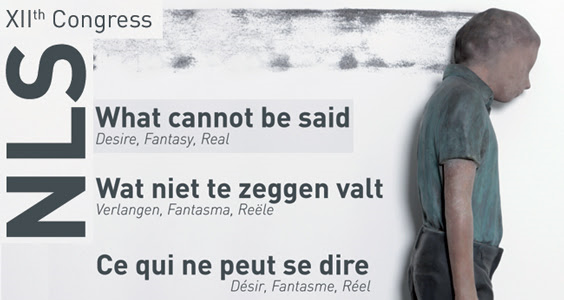
> Send a paper for the Blog to florenciashanahan@gmail.com (max 2500 characters)> Submit a paper for the Congress – before March 31st 2014.
-
- Priority given to clinical cases: Particular attention will be paid to the construction of the case – reduction and selection of the ‘material’, serialisation and shoring of the fantasy/symptom binomial, according to the question that the case poses to the practitione
- Deadline and length of texts: Please send your text of no more than 7000 characters including spaces, to Dominique Holvoet (dominique.holvoet@gmail.com) and Lieve Billiet (billietlieve@gmail.com) before March 31, 2014. E-mail subject: CONGRES NLS. The name of the attachment must be the author’s full name.

