

Paris 2014
November 2013 / Issue 8
Congress Web Site/ EVENT: SCILICET IS IN PRESS / Bibliography / Theme:
Graciela Brodsky / Reminder: Clinical Day: Call for papers / Traveling to Paris /
Registration!

7th Clinical Study Days in NEW YORK
We are happy to let you know that the 7th Clinical Study Days will take place in New York, February 14-16, 2014.

Forthcoming activity in Amsterdam
Lacanian Psychoanalysis Workshop, Popular University Jacques Lacan.
This workshop will be conducted in Dutch
“De angst in dehedendaagse kliniek” (Anxiety in the contemporary clinic)
23rd November 2013, 11.30 am – 4.30 pm
Marnixstraat364-366, 1016XW, Amsterdam (near Leidseplein)
Anne Lysy and Lieve Billiet, membersof the Kring voor psychoanalyse van de NLS (Dutch speaking circle of theNew Lacanian School).
Registration: m.vitto@psicologo.nl
We seek to further strengthen the links between Societies and Affiliated Groups of the NLS.
For the Executive Committee
| 2013-2014 | Geneva | Athens | Tel Aviv | London | Bruges |
| 21/09/2013 | 21/09/2013 | 16/03/2014 | 11/01/2014 | 22-23/02/2014 | |
| Societies | Kring: Thomas Van Rumst | ASREEP-NLS: Jacqueline Nanchen | Hellenic Society: Yannis Dimitrakos | GIEP: Susana Huller | London Society: Roger Litten |
| Groups | Krakow& Warsaw: Dorota Parnowska | NLS-Québec: Anne Béraud | Bulgaria : Biliana Mechkunova | Russia : Mickaël Strakhov | ICLO: Rik Loose |
| Member EC | EC: Yves Vanderveken | EC: Dominique Holvoet | EC: Florencia Shanahan | EC: Nathalie Laceur | EC: Despina Andropoulou |
| Extime | Monique Kusnierek | Maria Cristina Aguirre | Russell Grigg | Jean-Louis Gault | Jean-Pierre Klotz |
| Case 1 | Babeth Hamel | Anne Béraud | Biliana Mechkunova | Mickaël Strakhov | Rik Loose |
| Case 2 | Dorota Parnowska | Jacqueline Nanchen | Yanis Dimitrakos | Susanna Huller | Roger Litten |
| Case 3 | Thomas Van Rumst | Despina Karagianni |
Veronique Voruz |
||
| Chair | Lynn Gaillard | Epaminondas Theodoridis | Samuel Nemirovsky | Natalie Wulfing | Lieve Billiet |
| Report | Dominique Tercier | Marina Frangiadaki |

HELLENIC SOCIETY OF THE NLS
Knotting Seminar in Athens
21st September 2013
Report
by Thanos Xafenias
The annual Knotting Seminar of the NLS in Athens, organised by the Hellenic Society, took place at an overcrowded amphitheater of the Gennimatas General Hospital, with the presence of Dominique Holvoet, President of the NLS. The title of the Seminar was that of the next Congress of the NLS: “What cannot be said; desire, fantasy, real.”
During his inaugural speech, entitled “The hard core of the object’s function in desire”, Dominique Holvoet followed J.A.Miller’s intervention in Athens, focusing on the last part of the 6th Seminar, on the “dialectics of desire”. He reminded us that the big secret of psychoanalysis is that “the Other is without Other”.[i]Until 1958-59, The Name-of-the-Father had appeared to be “the Other of the Other”.The success of the symbolic order and its laws[ii]concealed the revelation of the “secret.” The repression of this intolerable truth is the very object of psychoanalysis.
The Freudian Thing, being irreducible to the Order of the Father, leads to an unceasing talking, which is the proof of its genuineness[iii]. There is an irreducible core, which is that of desire. The symbolic order must be read as a defense against that which cannot be said. Starting from Seminar VI, Lacan meticulously begins the deconstruction of the symbolic order, entering in such a way into the ineffable zone of the Real.
At the beginning of an analysis, the subject is searching its representation, the truth of its desire, its own Name-of-the-Father. But later on, the subject aims at the encounter with itself, “the subject aims at the encounter with what it wants”[iv]. The subject must search its truth in the Other, but there, it will find the absence of the signifier, as “there is no signifier which can guarantee the specific sequence of whichever manifestation of the signifier”. [v]This is the meaning of the thesis that there is not an Other of the Other.
What makes this mechanism of internal reference indispensable is what he will later call the object-cause of desire. It is something which comes before, propelling the desire. In terms of the 6thSeminar we could say that the fantasy is what guides the subject. The existence of this mechanism will lead Lacan to find another way of interpretation, which will not be based only on the symbolic field; this is what he will call the function of cutting.
Logically, the locus of the absent signifier, this signifier that the Other does not have in his possession, is not in the nature of the symbolic. It is a place where something is missing, Lacan is calling this part a “sacrificed piece”; it is a piece of the organism of vital force. Lacan remarks that as parlêtres we are subjugated to meet our fate in its meeting with this incommunicableness object.
The 6th Seminar explores the field where the Other does not respond, the “field of fantasy”, the bond between the symbolic and the imaginary. The absence of a response from the Other immerses the subject into a deep desperation, a feeling of abandonment which can reach the point of panic. It is a point of rupture with the symbolic, where the subject cannot say something about itself. This is when it seeks refuge to the imaginary, the imaginary of fantasy, the subject defence itself with its Ego. But this is not sufficient. If there was a transgression of fantasy, a phrase that Lacan had only mentioned once, it would have produced a renouncement of Being, an existential emptiness, a cynical remainder which leads to itinerancy or quackery.
Lacan moves the fantasy from the imaginary locus and places it to the Real. The cornerstone of the 6th Seminar is the unconscious subject-object relation, in the experience of fantasy’s desire. The invention of Lacan is that the value of the subject is not imaginary anymore but real. The object is not under the dominance of the symbolic order. On the other hand, the object cannot be absorbed into the imaginary either. Lacan points out that the fundamental fantasy connects the subject with a real object, a connection which is made at the time of the panic.
The Seminar allows us to distinguish “imaginary phantasmagorias”, the Ego’s poses, from the “fundamental fantasy”, which is not accessible as such. The fantasy for which we will be talking during this year in the context of the NLS remains unconscious; we do not have a direct experience of this dimension. It is not an element that can be conceived through the symbolic or the imaginary. The issue for the parlêtre is to manage to grasp something which is neither symbolic nor imaginary. It is about a make-up of this certain experience of this dimension.
The subject gets caught in the cut, the point at which it does not exist, it does not know what it is, the last module of symbolic, according to Lacan. This object, with which the subject is connected, is a real object as far as it has been detached from the living body. Lacan brings all these elements to the surface at the end of his Seminar. This is where he begins from to construct what he will later call the object-a[vi]. These objects of the fantasy are “surplus” jouissance; they appear away from normality. They are not inscribed in a maturity process of desire. This particular idea of the maturity of desire is related to the idea of the possible existence of an ideal object. In the end, this was the dream, the phallus in the place of an ideal object. “The real shows up as something which resists to the demand (…)that form of the Real which is named inevitable appears in the fact that, the Real comes back always at the same place”.[vii]
During our work this year, we have to pinpoint what returns always to the same place. This inevitable recurrence, this insistence, traces the field of desire. This field is not a harmonious one; this is the desire’s perversion. Desire can only be spoken “between the lines”. None of the subject’s demands can exhaust this desire. We are in front of “the hard core of the object’s function in desire”.
In the clinical part of the seminar, Anne Béraud, member of the NLS (Montreal), presented the first clinical case, entitled “The vertigo of the ineffability.”
It concerned a young hysteric woman who, throughout her analysis, manages to construct knowledge, deciphering her puberty symptoms and identifications.
Consequently, an interpretation allows her to change her subjective position, get rid of some bodily symptoms and become a mother. From that moment, she will be confronted by the jouissance which is at stake in her scenarios and dreams. Anxiety and jouissance are mixed and are bringing forward the vertigo as ineffability.
During the narration of her story we could witness the interpretation based on equivocation of certain signifiers and the emergence of a particular signifier which is representing the feeling of vertigo. The signifier “falling” –in her mother tongue- boils down the path of her analysis, this felling of vertigo.
The second clinical case came from Jacqueline Nanchen, member of the NLS and the ASREEP-NLS. Her paper was entitled “the logic of a case in the context of the clinic of sinthome”. A middle-aged man, who tends to produce bodily symptoms since his childhood, had his second severe crisis in his life. The first one appeared when he had to choose between what he called life and what he called death, using love as defense against the chasm that death opens.
For the moment, under similar circumstances, on a similar occasion of a choice which has to be made, he is trapped between the obscure demand of his wife and the explicit claim of a potential lover. A signifier has emerged –the basis of his bodily symptoms recurrence- constituting a unique characteristic of his entire life. His jouissance can be compressed to this particular signifier, which can be found in a great variety, involving his body and ethics. As a servant of his mind function he calculates ceaselessly. At the same time, the same function is very useful for him when he practices his dangerous hobby. What is at stake is his very life.
Finally, Despina Karagianni, member of the NLS and of the Hellenic Society, presented the third clinical case, under the title «nobody does it like Mother». A young woman is looking to be directed in her life, while the dimension of subjective lack is absent. During her destabilization, separation and loss themes that causing great distress and anxiety are dominant.
Without concerns about her family history, she breaks down when she loses her daily schedule. Her destabilizations take place every time she is confronted with an Other in lack. As a result, she resorts to specialists to be instructed how to live her life. With her husband’s help, she can tolerate herself. Her husband is valuable and indispensable due to the fact that he can bear her like her mother would have done.
A signifier she has invented to nominate the intrusive jouissance helps her to keep her life in order. In such a way, a certain stabilization is achieved. In addition, a holophrase brings consolidate meaning. This particular signifier of her jouissance, despite tyrannical, is very essential. The point is to become viable as her unique characteristic.
The Hellenic Society would like to thank all the participants to this seminar, particularly the three speakers, and above all the President of the NLS DominiqueHolvoet, whose introduction will orient our work for the upcoming NLS Congress in Gent.
[i] [nls-messager] 806.en/ XIIth NLS Congress: Jacques-Alain Miller’s presentation in Athens; “The Other without Other”
[ii]Ibid., p.6
[iii]Lacan, J., Le Séminaire,Livre VI, Le désir et son interprétation,Paris, Édition de la Martinière, Le Champ freudien, 2013, p.424.
[iv]Ibid., p.349
[v]Ibid., p.441
[vi]Ibid., p.469
[vii]Ibid., p.565


Report on the ICLO-NLS Seminar with Patrick Monribot
Dublin, 28th September, 2013
In her opening address, the Chair of ICLO-NLS Florencia F.C. Shanahan welcomed all attendees and introduced Patrick Monribot from Bordeaux who was presenting to us for the first time. Patrick is a Psychoanalyst and Psychiatrist. He is also an analyst member of L’Ecole de la Cause Freudian and the WorldAssociation of Psychoanalysis (WAP). He teaches in many different clinical sections of the WAPand many different countries including Italy, Spain, and of course France.
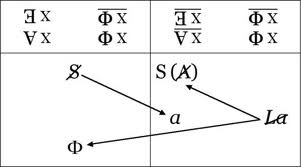
It was reiterated that we were delighted to host the event and Patrick was thanked for traveling to Ireland in order to speak to us on: ”‘There is no Sexual Relation‘ What Does it Mean? Clinical Consequences of Lacan’s Formulae of Sexuation”. He began by situating our reading as follows: Lacan presented the formulae of sexuation in march 1973 in chapter seven of seminar XX Encore (seen here below) which Patrick urged must be read in conjunction with two other previous writings from Ecrits.The first is The Signification of the Phallus” (1958) and the second is Guiding Remarks for a Convention of Female Sexuality” (1960).
Patrick clarified the meaning of Lacan’s celebrated phrases regarding the modalities of the ‘there is not’; la femme n’existe pas “the woman, does not exist” that is to sayTHE woman, the universal woman does not exist (as indicated as La barred in the schema) & il n’y a pas de rapport sexuel “there is no sexual relation” in the sense that the sexual relation does not cease not to be written, as Lacan states in chapter three.The sexual relation is impossible in terms of writing – nothing allows for a ciphering that would connect the two sexes. Indeed, in 1894 Freud indicated that sexuality produced a “hole” in the psychical apparatus. In Patrick’s words this is because “the sexual relation is a pure real” and is thus irreconcilable with our subjectivity.
This non-relation is not new in Lacan who had already evoked the false evidence for the sexual act in his seminar Logic of the Fantasy onApril 12th of 1967 and returned to this topic in the seminar From an Other to the other and also in Television. However the seminar Encore is a breakthrough in the topic: the formulae of sexuation are mathemes that write the separation between feminine and masculine positions. Ultimately, it is a writing about the impossibility of writing the sexual relation at the level of structure.
Patrick elaborated much further with logical and technical eloquence but to keep this review within reasonable limits we shall leave the tracing of the talk here and simply say that the concept is evoked beautifully in the myth ofAristophanes which can be found in Plato’s symposium; that is that man and woman once existed undivided as one creature with four arms and four legs with a head of two faces but Zeus fearing their power split humanity into their respective sexes and ever since we have been doomed to search for our missing other half.
The presentation was accessible and revealing yet so stimulating that we ran over time, though the attention of the audience never faltered. One could sense that there were questions and comments buzzing in everyone’s thoughts pitted against restraint out of consideration not to hold up our guest or those whom might have other engagements afterwards.
Quite a feat laying bare a picture of Lacan’s formulae of sexuation with such clarity, precision, and high resolution balanced against such a close reading of the surrounding texts. We sincerely look forward to Patrick’s next visit.
Michael Power


The Clinical Day
of Wenesday, 16 April, 2014
Call for
Papers
Clinical Day – Wednesday
The
Clinical Day of the next Congress will take place on Wednesday, 16 April 2014.
In eight parallel sessions, the
members of the WAP will have the opportunity to present their works.
The
presentations must be inscribed within one of the thematic axes that the
Scientific Committee has proposed by way of orientation. See below.
A Real for the 21st Century, the
title of the Congress, requires that we give ourselves pause before the stakes
it contains, and the clinical papers will devote themselves clearly to draw out
the consequences for analytic treatment.
This
means that we expect from each presenter that s/he will let us hear in what way
it is not only the analysands who are of this century, but also how his or her
own practice is implicated there.
Papers
should, therefore, contain a reflection articulated to the clinic, and may have
an orientation that places more emphasis on one or the other point: clinical-theoretical
or theoretical-clinical.
We shall
work in one-hour long sessions,
during which two papers of 15 minutes
each will be presented; a chairperson
will be responsible for facilitating the discussion that will highlight the acute
points of the presentations, as well as for ensuring time keeping; s/he will be
accompanied by a discussant, who
will have had previous exchanges with both presenters, in order to refine the
articulation of the papers, not only with regards to the theme of the session,
but also between them; the presenters
will also answer questions from the audience.
Themes:
You are
asked to choose one among the main concepts that emerge from the directions
provided by Jacques-Alain Miller in his presentation of the theme of the Paris
Congress.
• The
putting back into question of interpretation;
• The elaboration
of a clinic focused on «dismantling the defence»;
• The
redefinition of the desire of the analyst;
• The
relevance of approaching the Real by means of the Borromean knot: what knottings
for the speaking being in the 21st Century?
Other concepts may be integrated into these axes, such as the
question of style, contemporary creation, addictions, solitude, sexuality,
societal reconfigurations [violence, fanaticism, homosexual marriage], the body
treated by machines [aesthetics, sports, etc.]…
The Scientific Committee of the
Clinical Day will be coordinated by Pierre Naveau. The committee is
composed of Hélène Bonnaud, Sonia Chiriaco, Philippe de Georges, Philippe
Hellebois, Sophie Marret-Maleval and Pierre Stréliski.
General
recommendations:
- – Papers
should not exceed 7,000 characters,
including spaces. - – The
deadline for submissions of papers is 15
December 2013 – after which the reading and selection of papers will be
carried out. - – The
selected papers will be distributed among discussants, who will seek to promote
exchange with and between the authors, as well as to adjust the papers to the
theme of the session in which they will be presented. - – Papers
must be sent to the following e-mail address:
amparis2014-jclin@congresamp2014.com.
The
subject of the e-mail should read: Clinical
Day + SURNAME and first name of the author.
Important:
An email
acknowledging “RECEIPT” of your paper will be sent to you. If you do not
receive this confirmation email, please send your paper once again.

THE INTERNATIONAL LACANIAN JOURNAL OF PSYCHOANALYSIS
Call for papers
Issue 11
The
editorial team would particularly welcome papers working towards the XIIth NLS Congress, "What Cannot Be Said".
We are also open to papers on
other themes from the working community of the NLS and beyond.
Deadline for issue 11:
15 January 2014
Please note: Texts must be in English (unless you are unable to get your text translated) and of no more than 12,000 signs including spaces, to the following address:
