
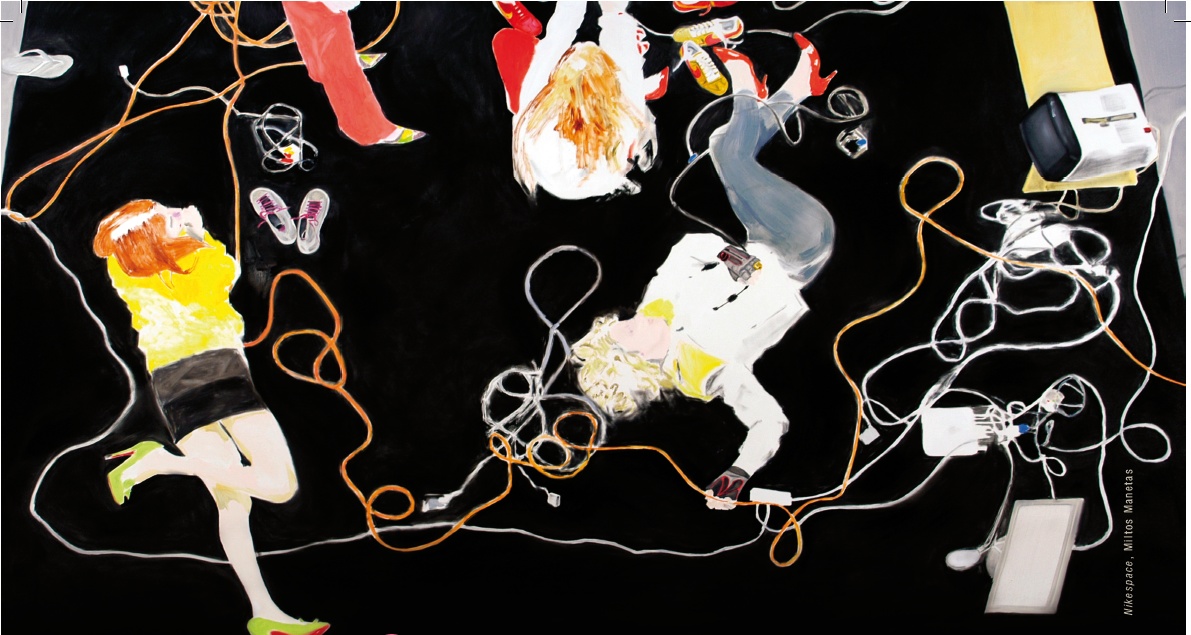
Miltos Manetas
“The El Greco of the Geeks”
Miltos Manetas, “The El Greco of Geekdom” as the Guardian’s journalist Steve Shipside named him, is an artist and theorist whose work explores the representation and the aesthetics of the information society.
Manetas is the Founder of the Art Movement Neen, a pioneer of Machinima[1] and an instigator of Internet Art.
Born (in 1964 in Athens) and grown up in Greece, Manetas defines himself as a “Southerner”. Her mother was working at the central phone station connecting phone calls as a phone operator and his father was repairing the electric circuits at the same building. He lived in a “PC universe”, in a “PreComputers and PreContermporary art” environment, as he says, and he remembers himself feeling “excited, bored and happy”.
He left Greece in 1985 at the age of 20. At that time, it was the “new Greece” that started to get born, the Greece of the “new south” populated by “MAC”, (Man After Computers / Man After Contemporary Art). Trying to escape from his Family and more precisely from the concept of the Family and the obligation to have one, he went to Milan where he studied Fine Arts.
In 1995 he started painted. He was then included in Traffic show, and later in Bourriaud’s book Relational Aesthetics. But at this time, Manetas decided to change his approach to art. He abandoned performance, objects and site specific installations and he began making paintings about computer technology, exploring the possibilities of creating art by using video games and the Internet. “Having to deliver works for four final exhibitions that were supposed to be my last, I bought four canvases and painted the same picture on all of them. These first paintings (Sad Tree, 1995) were successful and I continued painting first laptops and digital cameras and later all kinds of hardware. At that point, I didn’t know how to use computers, I learned quickly and I became “a screen junkie”. While I was doing my paintings, I started using digital media to portray the digital world”.
In 1996, Manetas moved to New York City and began working on a series of video game-related artworks, using Lara Croft and Mario as “ready-made” characters. Both works were exhibited at the Institute of Contemporary Arts, in the exhibition entitled Made in Italy. It was at that occasion that The Guardian published an article on Manetas calling him the “El Greco of the Geeks”.
In Super Mario Sleeping, a video from 1998, Mario sleeps under a tree, while in Flames, a 1997 video, Lara Croft is constantly getting hurt.
Manetas was one of the first artists to both recognize and celebrate the influence of videogaming on contemporary art, on visual culture tout court, and on our psyche. His epiphany spawned a series of game-based artworks for different media (painting, videos, installations) and therefore he is a true pioneer of Game Art. His “Videos after Video Game (1996-2006)” series is considered the first example of Machinima. “In the same way that the impressionists focused on nature, computer landscape became for my generation the most important subject matter. Of course, video games were around a long time ago, but it was only during late 1990’s that we realized that they were part of that computer landscape, and not just yet another bit of visual excrement that was dropping out from television”, Miltos explains.
In 1999, Manetas leaves NYC and enjoys being an “orphan”. Having moved again, this time from the Far North of New York to the extreme West of Los Angeles, he tried and he succeeded to distance himself even from that second happy family of his: the Art World.
”I started looking for new friends, other orphans, who were -like myself-under the existential spell of computing. That’s how the Electronic Orphanage in LA’s Chinatown was born and that’s how the art movement Neen was initiated. But the Art World started expanding west, and so I left Los Angeles to diffuse Neen to the World”. Manetas was compulsively traveling all over the world and displayed exhibitions.
Another important show was Elysian Fields at Centre Georges Pompidou in Paris, curated by the Purple Institute. In spring of 2000, Manetas presented the new name, Neen, to an exhibition-performance held at the Gagosian Gallery in New York City. Manetas says about “neen”: “Neen in Greek means “exactly now”; the absolut present.
It is the latin “Nunc” (from “futurum nunc est,” in Greek το “μελλει ειναι νυν” (what’s going to be is now). In numbers, NEEN is 5555. The keywords for the number 5 are: activity, influence, courage, motivation, change freedom, curiosity, telepathy, experience, the intellect.
But more importantly, Neen is an animated word. It is a palindrome. It is a mirror-word: you can read it backwards and upside-down. NEƎИ”
Having developed the technique of “Invisible Painting”-a very personal and simple manner to keep doing his art while he was traveling, he was going around shamelessly, as he says, until he met Catalina and immediately their “genes start talking to each other so loudly” that they decided “to co-produce a baby”. He started desiring “to become a local again”.
He explains «Invisible art» like this: “There was a change for me after I had a recent accident in 2010, when I went down 40 meters from the top of a rock on my back with a little tree, finally saving my life. After a month of immobility in the hospital, I returned to that same place where I had the accident and I rented a little house there. Waiting to recover completely, I had my colors and canvasses brought there but I couldn’t paint: regular painting just didn’t seem a good idea anymore.
Finally, one day that I took a brush and without any color on it, I started “painting” over the landscape. A few days after my “discovery”; I kept my Blackberry on my left hand, I start filming whatever it was that I was painting. A Blackberry and a brush was now all that I needed for a studio. That’s how the BLACKBERRY PAINTINGS were born and from that moment, I decided to continue my life by painting it at the same time”.
Meanwhile, in 2007, London’s Hayward Gallery commissioned Manetas to do a special project around the idea of Existential Computing, a new term he was using for his practice. During this show, Manetas met Malcolm McLaren and they participated together in a show that artist Stefan Bruggemann curated at the I-20 gallery in New York City. Manetas’ work for this exhibition was a piece commissioned previously by Newcastle’s Baltic Centre for Contemporary Art and the British magazine Dazed & Confused for the Dazed & Confused versus Andy Warhol exhibition. It consisted solely of a URL written on the wall: “http://www.ThankYouAndyWarhol.com.”
Malcolm McLaren (1946-2010) became a friend and a master to Manetas. He followed his advice “to find himself a private place”.
Manetas chose to settle down with Catalina in Rome. ”The reason that I picked Rome instead of Los Angeles or Nairobi, was because Enzo Cucchi had recently told me that “Rome is not one city but many, at least seven, one over the other, all still very active”. Always amazed by Parallel Worlds, I went there, but already from my first months there, I discovered that there is something else that was making from Rome a very special city and that had to do exactly with the concept of Middle South.
For centuries now, Rome is the border between South and North and I suspect that the city actually owns at least a part of its riches to the job it does dividing the two”, Manetas explains.
“So when it came to us, having decided to “Start Up” our daughter there, it was like a statement to me. Indeed, we called her Alpha, which as a symbol and term, is used to refer to or describe the first or most significant occurrence of something”. Her daughter, gave him a new inspiration: ”In my pictures, I try to re-invent family photography. I am doing that by projecting the pictures that I take from Alpha, back to the room where I photographed her or to some other place. Then I am re-photographing them. Decontextualizing the pictures that way helps me to think of the three of us not as a family but as MAC (Miltos/Alpha/Catalina): a network”.
In 2009 he started the Internet Pavilion of the Venice Biennial and from 2011 he directs the MACROeo (electronicOrphanage at the MACRO Musem in Rome).
According to Lev Manovich, Manetas is a true “painter of information life”, “the only contemporary painter who made this reality the focus on his paintings”.
Sources:
The site of the artist: http://cargocollective.com/manetas
http://en.wikipedia.org/wiki/MiltosManetas
Lev Manovich (2009) How to Represent Information Society?, Miltos Manetas, Paintings from Contemporary Life, Johan & Levi Editore, Milan
South Magazine, MAC, my family at “Middle South” by Miltos Manetas
Steve Shipside: “El Greco of Geekdom”, the Guardian, 23 Oct 1997, Gb 1996

18th and 19th May 2013 | XIth NLS Congress in Athens 18 et 19 mai 2013 | XIè Congrès de la NLS à Athènes
|
The Blog of the Congress is on-line!
We invite you to read and to respond with your comments, questions and reflections to the twelfth paper, “The Borromean Knot before the Sinthome” by our colleague Ruzanna Hakobyan member of the NLS in Montreal.
[This paper is published both in French and in English] |
Le Blog du Congrès est en ligne!
Nous vous invitons à lire le douzième texte, “Le nœud borroméen avant le Sinthome” par notre collègue Ruzanna Hakobyan membre de la NLS à Montréal, et à y répondre avec vos commentaires, questions et réflexions.
[Ce texte est publié en Anglais et en Français] |
||||

18th and 19th May 2013 | XIth NLS Congress in Athens 18 et 19 mai 2013 | XIè Congrès de la NLS à Athènes
|
The Blog of the Congress is on-line!
We invite you to read and to respond with your comments, questions and reflections to the tenth paper, “Of whom shall we speak?” by Sari Edelstein, from Israel. |
Le Blog du Congrès est en ligne!
Nous vous invitons à lire le dixième texte, “De qui on parlera?” par Sari Edelstein, d’Israel, et à y répondre avec vos commentaires, questions et réflexions.
|
||||


The introduction and first part of the Seminar given by Marie-Hélène Brousse in Dublin last February, entitled: “New Love Disorders: Love symptoms in times of ‘there is no sexual relation‘ “; is now available to be watched HERE

18th and 19th May 2013 | XIth NLS Congress in Athens 18 et 19 mai 2013 | XIè Congrès de la NLS à Athènes
|
The Blog of the Congress is on-line!
We invite you to read and to respond with your comments, questions and reflections to the eighth paper, “Heading for Tomorrow” by Thanos Xafenias, member of the Hellenic Society. |
Le Blog du Congrès est en ligne!
Nous vous invitons à lire le huitième texte, “Vers demain” par Thanos Xafenias, membre de la Société Hellénique, et à y répondre avec vos commentaires, questions et réflexions.
|
||||

Sous la présidence de Dominique Holvoet, Psychanalyste, Président de la New Lacanian School, membre de l’École de la Cause Freudienne. Premier séminaire de la NLS à la Société Bulgare de Psychanalyse d’orientation Lacanienne, Groupe Affilié à la NLS.
Le 1er février dernier, dans la salle de l’Institut Français de Sofia, s’est tenu le Premier Séminaire de la New Lacanian School en Bulgarie, après plus d’une décennie de Séminaires du Champ freudien. Ce premier Séminaire de l’Ecole en Bulgarie, qui s’inscrit comme activité préparatoire au Congres de la NLS à Athènes (18 et 19 mai 2013 sur le thème “Le sujet psychotique à l’époque Geek, typicité et inventions symptomatiques”), a été marqué par la parution du recueil « Les psychoses. Les avancées de la psychanalyse lacanienne » dont la présentation officielle a eu lieu le soir même.
Le séminaire de la NLS a conservé l’excellent exercice de discipline du commentaire introduit dans les Séminaires du Champ freudien. Deux exposés portaient sur le commentaire de deux phrases du premier chapitre de ce Séminaire de Lacan, proposées par Dominique Holvoet. Ils nous ont introduits dans le vif du sujet avec « l’accent que Lacan met sur le piège du sens et de l’expérience brute ». Le Dr. Bilyana Metchkounova, psychiatre et membre de la NLS et de la SBPL, nous a présenté un exposé très riche et approfondi sur la critique de la notion de compréhension de Jaspers que Lacan fait dans cette première leçon. Elle a accentué le rapport que le sujet a avec sa propre parole et sur la valeur première du signifiant. De même, le Dr. Lubomir Joupounov, pédiatre et membre de la SBPL, a poursuivi avec un développement large sur la nature de l’aveu que le sujet fait dans l’expérience analytique qui « n’est nullement pré-conceptuelle » et « pure », comme Lacan nous l’indique au début du Séminaire III[1] mais déjà bel et bien structurée.
Le travail s’est poursuivi avec l’exposé de Dominique Holvoet, centré sur le concept de forclusion, sur la Verwerfung freudienne de « L’homme aux loups » pour lequel Lacan précise qu’elle « se distingue de la Verneinung, laquelle se produit à une étape très ultérieure »[2]. Dominique Holvoet a détaillé dans un premier temps l’élaboration du concept de forclusion qui deviendra majeur dans la psychanalyse et par laquelle Lacan introduit un nouvel abord de la psychose. Il s’agit donc de la doctrine classique de la forclusion, telle que Lacan la formalise dans le séminaire III. Elle porte sur un signifiant – le Nom-du-Père – qui a comme fonction de stabiliser la langue, de capitonner le rapport signifiant – signifié. Dans la suite de son exposé, Dominique Holvoet a dessiné la perspective sur la deuxième partie de l’enseignement de Lacan « dont la doctrine ne porte plus sur le signifiant mais sur l’objet ». Ce remaniement théorique, comme il l’a souligné, est passé par le chemin de la pluralisation du Nom-du-père et de la formalisation de ses quatre discours, plus le discours capitaliste – « Une fois le Nom-du-Père pluralisé, ce qui vient à la place c’est ce qu’on peut appeler un symptôme ». Dans la perspective du futur congrès de la NLS à Athènes, Dominique Holvoet a terminé son exposé sur la question du traitement de la psychose qui est avant tout un auto-traitement et sur la place du praticien dans l’accompagnement de la « typicité » et des « inventions symptomatiques » du sujet psychotique.
Les deux cas cliniques qui ont été présenté dans l’après-midi nous ont permis d’éclaircir plusieurs points de la partie théorique du séminaire. Milena Popova, psychologue dans le Centre pour enfants et adolescents, géré par le Dr. Metchkounova, nous a parlé d’une fille de 10 ans qui se plaint des cris de sa mère et qui demande que quelqu’un « guérisse sa vie ». Dans une discussion très intéressante et enseignante sur les difficultés de symbolisation et les solutions imaginaires de cette jeune fille, Dominique Holvoet a relevé la question sur l’importance de l’ordre de ces difficultés et les statuts forts différents qu’un même énoncé peut avoir. Ainsi, sans donner une réponse à la question « est-ce qu’il y a « oui » ou « non » cette admission primaire d’un signifiant ou est-ce que, au contraire, le réel est passé de l’autre côté et les cris de la mère sont devenus des cris de l’Autre », Dominique Holvoet a souligné la nécessité de rester prudent et de ne pas « trancher définitivement et trop vite le diagnostic pour laisser la possibilité que la construction qui est à l’œuvre puisse se déployer ».
Après avoir parlé sur les nuances dans la tonalité de la langue que ce premier cas présentait, nous avons continué le séminaire sur la place que le praticien a dans l’accompagnement du sujet psychotique et ses inventions. Ivan Nenchev, interne en psychiatrie dans une clinique à Berlin, nous a parlé de Mme V. sous le titre « Comment une psychose se stabilise-t-elle ? ». Il s’agit d’une femme, âgée de 52 ans, admise en psychiatrie sous contrainte et dans un « état psychotique aigu» après une longue phase de rémission. Dans ce texte passionnant, nous étions frappés par la grande intelligence de cette dame par rapport à sa psychose qu’elle appelle sa « labilité » et par le « tact et la subtilité du psychiatre dont l’écoute permet à la patiente de lui donner la clé de sa stabilisation ». Grâce aux commentaires de Dominique Holvoet et aux questions posées de la part des participants, la discussion s’est poursuivie sur la question de l’identification imaginaire « qui maintient une certaine vitalité mais qui peut produire des effets délirants » et le traitement par la lettre qui « laisse de côté la dimension du sens ».
Nous remercions chaleureusement Dominique Holvoet pour sa participation, sa présentation, ses précisions et ponctuations lors de ce séminaire. Nos remerciements vont également aux collègues qui nous ont présenté leurs textes et études de cas ainsi qu’à Guy Poblome [3] qui a poursuivi ce riche travail lors du laboratoire CIEN les deux jours suivants. La préparation pour le congrès de la NLS se poursuit ! Nous y serons nombreux !
Théodora Pavlova
[1] Lacan J., Le Séminaire, Livre III, Les Psychoses, Paris, Seuil, p.17.
[2] Lacan J., op. cit., p.21.
[3] Compte rendu du labo CIEN paru dans nls-messager n°663.fr

ICLO-NLS Open Seminar, 9th March 2013, Dublin


Knottings seminar in Tel-Aviv
Below are some notes taken from the Knottings seminar which took place in Israel on 19/01/13 with the happy presence of Florencia Fernandez Coria Shanahan from the Irish Circle of the Lacanian Orientation-NLS and the Executive Committee of the NLS and Veronique Voruz from the London Society of the NLS. They brought with them a refreshing presence that enabled a fruitful discussion among the participants.
Between being programmed and programming, between the parasitic nature of language and inhabiting language, Florencia unfolds her presentation—“Connected Alone”.
Florencia chose to relate to the topic of the next NLS congress, “The Psychotic Subject in the Geek Era” via the “geek era”, through the perspective of what Jacques Alain-Miller termed, “a great disorder in the real”.
We moved with her from the geek as a deviation from nature, to the geek as a particular way of inhabiting the social bond, as a creation of nomination based on the claim of one’s right to ‘oddness’, “one all alone” organized in a swarm-like way.
Florencia referred to Eric Laurent’s closing speech in the NLS Congress in Tel-Aviv, in which he stated that “what interests us in the practice of psychoanalysis are the forms of discourse by which the subject inserts himself, though never entirely, into the established discourses, into what we call civilization”. She placed the term “established discourses” under a question mark, asking how we determine who is inside or outside discourse. One could also ask, how can we talk about inside or outside discourse if it is established and is not an establishment? This question lead Florencia to relate to the particular way in which signifier and signified are stabilized for each subject; a way that is not independent from how language and body come to be connected together for each of us, always with a failure. She knotted this to the symptom as a response of the subject to the program imposed on him from the Other.
Florencia mentioned two theorists from the 1980’s who captured something of the relation between man and machine. Donna Haraway in her metaphor of the ‘cyborg’ mixtures of human and machine; claiming that it is no longer possible to use old body/mind dualisms .Florencia reads Haraway’s feminist call for a technological utopianism as way to deal with the inexistence of the Other.
Sherry Turkle places technology in general, and computers in particular, not as a tool, but as part of our everyday psychological life that define the way we think and act.
Florencia stated that she sees in the effort to conceptualize the human experience in the ‘geek era” a possibility to interrogate the status of the object a as theorized by Lacan, especially the issue of its extraction as the operation that founds a closed reality for the subject, by establishing a point of impossibility and an order which is installed through its limits
She brought back Dominique Holvoet’s question from the argument for the Congress 2013″is not the ‘I-object’ a supplementary organ whose function s sought by the bloggers we are?”
Florencia returned to a talk Turkle gave in 2012, entitled “Connected but alone?”, wherein the author opposes conversation and connection, stating that we have a new way of being together alone. Technology enables a new way of “being alone together”. Florencia emphasized the signifier “but” and the interrogation mark in Turkle’s title, claiming that they mark an illusion that it could be otherwise. That we could relate to the Other without being plugged into it via something.
Florencia stated that the opposition is not between connection and loneliness for at the level of jouissance the speaking being reveals himself alone connected via the object a.
She mentioned Laurent’s claim that despite the advances of science that have gone to the point of silencing nature, the drive insists. The question of how to live in one’s own body and how to do with the non-sexual relation remains. The geek era is the era of ‘lives ruled by non-standard signifying inventions’.
Florencia’s paper was followed by a lively discussion. It opened a space for different avenues of interrogation, a start.
We heard two clinical cases
Vera Elad presented a work with a young woman in a mental health hospital, which took place mostly through writing. In her opening words Vera stated that “it is a case of a ‘forced choice/invention’ of a subject who took the radical freedom and at the same time the prison not to speak and not to make her voice heard”.
This case made it possible to raise a question about the very act of speaking and to mark the pair speech and writing.
Veronique Voruz’s case demonstrated to us the metonymic use of speech by moving from one framework to another, from one style to another creating a gap between s1 and s2 that can delineate the gaze and give a function to the eye.
The discussion on the cases made it possible to isolate the point of impossibility.
By pointing towards these points the discussion received a breath of fresh and invigorating air.
Reporter: Sharon Zvili-Cohen

Towards Athens – Call for papers: Deadline March 31st
Reference texts for the Congress are:
– The presentation of the theme by Eric Laurent entitled "Psychosis or radical belief in the symptom"
– The argument which develops the title "The Psychotic Subject in the Geek Era. Typicality and Symptomatic Inventions"
– The short bibliography for the Congress. You will find all of them on the NLS website.
The main axis focuses on questioning the category of psychosis in the 21st century, in its displacement towards the autistic paradigm as the root of the speaking being's defense against the impact of language on the body.
With its emphasis on the Geek, the argument invites you to consider a new logic of the living [du vivant]. What was still of the order of the gadget in the last century has become, with the screens, a true complementary organ, lively bodily prolongation which the speaking being cannot do without.
The papers may therefore support this new orientation of a continuist clinic which is no longer solely articulated through the paternal paradigm, but also through the claim for particular life-styles stemming from desires to be transcribed into laws.
– From the man-machine to the object outside-the-body
– The noise of lalangue and the ways of knotting RSI
– Screens as "new privileged forms of the Other» (E.L.)
– The psychotic subject as he who believes the most in the meaning of his symptom
– Offensive and attractive categories: claim and rejection
– Autism as belvedere of the clinic
– Support on established discourses and psychotic invention?
– The jouissance of the One-all-alone… and the Other
– Use of symptomatic inventions in practice
– Life-style and normalisation of the symptom
Scientific Committee
The Scientific Committee is not disjoint from the Congress Organising Committee. Just like this team has prepared the logistic details, it will take part in the selection of papers. The Committee will review all texts sent and will contact the author to help refine the text if necessary. It is therefore important that each author submits his or her text in French or English and that the deadline is respected so hat this preliminary work can be carried out.
Deadline and length of texts
The Congress Team
- Direction: Epaminondas Theodoridis & Dominique Holvoet
- Logistics: Anna Pigou, Japd9@hotmail.com
- Translations: Réginald Blanchet, rblanchet@otenet.gr
- Local Treasurer: Nassia Linardou, naliblan@otenet.gr
- NLS Treasurer: Sandra Cisternas, treasurer@amp-nls.org
- Library: Marina Frangiadaki, frangiadaki@yahoo.fr
- Executive Committee: Despina Andropoulou – Anne Béraud – Nathalie Laceur – Florencia F.C. Shanahan – Yves Vanderveken and Sandra Cisternas
I WANT TO REGISTER FOR THE CONGRESS IN ONE CLICK!!

P.Hallward@mdx.ac.uk
Paris, Feb. 26th 2013
Dear Peter Hallward,
Thanks you for sending me your two beautifully--edited volumes on Cahiers pour l’Analyse.