|
Aucune image? Version web 
NLS-Press n° 34 – November / novembre 2017 Activités des sociétés et groupes de la NLSActivities of the Societies and Groups of the NLSNovember / novembre 2017ASREEP-NLS (Suisse)
Aigle

Fribourg
Genève

Martigny

London Society-NLS (United Kingdom)
London

London

London

London

Société hellénique-NLS (Grèce)Athènes Séminaire de clinique psychanalytique à l’hôpital psychiatrique de Dafni, sous l’égide de la Société hellénique de la NLS :
La Crète
Thessalonique

GIEP-NLS (Israel)
Tel-Aviv

Tel-Aviv

Tel-Aviv

ICLO-NLS (Ireland)
Dublin

Bulgarian Society of Lacanian Psychoanalysis of the NLS (Bulgaria)
Sofia

Cercle de Cracovie (Pologne)


Cercle de Varsovie (Pologne)
Poznan


NLS-Copenhagen (Denmark)Copenhagen
"The Psychoanalytic Act", with Jakob Soelberg.
Conference by Francois Sauvagnat: "Aspects of the Transference".
Reading of Chapter 2 of Seminar XVII, "The Other Side of Psychoanalysis". ACF – PortugalLisbonne

NLS-Québec (Canada)
Montréal
Lacanian Compass (USA)Virtual meetings
Columbia, Missouri
Houston, Texas
Miami, Florida
New York, NY
Omaha, Nebraska

Lacan Circle of Melbourne (Australia)
Melbourne
Secrétariat de l'Est
Moscou

Amsterdam (The Netherlands)
Amsterdam

Berlin (Germany)
Berlin

Vienna (Austria)
Vienna

Vienna

Introducing the Nottingham-Dublin Lacanian Studies Programme

PublicationsNew Releases:
La traduction polonaise du Séminaire I, Les écrits techniques Freud, de Jacques Lacan 
La traduction polonaise du Triomphe de la religion, de Jacques Lacan. 
Talking to Brick Walls: A Series of Presentations in the Chapel at Sainte-Anne Hospital, by Jacques Lacan. An English translation by Adrian Price. Journals: THE LACANIAN REVIEWJOURNAL OF THE NEW LACANIAN SCHOOL AND THE WORLD ASSOCIATION OF PSYCHOANALYSIS

LROTHE LACANIAN REVIEW ONLINE
Les Cahiers de l'ASREEP-NLS n° 1LA « POSITION MÉLANCOLIQUE » DANS L'HYPERMODERNITÉ
via LacanWEG VAN HET ONBEWUSTE ?Second edition of the journal of the Kring voor psychoanalyse van de NLS 
Revue International de Psychanalyse de l'EFPMental 35SIGNES DISCRETS DANS LES PSYCHOSES ORDINAIRESGerman journal from the L.O.B.
Revue Internationale de Psychanalyse 6


Introduction à la clinique psychanalytique. Neuf conférences espagnoles
New Lacanian SchoolContact: New Lacanian SchoolEnquiries: Nouvelle inscription: New registration: Vous désinscrire en cliquant ici: Unsubscribe by clicking here: Crédit image pour le logo NLS et ses déclinaisons ©Anish Kapoor, 2014
NLS Nouvelle École Lacanienne de Psychanalyse – New Lacanian School of Psychoanalysis
Vous recevez cette lettre parce que vous êtes inscrit à NLS-messager / You receive this because you subscribed to NLS-messager
|


|


|
New Lacanian School Nous contacter : nls-messager-help@amp-nls.or Inscription : https://amp-nls.org/page/ Le site de la NLS : https://amp-nls.org Le Blog du Congrès NLS 2017 : http://nlscongress2017.org/fr/ Lacan Quotidien : http://www.lacanqu |
New Lacanian School Registration: http://www.amp-n The website of the NLS: https://amp-nls.org Blog of the 2017 NLS Congress: http://nlscongress20 Lacan Quotidien : http://www.lacanqu |



|
New Lacanian School
Nous contacter : nls-messager-help@amp-nls.or
Inscription : https://amp-nls.org/page/ Le site de la NLS : https://amp-nls.org Le Blog du Congrès NLS 2017 :
http://nlscongress2017.org/fr/
Lacan Quotidien : http://www.lacanqu
|
New Lacanian School
Registration: http://www.amp-n The website of the NLS: https://amp-nls.org
Blog of the 2017 NLS Congress: http://nlscongress20
Lacan Quotidien : http://www.lacanqu |
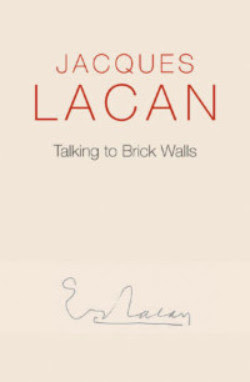
“I’ve been talking to brick walls” says Lacan, meaning: “Neither to you, nor to the Big Other. I’m speaking by myself. And this is precisely what interests you. It’s up to you to interpret me.”These brick walls are those of the chapel at Sainte-Anne hospital. Getting back in touch with his younger years as a junior doctor, Lacan amuses himself, improvises, and lets himself go. The intention is a polemical one: the best of his pupils, captivated by the idea that analysis evacuates all prior knowledge, have been raising the banner of non-knowledge, borrowed from Bataille. No, says Lacan, psychoanalysis proceeds from a supposed knowledge, that of the unconscious. One gains access to it by the path of truth (the analysand ventures to say what comes to mind, frankly and with no frills) when it comes to an end in jouissance (the analyst interprets what the analysand says in terms of libido).However, two further paths bar access to this one: ignorance (to devote oneself to it with passion is always to consolidate established knowledge), and power (the passion for might obliterates what is revealed by parapraxes). Psychoanalysis teaches the virtues of powerlessness: this, at least, respects the real.A wise lesson for an era, this era of ours, that has seen bureaucracy, arm in arm with science, dreaming of changing humankind in its deepest reaches – through propaganda, through direct manipulation of the brain, through biotechnology, and even through social engineering. Admittedly things were no better before, but tomorrow they could be far worse.Jacques-Alain Miller
|
New Lacanian School
Nous contacter : nls-messager-help@amp-nls.or
Inscription : https://amp-nls.org/page/ Le site de la NLS : https://amp-nls.org Le Blog du Congrès NLS 2017 :
http://nlscongress2017.org/fr/
Lacan Quotidien : http://www.lacanqu
|
New Lacanian School
Registration: http://www.amp-n The website of the NLS: https://amp-nls.org
Blog of the 2017 NLS Congress: http://nlscongress20
Lacan Quotidien : http://www.lacanqu |
 |
Garanti sans virus. www.avast.com |




Impossible Professions
Paola Bolgiani
Freud has recognised the Oedipal structure and the paternal function as the backbone of every society. Whether it is about the organisation of the state or religious organisation, he locates the Oedipal matrix, leaning on a Father who establishes the law and structures it rules and prohibitions.
However, in his opinion, psychoanalysing, educating and governing are three impossible professions.[1] The symptom cannot be fully decoded. The drive cannot be totally subject to the law. Individual needs cannot be completely channelled into the social bond. There are always remnants, which are impossible to analyse: they are unteachable and ungovernable.
We can affirm that democracy is the form of government which best takes into account this remnant. We could in fact say that only the democratic form of government makes room for dissent, for what cannot be assimilated. Therefore, democracy alone can include and, eventually, make room for psychoanalysis: in the same way that analysis aims at producing absolute difference, the exact opposite of producing subjects assimilated to the mainstream thought; so too psychoanalysis as a discourse, right from the beginning in Freud, carries a critique of society by showing that civilisation produces, structurally, its own discontents.
So the decline of the Name of the Father and the rise to the zenith of the objects of jouissance, at the expense of the ideals, pose an increasing problem concerning the legitimacy of the powers that be. Whether it is the legitimacy of he who psychoanalyses or educates or rules, these “impossible professions” are called into question at their very base.
The state’s response is to regulate, increasingly narrowly and bureaucratically, those professions which concern themselves with these areas – let’s think, with regard to the professions of care and education, about the increase in the number of titles and “credits” to be accumulated – with the paradox that the form proves powerless at the level of “substance”.
A few years ago, Giorgio Agamben highlighted the importance of distinguishing “between two essential principles of our ethical-political tradition, of which our societies seem to have lost all awareness: legitimacy and legality.”[2] He continues: “If, as happened in 20th-century totalitarian states, legitimacy expects to do without legality, then the political machine idles, often with lethal results; if, on the other hand, as in modern democracies, the principle that legitimates popular sovereignty limits itself to the election period and reduces itself to juridically pre-established procedural rules, legitimacy risks disappearing into legality, and the political machinery will be equally paralysed.”[3]
The question of legitimacy, no longer guaranteed by the Name of the Father, cannot be simply dismissed in terms of legality, which reduces it to norms and protocols that must to be followed, even if they are juridically unassailable, and which flattens the impossible professions under technical procedures that it would be sufficient to apply in order to attain good governance as well as good education and good care.
In 1958 Lacan wrote, “I intend to show how the inability to authentically sustain a praxis results, as is common in the history of mankind, in the exercise of power.”[4] Lacan showed that the more we avoid the responsibility of an “authentic practice”, like the one that results from educating, governing and psychoanalysing, the more we fall into the exercise of power which can manifest itself through seduction and suggestion, or in terms of prevarication and authoritarianism.
In its field of expertise, the response of psychoanalysis is based on the demonstration, case by case, of knowing what to do with the irreducible that psychoanalysis entails, hence, on taking responsibility for his own act, which cannot be reduced to any guarantee, even if it submits to the rule of law.
From this perspective, can psychoanalysis transmit something to other “impossible professions”? Yes! This is the wager we make by meeting in Turin.
With thanks to Janet Haney for her help with the translation.
[1] Freud, S., “Analysis Terminable and Interminable” [1937], S.E. Vol. 23.
[2] G. Agamben, The Mystery of Evil: Benedict XVI and the End of Days, Stanford University Press, 2017.
[3] Ibid.
[4] Lacan, J., “The Direction of the Cure and the Principles of Its Power” [1958], Écrits, Norton, New York/London, 2006, p. 490.
|
New Lacanian School
Nous contacter : nls-messager-help@amp-nls.or
Inscription : https://amp-nls.org/page/ Le site de la NLS : https://amp-nls.org Le Blog du Congrès NLS 2017 :
http://nlscongress2017.org/fr/
Lacan Quotidien : http://www.lacanqu
|
New Lacanian School
Registration: http://www.amp-n The website of the NLS: https://amp-nls.org
Blog of the 2017 NLS Congress: http://nlscongress20
Lacan Quotidien : http://www.lacanqu |

|

|
New Lacanian School Nous contacter : nls-messager-help@amp-nls.or Inscription : https://amp-nls.org/page/ Le site de la NLS : https://amp-nls.org Le Blog du Congrès NLS 2017 : http://nlscongress2017.org/fr/ Lacan Quotidien : http://www.lacanqu |
New Lacanian School Registration: http://www.amp-n The website of the NLS: https://amp-nls.org Blog of the 2017 NLS Congress: http://nlscongress20 Lacan Quotidien : http://www.lacanqu |


|
New Lacanian School Nous contacter : nls-messager-help@amp-nls.or Inscription : https://amp-nls.org/page/ Le site de la NLS : https://amp-nls.org Le Blog du Congrès NLS 2017 : http://nlscongress2017.org/fr/ Lacan Quotidien : http://www.lacanqu |
New Lacanian School Registration: http://www.amp-n The website of the NLS: https://amp-nls.org Blog of the 2017 NLS Congress: http://nlscongress20 Lacan Quotidien : http://www.lacanqu |
|
Garanti sans virus. www.avast.com |


The Beautiful Soul of the Intellectual
Miquel Bassols
The question that we are taking up with the Forum in Turin is central in the debate for the construction of Europe today. Which democracy? There is in fact not just one democracy that would come already formatted by the laws and the recourse to the Constitution of each country. There is a plurality of desires for democracy, some more decided than others, which come into play like a politics of the symptom impossible to treat with the sole recourse of juridical law. It is said and repeated, especially in relation to the events that currently taking place in Catalonia and in Spain, that the maintenance of democracy is a matter not of a merely juridical question but rather of a political question, of a necessary dialogue on the basis of legitimate positions as long as they do not violate the fundamental civic rights of freedom of expression and of thought.
In this politics where the master signifiers are put in play, the position of the Hegelian beautiful soul also turns out to be decisive.
The beautiful soul, that Hegelian figure that complains about the disorder that it itself provokes, is the daily bread of politics. The beautiful soul is not in fact a politics, it is a strategy that is used to submit politics to the inhibition of the act, as much on the right as on the left. One thus has to appeal to the responsibility of each subject, of the subject that is consequence of its acts, not the subject to which good intentions are always attributed, in order to make this subject speak and to listen to it in an analytic way. When the politician alludes to his always good intentions one has to remind him of the following: one is only responsible in the measure of one’s know-how, the affirmation of Jacques Lacan that should be the compass of any democratic conversation that wishes to be consequent in its acts. This is the ethics of consequences in contrast to the ethics of intentions. From each, according to the responsibility that their position demands. To each, according to the consequences of their act, that of their know-how. Today this no doubt seems a very high ideal by which to measure not just the action of the politician but also the political choice that public opinion supposes in each instance, that of the journalist, of each citizen, of the so-called intellectual, whether they be of the right or of the left. And also that of the psychoanalyst, called on like anyone else to take sides… on a non-partisan basis. This is a difficult choice when politics is more a question of party politics and not of each politician taken one by one as the subject of their act. Parties, but also the media, tend necessarily to efface the consequences of the singular political act of each subject. This is on account of the inertia intrinsic to the interests of the one or the other.
I am led to give this introduction in order to comment on a position that I have been hearing over the past weeks in public opinion in relation to the “Catalonia symptom” in the Spanish State and the conflicts that surround the calling of the referendum of October 1st along with the whole context that accompanies it. I am speaking about the position maintained by certain groups of intellectuals, one that I have also read in an article by the always appreciated Jordi Évole, well-known Catalan journalist, in his article in the Barcelona newspaper “El Periodico” from 18th September 2017 entitled “Deterioration”. In this article he proposes a supposed equality of legitimacies: “Having arrived at this point, is it legitimate to be critical of the reaction of the [Spanish] State, and with the same legitimacy to be in disagreement with the calling of this referendum [by the Catalan government of the Generalitat]? I believe that it is. And I can assure you that a great many, the silent majority, are of this opinion. They proceed with caution because as the date approaches the more they are required to take up a position. And the middle ground is not an option.”
The “reaction of the State” in the past days is one of a clear and explicit repression of the rights of democratically elected political representatives, of the media, and finally of civil liberties, as has been recognised by various European Deputies and officials of the United Nations Organisation itself. This repressive reaction has been measured under the circumstances but it is nonetheless a repression that immediately brings to mind the worst times of Francoism. It is already obvious that it will not halt at anything if no-one stands up to it in a decided way. The “calling of the referendum”, supported by an ample majority of the Catalan population, has in effect been decided. But it neither can nor wishes to resort to the same repressive means in order to defend itself.
Having arrived at this point it has to be said that no, it is not legitimate to put the two positions on the same footing, with an appearance of democratic equidistance – sacred “equidistance”. Just as it is not legitimate to attribute to the supposed silent majority a homogenous position which would have to be questioned, one by one, in their responsibility as citizens. Silence is equivocal, and is always used by those who believe themselves to be master of words: it could be the silence of the fearful but also that of those complicit with the repression unleashed by power. The beautiful soul thus always believes itself to be master of its silence before resorting to speech… until it speaks. And yes, at this point the middle ground is not an option because they too, even if in a moderate and inhibited manner, inscribe the necessary decision of the political act.
In such a way that putting the most crude repression and the claims of the majority on an equal footing, no matter how much one is in disagreement with the one or the other, or with both at the same time, is today as dangerous and inconsequent as was putting on equal footing radically heterogeneous political positions in French politics earlier this year. We recall the “de-demonisation” of Marine Le Pen and French public opinion being led to an inertia that almost allowed the National Front to run away with the foundations of the French Republic. Various intellectuals elevated to the category of personalities, on the right as well as the left, found themselves trapped in this apparently democratic position of giving Marine Le Pen and her clearly racist and xenophobic position a place on equal footing, as democracy obliges, with the representatives of other political parties. It was necessary to come out decidedly in order to unmask the strategy of the wolf in sheep’s clothing and to denounce clearly the great danger that the fascism hidden in the discourse of Le Pen entailed. Even though this meant voting for the right, it was the only viable way of taking a stand at that moment.
The error of good faith could be unforgiveable here: in Spain, the discourse of racism and xenophobia, the most out-dated Francoism that nonetheless appears to be still alive, continues in an underhand way to mark the politics of the democratic right. The blindness of the beautiful soul could find itself in this way giving succour to the worst of masters by giving him a place on the basis of the supposed equidistance between parties, without paying attention to the subject of the politician who puts the strategy of his position before the subject responsible for his know-how and who could win the day without ceremony.
One always has to ask the Hegelian beautiful soul to take responsibility for his know-how, for the consequences of his act, even when these are not known or are not made known in an explicit manner.
Barcelona, 1st October 2017
Translated by Roger Litten
|
New Lacanian School
Nous contacter : nls-messager-help@amp-nls.or
Inscription : https://amp-nls.org/page/ Le site de la NLS : https://amp-nls.org Le Blog du Congrès NLS 2017 :
http://nlscongress2017.org/fr/
Lacan Quotidien : http://www.lacanqu
|
New Lacanian School
Registration: http://www.amp-n The website of the NLS: https://amp-nls.org
Blog of the 2017 NLS Congress: http://nlscongress20
Lacan Quotidien : http://www.lacanqu |


What’s Happening in Barcelona?[1]
The Difficult Pass of the New
Anna Aromí
This time the instant of seeing occurred for many at once, as well as for each one. On Sunday 1st October all the screens showed the scene. Since then, this scene has not stopped passing[2], in a loop.
What is at stake is not to let oneself be trapped in this loop. Let’s apply the analytic art of reading. What is this scene? What is seen in it?
Firstly, the horror of police brutality. For many this brutality was not new, which is part of the horror, because it reminded us of the violence of other times and the same chilled, stale traits – even the covering up of the sociopath – could be recognised in it.
One must not get confused: this was the application of force by the government, it was not a manifestation of Justice or Law, with capital letters, in so far as its ethical efficacy emanates from the recognition of a point of impossibility, of a re-presentation of S(A/). Precisely, there are acts which only obtain their legitimacy starting from the impossible treatment of the irreconcilability of that bar and the irreducible of that impossibility. Hence the fact that the greatness of a juridical act has as a correlate the authenticity of its modesty. As a magistrate told me recently: social progresses are always ahead of the law, that is why it is progress, and justice goes behind trying to order it.
Psychoanalysis has much to talk about with the field of justice: Freud or government as impossible, Lacan or the master’s discourse of the unconscious, among others. At bottom it is very simple and very difficult at the same time, as Jacques-Alain Miller said in one of the Anti-Hate Forums: it is about making politicians recognize that in politics there is a real. It’s very serious. And not just for politicians, it is especially serious for analysts.
But let’s get back to the loop scene. That Sunday police brutality, however, was new to many others. Several generations of young people – and others not so young – knew something of this via the family narrative, via their schooling, but never before had they been in something like this. They had not lived it. That Sunday, their bodies were there and they received the impact: the less fortunate received the impact of the physical blow, but all without exception received the physical impact of the images. An image can be a body event.
Rage, sadness, bewilderment, fear, stupor… affects come to the fore as an effect of such an event. These days are turning out to be a kind of forced sentimental education, in the sense of politics, for many. But it is not in affects that we are interested in reading. It does not matter because in the world of affects, as Lacan says, deception is assured. If anything, anxiety (something of a true compass) could allow each one to investigate the way of his singular desire. To read in that anxiety and its manifestations is what the analysands apply themselves to these days and, as far as I can hear, with a rigor and a courage that make me think of the praises that Freud and Lacan dedicated to neurotic subjects in analysis in times of confrontation.
Let’s go back to Sunday 1 October: one cannot say that everything starts there, of course. Like everything else, it has a story that comes from afar, even from very far away. To take only the former, it comes from a Constitution that knotted the end of the Franco regime with European modernity, leaving the rest of the (bad) state of Autonomies; it comes from a war in the only country in Europe whose governments have never reneged on National Socialism; comes from a Republic that …
But in order to read one has to cut somewhere. In this sense reading is related to castration. One reads from the cut, one reads from isolating a signifier from the chain.
To read, to speak, one does not have to look for the One. It would be a complete contradiction. One speaks or reads from the cut, that is to say, from the risk of the Other. To speak is to accept the possibility of encountering the Other, the different, in the interlocutor or in oneself. If this is not accepted, speaking is reduced to trying to convince the person in front of me of what I say, it is the stick [truncheon] by other means.
This is something that the most lucid therapists know and that is why, the most ethical ones, are sometimes anguished. Practicing psychoanalysis involves not only practicing an impossible profession but also consenting to a clinic that only operates while preserving its background of radical inhumanity: to know that there are things that do not deserve to be attempted, for example.
Third time, let’s try hard again to row in the hard bank of the loop scene: the most significant thing that was seen on Sunday was not the brutality, old and known. That’s not how I read it. What was significant was the people. There was the surprising thing. And it is. And, if I write today after trying to maintain a discreet silence all these days, it is to contribute to that this effect of surprise not be crushed. Or at least that it not be crushed too quickly, before we’ve been able to pick it up, read it, learn something from it.
First, beyond the political sensitivities of each analyst – arethere –, we would have to recognize that these surprising people are not the other pole of police brutality. It is not a‘, it is not the mirror, in this matter there are already too many mirrors. Although many people were helpless and restrained, handed in with their hands up, were beaten and some of them humiliated, their function in the scene we are trying to read cannot be reduced to sustaining the role of partenaire. It’s something different.
It has been said that all this points to a new form of democracy, to a new way of intervening in politics, to an updated continuation of the indignados of the M15, whose replicas appear filling up squares and streets… A new political subject. Miquel Bassols has recently dedicated one of his texts to this subject.
There is no doubt that there is something new in this political subject, in its forms of presentation and organization. It is the new emerging from the old, using it in order to emerge, from Buñuel to Berlanga passing through Almodóvar. I am not trivializing at all, as I explained elsewhere, this is the operation Lacan does with cinema; art is something very serious because it puts words and images to things that otherwise we would not even know they exist.
That is why it seems to me that psychoanalysis could help to localise in what is happening in Barcelona, in Catalonia, in Spain, something as modest as it is central [nuclear]: the authentic manifestation of a desire for something else.
This desire, rather than stuffing it with political labels, would not it be about reading in it a Wunsch, a push of the drive? Will I be told that there is a death drive there? Of course! But in so far as the death drive is indissoluble from life (Freud dixit). The death drive does not walk alone, otherwise the world would not exist. Now, when so much is said about division, one should remember that only in division is the life of the subject possible, division is a condition of its existence, and a condition for desire as well.
It may not make me very popular saying these things, I do not expect it to, although I also do not expect to offend anyone. I think that, as a good friend and analyst told me, in these very complicated days it is paradoxically a question of “not losing out on the best of life”; that is, life itself. The real of life.
I am convinced that the new that tries to break through such confusion is something that has not yet found its name.
Will analysts want to put something of themselves for it to find it?
Barcelona, 7 October 2017
Translated by Florencia Fernandez Coria Shanahan
|
New Lacanian School
Nous contacter : nls-messager-help@amp-nls.or
Inscription : https://amp-nls.org/page/ Le site de la NLS : https://amp-nls.org Le Blog du Congrès NLS 2017 :
http://nlscongress2017.org/fr/
Lacan Quotidien : http://www.lacanqu
|
New Lacanian School
Registration: http://www.amp-n The website of the NLS: https://amp-nls.org
Blog of the 2017 NLS Congress: http://nlscongress20
Lacan Quotidien : http://www.lacanqu |


|
New Lacanian School Nous contacter : nls-messager-help@amp-nls.or Inscription : https://amp-nls.org/page/ Le site de la NLS : https://amp-nls.org Le Blog du Congrès NLS 2017 : http://nlscongress2017.org/fr/ Lacan Quotidien : http://www.lacanqu |
New Lacanian School Registration: http://www.amp-n The website of the NLS: https://amp-nls.org Blog of the 2017 NLS Congress: http://nlscongress20 Lacan Quotidien : http://www.lacanqu |