From LQ 252
21st November 2012
The Unconscious in the Crisis
In Greece, the Golden Dawn of Racialism
by Réginald Blanchet
It is a sign of the times, in which an ill wind is blowing, bringing no good to the human beings that we are: On Friday the 16th of November, the American Ambassador published a warning to all American foreign nationals of African, Asian, Latin American and Middle Eastern origin. It warns them of the risk of coming to Greece at a time when recurrent and particularly violent aggressions are perpetuated by members and partisans of the Chrissi Avgi (Golden Dawn) neo-Nazi party against immigrants and those who would be perceived as such. American pragmatism – once more confirmed – will not be seen to be at fault. The racialism of the neo-Nazi party, and its consequent racist politics, is now a confirmed fact. What is more, these politics are very popular. Last October, the electorate voting intention for this party was 14%, which means that the score has doubled in three months since the legislative elections in June. The score could reach 30% if things were to get worse1. According to the recent polls, the popularity of the extreme right-wing party would have already reached 50% amongst the police2.
We could well question ourselves about the causes of the adherence of public opinion to the racist arguments and practices put to work by Chrissi Avgi and its henchmen. They are multiple. But the question remains: Why is this political movement the promoter of violence against immigrants? Why does it make of this violence its insignia? It could be that we are mistaken in looking elsewhere than the fact of ethicised violence and its real cause. Chrissi Avgi has inscribed it in full letters in its program. “Blood, honour, Chrissi Avgi!” Such is its war cry. This is because it is very much a question of blood. In the phraseology of the discourse: “Purifying Hellenic blood” is washing it of filth. And in the direct actions that it leads to: Letting blood flow. What Pakistani or Afghan living in Athens will not shortly be wearing a scar from a razor cut given by a thug of the Golden Dawn. We could not define more clearly the motive of the racialist politics: The blood that pollutes is raised to the status of the κακόν to eradicate. This is the matter that has to be combated with full force, blood against blood. Here, violence imposes itself.
This politics of blood also has another side: the blood bank opened by the party to serve only nationals. The propaganda photo shows one of the eighteen neo-Nazi parliamentarians lying on a medical examination table, in a state of ecstasy to say the least, to give blood in order to help his kind decreed as being without blood. It is this parliamentarian, with Christ-like hair, who recently made headlines by policing identity papers in a market on the outskirts of Athens. At the head of a well-muscled gang, he illegally demanded to check the visas of foreign market-traders. When a visa was found to be invalid, these guardians of ethnic integrity simply destroyed the merchandise. The task accomplished, like a new Christ driving the merchants out of the temple, all usurers and profiteers, profaning a sacred place, the neo-Nazi prophet declared that he was going to perform his devotions at the church of the Madonna.
This holds up. We see in the blood the shameful object when it is of the Other, and the sacred object when it is designated to define the very being of the ethnic group. This is in concordance with the rising to the zenith of the object a concomitant to the decline of the Name-of-the-Father. Because the politics of blood, when in the position of the object a, artificially inscribes itself against the semblant of the collective, starting from the family. When blood ties are promoted to the first rank of social relationships they are always of the incestuous kind, if we are willing to admit that they contest the primacy of the paternal convention, its law of semblance and its fictitious character. This is the regime of the mafia where we know that behind the scenes it is the Madonna that makes the law, which is equivalent to a law that would be the “law of jouissance”.
Chrissi Avgi is no exception. It is wearing the mafia’s habit. However, the project is political, different from the economic endeavours which define the aims of the mafia. It now becomes necessary to distinguish between strategy and tactics.
Strategy is of an institutional order. It is a question of institutionalising violence as a mode of government. Without doubt, what will come next concurrently, to be added there and made use of, are the utilitarian and economic aims. Because – it is important to highlight this – it is not the illegalities, whether real or supposed, of immigrants that provoke the systematic violence that they encounter. On the contrary, it is violence wanted as such – blood obliges – that seizes the illegalities as an argument for its exercise. To reason differently leads to error. We saw this recently. Eminent political scientists had effectively predicted the fall of Chrissi Avgi at the legislative elections in June, on account of a particularly violent physical assault against a communist party parliamentarian perpetrated by the vice director of the neo-Nazi party. The scene was shown live on television. It went around the world. Our specialists, duped by their rationalism, declared that the neo-Nazi party showed its true bestial nature, and, as such, numerous disabused electors would be turned away. The contrary happened. The party gained four more points in their electoral score. The lesson is quite clear: Violence is sought by an increasing number of people as a politics for the treatment of contradictions. This is a violence that satisfies itself. The error of rationalism is to believe that violence serves rational ends, rational interests etc. This is not so. Violence is, in itself, its own satisfaction. It is blind and without hope. This is to say that when brought back to the body, it is the “enjoying substance” that is incarnated. It is deployed in the jouissance of the body of some by means of the bodies of others. This is another name for bio-politics.
Tactics is the way of the Good Samaritan. Its strength is found in protecting the weak against insecurity, rescuing the outcast, and slandering the profiteer’s oligarchy, traitors of the nation and Germanic Europe. It is, classically, the anti-capitalist rhetoric of modern populisms. Chrissi Avgi – needless to say – has come to the forefront in denunciating the politics of austerity which is making Greek blood flow (notably serial suicides). Samaritan tactics already want to incarnate an alternative power which is seeking to replace, state by state, a failing political system. This is pure strategy, consciously used as such. Like the Mafia, the ultra-nationalist movement is also politically cynical. It not certain that in the current state of things, the movement would have any other aim than instituting a state of civil war. The order that would result from this would evidently not be founded on anything other than extreme violence and its general exercise. This is what we are already witnessing, which is also openly promised by way of acts and slogans. It is the allegory built up from nothing but sculptured muscled bodies, thugs dressed in black on dawn raids, grouped together like squadrons of death, in the poorer areas inhabited by immigrants and their families. The healthy body, pure native blood, opposes itself to the teeming and invading substance of migrant bodies, veritable specular foil from which is detached the ideal image of an identity to defend. “Tell me who your enemy is and I’ll tell you who you are”, professes the leader of the neo-Nazi movement, nostalgic for the dictatorship of colonels and authorising himself on the basis of the concept of the political promoted by Carl Schmitt.
The golden dawn, which intends to align itself with a politics conceived in this way, announces itself through the current events for what it is. A mob of hired men, resorting to assault as an argument and to insults and death threats as intimidation measures, according to demagogic phraseology, for the phantasmagoria of ethnic purity and occasional charity aid, Chrissi Avgi is already a red dawn stained with “enemy blood”. It will not cease to extract blood from the bodies –today those of foreigners, tomorrow those of all classes and races mixed together, or almost– as being the enjoying substance itself. This is not antithetic with the ways of neo-liberal capitalism.
Translated by: Frances Coates-Ruet
1 Cf. Dina Kyriatidou, “Special Report: Greece’s far-right party goes on the offensive”. Reuters Agency, 12/12/12.
2 Cf. William Wheeler, “Europe’s New Facists”, The New York Times, 17/11/12.

ASSOCIATION MONDIALE de PSYCHANALYSE

Paris, le 6 décembre 2012
COMMUNIQUÉ SUR LE CONGRÈS DE L’AMP PARIS 2014
Chers collègues,
Un réel pour le XXIe siècle, c’est l’intitulé que nous propose Jacques-Alain Miller pour le Congrès de l’AMP qui se tiendra du 14 au 18 avril 2014 au Palais des Congrès, à Paris.
C’est un titre qu’il a ciselé pour nous aux fins de détacher ce qui du réel pouvait faire bloc pour tous. Si ses manifestations sont en ce siècle, diverses et désordonnées, la rencontre avec Un réel est toujours, de par sa contingence, singulière à chacun.
Aussi, là où le symbolique faisait nouage et fait maintenant défaut, nous trouverons tous les bricolages avec le réel que chacun tente et que les sociétés conçoivent pour pouvoir aménager les rapports entre les hommes.
C’est ce que nous aurons à considérer dans son incidence sur l’évolution du monde dans lequel nous vivons et dans ses conséquences sur notre façon de penser la psychanalyse au XXIe siècle.
Guy Briole, Directeur du Congrès, Paris 2014
Leonardo Gorostiza, Président de l’AMP
*******************************
París, 6 de diciembre de 2012
COMUNICADO SOBRE EL CONGRESO DE LA AMP PARIS 2014
Queridos colegas,
Un real para el siglo XXI, es el título que nos propone Jacques-Alain Miller para el Congreso de la AMP que tendrá lugar del 14 al 18 de abril 2014 en el Palais des Congrès en París.
Es un título que ha cincelado para nosotros para separar aquello que de lo real podía tomarse en bloque para todos. Si bien sus manifestaciones en este siglo son diversas y desordenadas, el encuentro con Un real siempre es, por su contingencia, singular para cada uno.
Por otra parte, allí donde lo simbólico anudaba y ahora falta, encontraremos todos los bricolages con lo real que intenta cada uno y que las sociedades conciben para poder arreglar las relaciones entre los hombres.
Esto es lo que tendremos que considerar en su incidencia sobre la evolución del mundo en el que vivimos y en sus consecuencias sobre nuestra manera de pensar el psicoanálisis en el siglo XXI.
Guy Briole, Director del Congreso Paris 2014
Leonardo Gorostiza, Presidente de la AMP
********************************
Parigi, 6 dicembre 2012
COMUNICATO SUL CONGRESSO DELL’AMP PARIGI 2014
Cari colleghi,
“Un reale per il XXI° secolo”, è il titolo che ci propone Jacques-Alain Miller per il Congresso dell’AMP che si terrà dal 14 al 18 aprile 2014 presso il Palais des Congrés, a Parigi.
E’ un titolo che ha cesellato per noi allo scopo di cogliere ciò che del reale poteva fare da sbarramento per tutti. Se le sue manifestazioni in questo secolo sono diverse e disordinate, l’incontro con Un reale è sempre, per la sua contingenza, singolare a ciascuno.
Così, là dove il simbolico faceva annodamento e fa ora difetto, noi troveremo tutti i bricolages che ciascuno tenta con il reale, e che le società concepiscono per potere regolare i rapporti tra gli uomini.
E’ ciò che prenderemo in considerazione nella sua incidenza sull’evoluzione del mondo nel quale viviamo e nelle sue conseguenze sul nostro modo di pensare la psicoanalisi al XXI° secolo.
Guy Briole, Direttore del Congresso di Parigi 2014
Leonardo Gorostiza, Presidente dell’AMP
********************************
Paris, 6 de dezembro de 2012
COMUNICADO SOBRE O CONGRESSO DA AMP PARIS 2014
Caros colegas,
Um real para século XXI é o título que nos propõe Jacques-Alain Miller para o Congresso da AMP, que se realizará de 14 a 18 de abril de 2014 no Palais des Congrès, em Paris.
Trata-se de um título que ele entalhou para nós, a fim de destacar o que do real podia ser tomado em bloco para todos. Se suas manifestações neste século são diversas e desordenadas, o encontro com Um real é sempre, por sua contingência, singular para cada um.
Do mesmo modo, ali onde o simbólico enlaçava e agora falha, encontraremos todas as bricolagens com o real que cada um tenta e que as sociedades concebem para poder ajeitar as relações entre os homens.
É o que teremos de considerar quanto à sua incidência sobre a evolução do mundo no qual vivemos e quanto às suas conseqüências sobre nossa maneira de pensar a psicanálise no século XXI.
Guy Briole, Diretor do Congresso, Paris 2014
Leonardo Gorostiza, Presidente da AMP
********************************
Paris, December 6th, 2012
STATEMENT ON THE CONGRESS OF THE WAP PARIS 2014
Dear colleagues,
A real for the 21st century is the title suggested by Jacques-Alain Miller for the WAP Congress to be held in Paris from April 14th to April 18th 2014 at the Palais des Congrès.
This finely-tuned title attempts to separate from the real what otherwise could be taken as a whole for everyone. In our century the manifestations of the real are diverse and disorganized. However, the encounter with “a” real always, by its contingency, particular to each of us.
Moreover, in the place where before the symbolic functioned as a knot and now is found lacking, we will find all the do-it-yourself ways that each person tries with the real. Also, we will find what societies conceive in order to organize relationships between men.
We should take all of this into consideration in order to study its effects on the development of our world and its consequences for psychoanalysis in the 21stcentury.
Guy Briole, Director of the Congress, Paris, 2014
Leonardo Gorostiza, President of the WAP


APPEL à PRÉSENTATION de TRAVAUX !
La Comité Scientifique du Symposium de la
Culture & de la Clinique initie cet appel d’articles pour
la conférence
“What Lacan Knew About Women” (« Ce que Lacan savait de la
femme »). Nous recherchons deux
types d’articles:
1. Présentations de cas cliniques, correspondant au thème du
Symposium “What Lacan Knew About Women” (« Ce que Lacan savait
de la
femme ») tel que le définit l’argument.
2. Articles correspondant à ce thème dans une
perspective sociale, culturelle ou le traitant d’un point de
vue
théorique.
Les textes doivent être d’une
longueur maximale de 20 minutes lorsque lus lentement et d’un
maximum de 12 000
caractères, incluant les espaces.
Les articles doivent commencer par un court titre + le prénom
et le nom de l’auteur. Tous les textes doivent être envoyés
en fichier joint, en format WORD uniquement, avec le titre
suivant: SYMPO + NOM.
Veuillez envoyer vos articles aux adresses suivantes
: arenasalicia24@gmail.com
et pierregillesg@gmail.com
Pour plus d’informations, visitez: www.miamisymposium2013.org
Attention!
Date de tombée pour la soumission d’articles: 15 janvier 2013
LLAMADO A PRESENTACIÓN DE TRABAJOS
Les
recordamos que el Comité Científico del Miami Simposium hace
un llamado a la presentación de trabajos sobre el tema: “Lo
que Lacan sabía sobre las Mujeres”. Se solicitan dos tipos de
textos:
1.
Presentaciones de casos clínicos relativos al Argumento del
Simposium.
2. Textos que aborden el tema desde una perspectiva social o
del ámbito de la cultura, también propuestas teóricas.
Ambos
tipos de textos no deben exceder los 12.000 caracteres con
espacios incluidos y no hay inconveniente si son mas cortos.
Los textos deben comenzar con un título breve y además llevar
el nombre y apellido del autor/a, y deben ser enviados en
archivo adjunto y solamente en formato WORD con el siguiente
remitente: SYMPO+ Apellido.
Favor enviar una copia a cada una de estas direcciones: arenasalicia24@gmail.com
y pierregillesg@gmail.com
Para
más información entrar en la Web: www.miamisymposium2013.org
Ojo!
Fecha limite para el envío de textos: 15 de Enero 2013
CALL FOR PAPERS Reminder!
The Scientific Committee of the Symposium of
Culture & Clinic is issuing this Call for Papers for the
Conference “What Lacan Knew About Women”. We are soliciting
two types of papers:
1. Clinical case presentations, which address the theme of the
Symposium “What Lacan Knew About Women” as developed in the
Argument.
2. Papers that address this theme from a cultural or societal
perspective, or treat the theme from a theoretical
perspective.
Papers should be a maximum of 20 minutes long when read slowly
and a maximum of 12,000 characters with spaces in length.
Papers should begin by a short title + first and
last name of the author.
All texts should be sent in attachment and under WORD only,
with the following subject: SYMPO+ LAST NAME.
Please send Papers to arenasalicia24@gmail.com and pierregillesg@gmail.com
For more information go to: www.miamisymposium2013.org
Attention!
Deadline for sending the Papers: January 15, 2013
CHAMADA PARA APRESENTAÇÃO DE TRABALHOS
O
Comitê Científico do Simpósio de Cultura/Clínica divulga esta
chamada para apresentação de trabalhos na Conferência “O que
Lacan Sabia Sobre as Mulheres”. Solicitam-se dois tipos de
trabalhos:
1.Apresentação
de casos clínicos onde o tema do Simpósio, como foi
desenvolvido no argumento,
2.Trabalhos que abordem o tema sob uma perspectiva cultural e
social, ou tratem-no teoricamente.
Os
trabalhos devem ter no máximo 12000 caracteres com espaços.
devem se iniciar por um curto título + nome e sobrenome do
autor.
Todos os textos devem ser enviados como anexo ao email,
somente em arquivo WORD, com o seguinte assunto: SYMPO +
SOBRENOME.
Enviar copia a: arenasalicia24@gmail.com y a pierregillesg@gmail.com
Para
mais informações: www.miamisymposium2013.org
Atenção!: Os trabalhos devem ser encaminhados
para apreciação do Comitê Científico até o dia 15/01/2013.
APPEL à PRÉSENTATION de TRAVAUX !
La Comité Scientifique du Symposium de la
Culture & de la Clinique initie cet appel d’articles pour
la conférence
“What Lacan Knew About Women” (« Ce que Lacan savait de la
femme »). Nous recherchons deux
types d’articles:
1. Présentations de cas cliniques, correspondant au thème du
Symposium “What Lacan Knew About Women” (« Ce que Lacan savait
de la
femme ») tel que le définit l’argument.
2. Articles correspondant à ce thème dans une
perspective sociale, culturelle ou le traitant d’un point de
vue
théorique.
Les textes doivent être d’une
longueur maximale de 20 minutes lorsque lus lentement et d’un
maximum de 12 000
caractères, incluant les espaces.
Les articles doivent commencer par un court titre + le prénom
et le nom de l’auteur. Tous les textes doivent être envoyés
en fichier joint, en format WORD uniquement, avec le titre
suivant: SYMPO + NOM.
Veuillez envoyer vos articles aux adresses suivantes
: arenasalicia24@gmail.com
et pierregillesg@gmail.com
Pour plus d’informations, visitez: www.miamisymposium2013.org
Attention!
Date de tombée pour la soumission d’articles: 15 janvier 2013
LLAMADO A PRESENTACIÓN DE TRABAJOS
Les
recordamos que el Comité Científico del Miami Simposium hace
un llamado a la presentación de trabajos sobre el tema: “Lo
que Lacan sabía sobre las Mujeres”. Se solicitan dos tipos de
textos:
1.
Presentaciones de casos clínicos relativos al Argumento del
Simposium.
2. Textos que aborden el tema desde una perspectiva social o
del ámbito de la cultura, también propuestas teóricas.
Ambos
tipos de textos no deben exceder los 12.000 caracteres con
espacios incluidos y no hay inconveniente si son mas cortos.
Los textos deben comenzar con un título breve y además llevar
el nombre y apellido del autor/a, y deben ser enviados en
archivo adjunto y solamente en formato WORD con el siguiente
remitente: SYMPO+ Apellido.
Favor enviar una copia a cada una de estas direcciones: arenasalicia24@gmail.com
y pierregillesg@gmail.com
Para
más información entrar en la Web: www.miamisymposium2013.org
Ojo!
Fecha limite para el envío de textos: 15 de Enero 2013
CALL FOR PAPERS Reminder!
The Scientific Committee of the Symposium of
Culture & Clinic is issuing this Call for Papers for the
Conference “What Lacan Knew About Women”. We are soliciting
two types of papers:
1. Clinical case presentations, which address the theme of the
Symposium “What Lacan Knew About Women” as developed in the
Argument.
2. Papers that address this theme from a cultural or societal
perspective, or treat the theme from a theoretical
perspective.
Papers should be a maximum of 20 minutes long when read slowly
and a maximum of 12,000 characters with spaces in length.
Papers should begin by a short title + first and
last name of the author.
All texts should be sent in attachment and under WORD only,
with the following subject: SYMPO+ LAST NAME.
Please send Papers to arenasalicia24@gmail.com and pierregillesg@gmail.com
For more information go to: www.miamisymposium2013.org
Attention!
Deadline for sending the Papers: January 15, 2013
CHAMADA PARA APRESENTAÇÃO DE TRABALHOS
O
Comitê Científico do Simpósio de Cultura/Clínica divulga esta
chamada para apresentação de trabalhos na Conferência “O que
Lacan Sabia Sobre as Mulheres”. Solicitam-se dois tipos de
trabalhos:
1.Apresentação
de casos clínicos onde o tema do Simpósio, como foi
desenvolvido no argumento,
2.Trabalhos que abordem o tema sob uma perspectiva cultural e
social, ou tratem-no teoricamente.
Os
trabalhos devem ter no máximo 12000 caracteres com espaços.
devem se iniciar por um curto título + nome e sobrenome do
autor.
Todos os textos devem ser enviados como anexo ao email,
somente em arquivo WORD, com o seguinte assunto: SYMPO +
SOBRENOME.
Enviar copia a: arenasalicia24@gmail.com y a pierregillesg@gmail.com
Para
mais informações: www.miamisymposium2013.org
Atenção!: Os trabalhos devem ser encaminhados
para apreciação do Comitê Científico até o dia 15/01/2013.
FLASH!
CALL FOR PAPERS Reminder!
The
Scientific Committee of the Symposium of Culture & Clinic is issuing this
Call for Papers for the Conference "What Lacan Knew About Women". We
are soliciting two types of papers:
1. Clinical case presentations, which address the theme of the Symposium “What
Lacan Knew About Women” as developed in the Argument.
2. Papers that address this theme from a cultural or societal perspective, or
treat the theme from a theoretical perspective.
Papers should be a maximum of 20 minutes long when read slowly and a maximum of
12,000 characters with spaces in length.
Papers should
begin by a short title + first and last name of the author.
All texts
should be sent in attachment and under WORD only, with the following subject:
SYMPO+ LAST NAME.
Please send
Papers to arenasalicia24@gmail.com and pierregillesg@gmail.com
For more
information go to: www.miamisymposium2013.org
Attention! Deadline for sending the Papers: January 15, 2013
……………………………………………………………………………………
LLAMADO A
PRESENTACIÓN DE TRABAJOS
Les recordamos que el Comité Científico del Miami Simposium hace un
llamado a la presentación de trabajos sobre el tema: "Lo que Lacan sabía
sobre las Mujeres". Se solicitan dos tipos de textos:
1. Presentaciones de casos clínicos relativos al Argumento del
Simposium.
2. Textos que aborden el tema desde una perspectiva social o del ámbito
de la cultura, también propuestas teóricas.
Ambos tipos de textos no deben exceder los 12.000 caracteres con
espacios incluidos y no hay inconveniente sin son mas cortos.
Los textos deben comenzar con un título breve y además llevar el nombre
y apellido del autor/a, y deben ser enviados en archivo adjunto y solamente en
formato WORD con el siguiente remitente: SYMPO+ Apellido.
Favor
enviar una copia a cada una de estas direcciones: arenasalicia24@gmail.com
y pierregillesg@gmail.com
Para
más información entrar en la Web: www.miamisymposium2013.org
Ojo!
Fecha limite para el envío de textos: 15 DE Enero 2013
………………………………………………………………………………
CHAMADA PARA
APRESENTAÇÃO DE TRABALHOS
O Comitê Científico do Simpósio de Cultura/Clínica divulga esta chamada
para apresentação de trabalhos na Conferência "O que Lacan Sabia Sobre as
Mulheres". Solicitam-se dois tipos de trabalhos:
1.Apresentação de casos clínicos onde o tema do Simpósio, como foi
desenvolvido no argumento,
2.Trabalhos que abordem o tema sob uma perspectiva cultural e social, ou
tratem-no teoricamente.
Os trabalhos devem ter no máximo 12000 caracteres com espaços. devem se
iniciar por um curto título + nome e sobrenome do autor.
Todos os textos devem ser enviados como anexo ao email, somente em
arquivo WORD, com o seguinte assunto: SYMPO + SOBRENOME.
Enviar copia a: arenasalicia24@gmail.com y a pierregillesg@gmail.com
Para mais informações: www.miamisymposium2013.org
Atenção!: Os trabalhos devem ser encaminhados para apreciação do Comitê
Científico até o dia 15/01/2013.

Report on the ICLO-NLS Clinical Conversation with Laure Naveau
The third clinical conversation with members of the WAP in the series for 2012-2013 entitled “The Names of the Real in the 21st Century” took place on the 1st of December in St Vincent’s Hospital Fairview in Dublin. In the morning, Laure Naveau (ECF, WAP, AE 2004-2007) spoke to the title of “Anxiety, signal of the Real”.
She began by emphasizing the importance of J.-A. Miller’s statement that we should take an interest in the idea that there is “a great disorder in the real”. Laure proposed to focus on the words disorder and anxiety in this context. She said that the disorder that should be of concern to psychoanalysis is political because the status of the real has changed due to the domination of the discourse of science and capitalism. These discourses have effectively destroyed the traditional structure of human experience. “The real is lawless” and Laure said that the modern master seeks to find a mass solution to this disorder. This is not the way of psychoanalysis.
Psychoanalysis, she said accompanies the subject to the radically singular real of the One-All-Alone to which the symptom is hooked at its root. For psychoanalysis it is crucial to disturb the defence against the real. Here we find the connection to anxiety. Laure said that anxiety is the affect that indicates something of the real. Thus this anxiety has to be faced and not avoided or erased. This then can lead to an awakening which should allow the subject to cross the barrier of anxiety. An effect of the crossing can be that anxiety is symptomatized into what Lacan called a “productive anxiety”. Laure suggested that production here can also imply an involvement in psychoanalysis as a material and political force.
Towards the end of her seminar Laure came back to anxiety and explored the difference between men and women. She argued that for Lacan in a certain sense, namely, her relationship to the real, woman lacks nothing and she is therefore more free and closer to the real. Regarding man, he has something to lose, namely, the phallic object and his anxiety pertains to being “put out of the game” in the sexual encounter. Laure then said that it takes time in an analysis to consent to this fall of the object such that a new kind of desire can be reached, one that is hopefully freer.
She finished the seminar by referring to the difference between the object of desire and the object cause of desire and it is indeed when we can consent to the fall of this latter object that desire can become more productive. However, in order to do so one has to cross anxiety as a signal of the real and thus, Laure concluded, anxiety is our compass, our orientation in the analytic clinic. Indeed, is it not possible to say that this orientation via anxiety is more pertinent then ever in a contemporary clinic which is dominated by consumption and external solutions that put the subject to sleep?
In the afternoon session, Lorna Kernan and Florencia Shanahan shared two extremely interesting clinical presentations. There were similarities between them in that in both anxiety played a huge role, but, there were, of course, crucial differences and this then lead to a conversation between Laure, the two speakers and the audience on questions of diagnosis, ordinary psychosis, hysteria, melancholic elements without a melancholic structure and the psychoanalytic act.
The day was an important one in the formation of members and participants of ICLO. On behalf of ICLO-NLS we would like to thank Laure for her enormous generosity and her committed transmission.
Rik Loose (ICLO-NLS)

From LQ 150
7th March 2012
The child who comes
“Not only meaning …”
by Eric Zuliani
When, about twenty years ago, I started to meet very young, so-called autistic subjects in a nursery, I had to turn away from the appetite I had for the origins of autism – a lot was already being written about it at the time – to focus my interest on the consequences that resulted from the singular position of these children; I had the feeling that they were the seat of something that caused[1] them, and it was from that point that I began to want to say something to them.
One anecdote, one of those that confront you directly with the results of your actions, is connected to that moment. The second time I went looking for Antonin, aged three and a half, in his living room, the childcare assistant tactfully indicated to me that my first encounter with the child had had some effects. Antonin no longer rocked for hours in a closet, biting one of his fingers until it started to bleed, instead he now galloped in all directions while screaming. She wondered, just as I did, how to judge this new behavior. A conversation ‘among several’ practitioners was necessary to agree on the fact that the incessant rocking in a closet was not much of a life, although one did not really understand these new manifestations. So I decided to continue meeting Antonin.
His carer deployed a whole treasure of inventions for every moment of his life; nothing was routine. She invented, with him and us, in tailor-made fashion and without seeking refuge in the sense of it all, a way of getting up, of washing, of feeding, and of putting him to bed. Curiously enough, we did not have the impression that we were merely answering to his needs, but rather that we were initiating in a delicate way something like a relationship. This was the crux of it for each of us.
In these regular meetings, I had then to consent to make a distinction, which did not seem to be such a big deal but in fact proved to be fundamental, between communicating and speaking. During the sessions, Antonin in fact did not speak and I spoke little, often to no one in particular. But umpteen things were going on around and about the small objects which little by little made the structure of language in which our encounters took place appear. Nothing stemmed from one person observing the other, everything indicated the involvement of both parties.
Meanwhile, I had started to see what is called a psychoanalyst on a regular basis. I experienced a process in which it was precisely a matter of speaking without ever communicating. At the same time, I was reading one of the most surefooted linguists, E. Benveniste, who also took an interest in this analytic process and who made the same distinction: he reserved communication for the animal kingdom, and the fact of speaking to human beings.
Also, for the so-called autistic subjects I met, I was interested in the phenomena where speech, especially the speech of others, had effects, which were sometimes undesirable, more than in knowing what they might be communicating. When the child care worker said for example: “Come to the table!”, Antonin sat down in front of his plate for a meal that promised to be long and tortuous. When that same person would talk to him in particular, implying the structure of “you”, and thus also of “I”, Antonin stayed deaf, and if one insisted, he could throw terrible tantrums. He did not hear, and for want of any grasp of the equivoque that revealed his subjective position, he underwent an astonishing number of audiograms.
Having had the feeling, over six years, of having established, based on indications given by Antonin, a relationship in making a reality, it seemed to me then that establishing a social bound was relative to the idea that we had of what language is.
Let us say with Jacques-Alain Miller, that “at the foundation of a social reality, there is speech(1)”. How then might one conceive of speech in as much as it founds the social bound? The answer is simple: our conception is that of Victor of Aveyron (2), and not that of his master. A teacher recently told me that Itard was the ultimate reference of her school inspector. I once read, I do not recall where, that this same Itard was a precursor of the cognitive-behavioral therapies.
What does the story tell? Itard was an enlightened master of the very early eighteenth century. As a son of the Enlightenment, he occupied himself with the most precarious ones: deaf children. He took a passionate interest in one child who was considered to be “wild”: Victor. This was in line with a reflection on the function of education as a way out for the subject of his social condition. His approach was empirical and sensualist. We know the film Truffaut made about this encounter. The book itself tells the story of a man who wanted to tie a social bond with one who was a-social: thus, a master and his pupil. Itard being an honest man, he recounts not only the operation but also its failure.
In what consists the lesson that Victor teaches his master? Itard proposed the following to Victor: “You will have a glass of milk when you say milk.” The description of this scene, which was repeated every day, allows us to perceive the obstacle. Victor does not hear. Not that he is deaf – Itard had asked himself this question – but he cannot hear… he cannot consent to this type of social bond. Yet Itard did notice the emotional bond that developed, during this period, with the young servant of the house, a young girl of twelve years who was around from time to time, and who expressed no want of anything in particular. So, things are not working out: Victor does not speak. Itard is about to give up: a renunciation… whereupon Victor grabs the glass, drinks it greedily, and in a jaculation says: ”Milk!” This does not satisfy the master. To his mind, this is not speaking.
Through this sequence, Victor makes us hear that the word has not only to do with the thing, but that the word refers to other words; and by doing so it produces significations; but that’s not all, moreover it says that the word has to do with the effect it has on the body, the “jouissance of the thing”, as formulated by Itard. Speaking has always to do with that; one can even say that all discourses, which are different ways of creating a social bond, are discourses on jouissance: “discourse is constantly touching it, by virtue of the fact that this is where it originates (3)”. Lacan even said that speaking is a jouissance. Itard’s experiment makes us understand that he who wishes to give a glass of milk, and thus the word “milk”, would do well to know whence he is giving it, from which place? The “milk” of Itard is a “milk” of speech, the social milk of demand, given by a master. But this “milk” which you really do want to learn is acquired against the backdrop of a refusal, a refusal of the jouissance of language, which you need to exchange for an attachment to a point whence it is given you: this is called love, and through love, you can share a common language. You want to share a common language with others, to speak about “milk” with others, to make a social bond, to make yourself heard on what milk is about; and this is done through love and against the backdrop of a refusal of what it does to you, for you, the milk of your language.
Philippe La Sagna(4), in an article on autism, reminded us that no one is forced to kit himself out with meaning only. One needs to remember that indeed, in many human registers – art and the sciences, for example, but also in an analysis –, meaning does not come first. Likewise, it often happens that the meaning of a piece of behavior or a comment, even of a lifetime, remains hidden for a long time, one only grasps it retroactively. There are even writings like those of Joyce and of Roussel that really do exist, which can be read, but nevertheless have no meaning. Meaning is not all there is to human experience and one sometimes needs an analysis to accept this fact and in spite of this come to forge a relationship with a young boy like Antonin.
What is it we do exactly when we meet, when we welcome, that is to say, when we say yes to subjects like Antonin? We make sure that speech does not give up. And when speech does not lean on the foot of meaning, this does not mean it will not have the support of another foot which never fails in this human experience. Jacques Lacan gave to this other foot of speech the name of jouissance.
Translated by: Francine Danniau
(1) JA Miller, “Vers PIPOL IV”; Mental 20, p.186.
(2) L. Malson, “Mémoires et rapports sur les développements de Victor de l’Aveyron par J. Itard”,
Les enfants sauvages, Paris, 10-18, 1964, pp.160-171.
(3) J. Lacan, The Seminar, Book XVII, The Other Side of Psychoanalysis, New York, Norton & Co, 2007, p.70.
(4) P. La Sagna, “Partager la planète autiste?”; Petite Giraffe n° 27, p. 83 to 86.

of public service the journal of the New Lacanian School is"
Reading Clérambault-
An Anatomy of Passions by Carole Dewambrechies-La Sagna
In this fascinating account of the
intriguing life and meticulous work of Gaëtan Gatian de Clérambault, the
psychiatrist and psychoanalyst, Carole Dewambrechies-La Sagna, gives us the
opportunity to become further acquainted with the man Lacan referred to as his
‘only master in psychiatry.’ This text provides us with a detailed and
insightful description of de Clérambault’s groundbreaking contributions to
psychiatry on erotomania and mental automatism, emphasising the precision and
perspicuity with which he differentiated the manifest phenomena from psychosis
itself.
It seems
that there is much more to what made de Clérambault the man that influenced
Lacan more than any other in the field of psychiatry. He was an attentive and
skillful interviewer of psychiatric patients and was the psychiatrist at the
Special Infirmary of the Paris Prefecture of Police. During the twenty years he
worked there, he issued more than twelve thousand certificates and it was he
who had to decide on whether the prosecuted, who had often committed a passage à l’acte, would be hospitalized.
He was also quite resented and targetted by the surrealists. This bachelor, de
Clérambault, eventually committed suicide by shooting himself in front of his
bedroom mirror. Certain aspects of his life will always remain unknown.
De
Clérambault’s fascination with Arabic draping, of which he took thousands of
photographs whilst in north Africa, seems to have been more than a mere
artistic interest. His lecturing at the School of Fine Arts in Paris on drapery
and the way fabrics fold depending on what is underneath is not simply a
peculiar side of de Clérambault’s endeavours. His interest in movement,
reflected in his fascination with drapery, is evident also in his meticulous
study of psychotic phenomena, of their differentiation and the search for what
underlies them, such as the role of mental automatism in delusional phenomena.
Reading
Carole Dewambrechies-La Sagna on de Clérambault can only make one want to learn
more about this mysterious figure and the immense contributions he made to
psychiatry and, through Lacan, to psychoanalysis. Undoubtedly, de Clérambault
can be counted among those, like Lacan, whose praxis left nothing the same in
the field they dealt with. It seems that psychoanalysis owes him much more than
meets the eye.

of public service the journal of the New Lacanian School is”
Éric Laurent
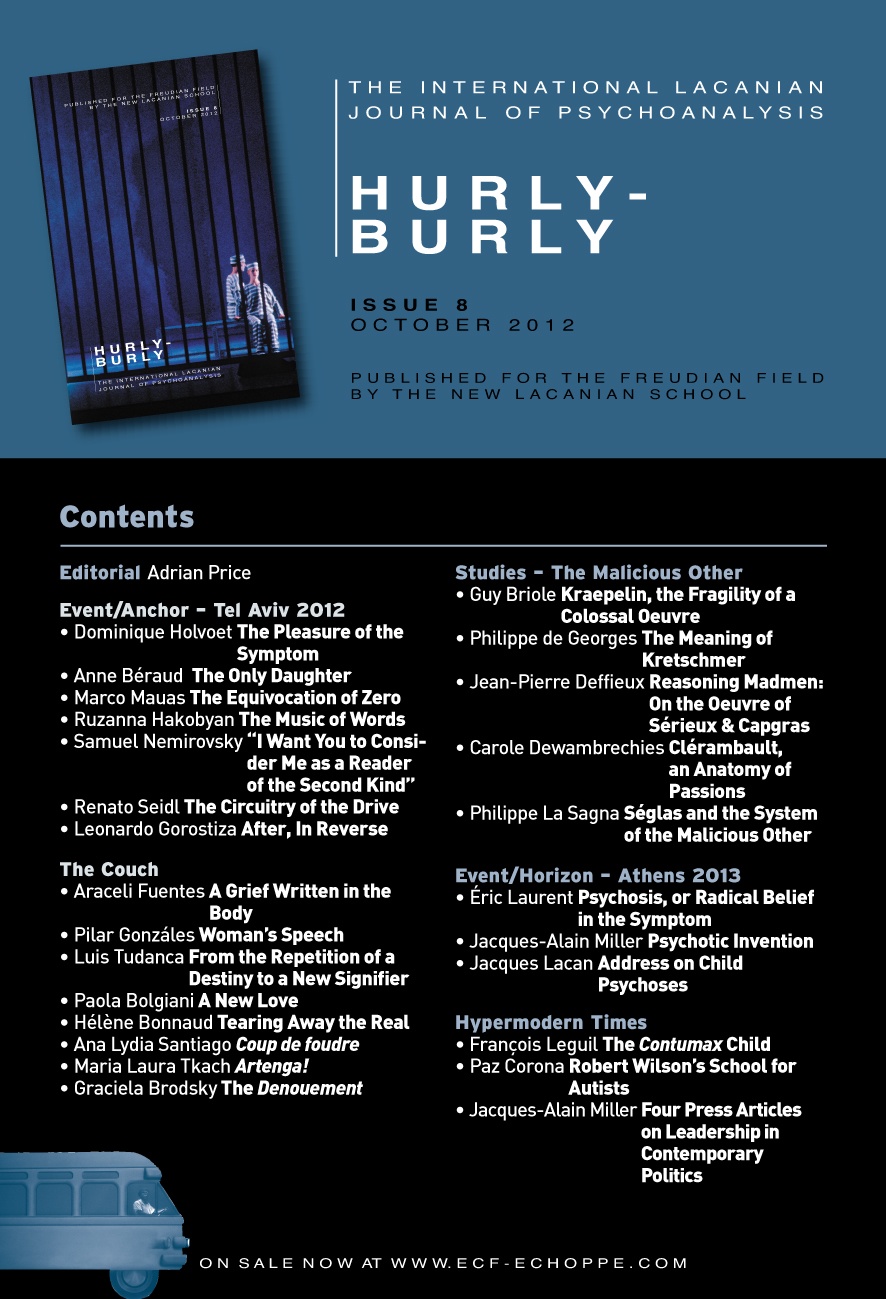
Guy Briole on Kraepelin – The Fragility of a Colossal Oeuvre
The era of the Other that does not exist and the rise of the ordinary psychoses has marked for us a clinical and epistemological threshold. It is this perspective that underlies the interest of the collection of texts to be found in the latest issue of Hurly-Burly under the title of ‘The Malicious Other”- an Other, we could say, that has managed to evade or to shake off its bar. For it now becomes possible to read what we could call the era of the Other as the product of a grand and systematic, even if somewhat outdated, delusion.


of public service the journal of the New Lacanian School is”
Éric Laurent
On Jacques-Alain Miller’s “Psychotic Invention”
Tom Svolos